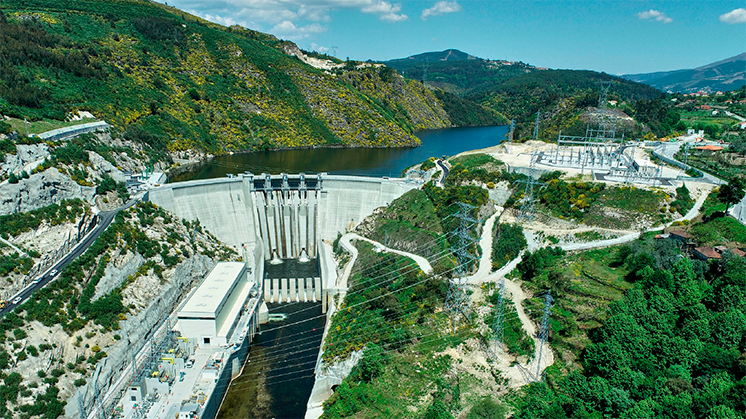

Iberdrola announced the commissioning of the Tâmega Norte wind farm, part of a wind-hydro hybrid project located between Braga and Vila Real, in the Portuguese municipalities of Cabeceiras de Basto and Montalegre.
It is the first of two wind farms that form part of the Tâmega Complex, (also known as the “giga battery”) and the first grid-connected wind-hydro hybrid project on the Iberian Peninsula. It will consist of two wind farms (north and south) linked to a large pumped-storage hydroelectric system. This combination allows hydroelectric and wind energy to use the same electrical infrastructure and grid connection, operating in a complementary manner. When wind resources are available, they are harnessed within the existing installed capacity; when conditions change, hydroelectric generation provides flexibility to the system.
Tâmega Norte will have a capacity of 195 MW, distributed across 27 Vestas wind turbines, each with a capacity of 7.2 MW and a rotor height of 172 meters, making it one of the onshore projects with the highest-capacity equipment installed by the company. Its implementation has been a “challenge,” Iberdrola said, due to weather and environmental conditions during the breeding season of certain species, which “significantly affected” the construction schedule during the spring and summer months.
The annual output generated by Tâmega Norte will be approximately 414 GWh, whilst at Tâmega Sul, currently under construction, it will be 185 GWh. The electricity will be transmitted using the complex’s existing infrastructure. The connection is made via the Red Eléctrica Nacional (REN) hub in Ribeira de Pena: northwards from the Daivões substation, and southwards from Gouvães.
The total investment for the two wind farms amounts to €346 million (~ $402 million USD), of which €237 million (~ $275 million USD) is for Tâmega Norte and €109 million (~ $126 million USD) for Tâmega Sur. The project has involved a large number of international and national suppliers, including Haizea Wind, a Basque group specializing in the design, manufacture and assembly of metal structures and cast components for the wind power industry, through its subsidiary HaizeaTecnoaranda, as a supplier to Vestas, a Danish company and leader in the supply of wind turbines.
One unique aspect of the project has been the use of BladeLifter technology to transport blades of “considerable size.” The complexity lies not only in their length, but also in the terrain: sharp bends and steep gradients. At Tâmega Norte, the BladeLifter enabled the blades to be raised by between 25 and 30 degrees, facilitating passage along narrow roads without the need to widen tracks or carry out major civil engineering works.
The complex is financed by the European Investment Bank (EIB) and involves Norges Bank, in partnership with Iberdrola, which will hold a 49% stake once the plant becomes operational.