

Volume 29 | Issue 2
Technology and talent are at the core of today’s reshoring successes with companies implementing advanced manufacturing technologies.
Click here to read the complete illustrated article or continue below to read the text article.
By Harry Moser, Founder/President, Reshoring Initiative®
Reshoring initiatives are capitalizing on advanced manufacturing technologies that make domestic manufacturing globally cost-competitive for an increasing range of products. High-tech manufacturing facilities drive efficiency, boost global competitiveness and create high-tech jobs that offer better wages and benefits. A shared success for businesses and workers. Reshoring, by way of advanced manufacturing technologies, is driving economic growth, investment, innovation, and workforce transformation.
Although skilled workforce recruitment and training have been a U.S. shortfall for decades, we find evidence that tech-charged reshoring initiatives are fueling a skilled workforce power cycle, overcoming the common image that manufacturing is declining and low-tech. As companies capitalize on tech-powered reshoring, investment in skilled workforce training is rapidly becoming part of the investment mix.
An estimated 3.8 million manufacturing jobs will need to be filled over the next ten years due to retirements, demographic shifts, and industry growth. But a skills gap will leave more than 2 million of those jobs unfilled. Additional worker quantity and quality is essential for the United States to provide the needed capacity to expand U.S. manufacturing via reshoring and foreign direct investment (FDI).
Workforce availability remains the leading limiting factor for U.S. production growth. According to the 2025 Reshoring Survey of 500 U.S. manufacturers, the key catalyst for increased reshoring is having an abundant, highly skilled U.S. workforce. The shortfall is further intensified by recruitment challenges rooted in negative perceptions of the industry and of trades versus degrees, as well as a tight labor market.
The World Manufacturing Foundation found that 74% of companies report a shortage of skilled workers, 94% expect to hire or repurpose workers through increased smart manufacturing technology adoption, and by 2030 more than half of the advanced manufacturing workforce will need upskilling.
A cohesive strategy emphasizing workforce recruitment and retention will be paramount to the success of reshoring a robust U.S. manufacturing sector. Manufacturers can attract young people by optimizing job descriptions for search engines i.e. using keywords that candidates would use when job searching online.
Consider diversity, equity, and inclusion (DEI) since it continues to be a key influencer for Gen Z (70%) and Millennials (63%). Take into account competitive benefit offerings like apprenticeships, tuition reimbursement, predictable hours and clear career development paths. Manufacturers can attract candidates by sharing authentic manufacturing experiences through social media platforms like Tic Tok and Instagram, highlighting short video content of actual skilled technician experiences.
The current “college for all” default pathway is waning as parents and students determine it’s no longer a guarantee for success or security. Nearly 9 in 10 parents think students should consider a career in skilled trades. Students are increasingly choosing skilled trades and vocational pathways over traditional 4-year degrees. Enrollment in four-year institutions grew just 2.8% in 2025 YOY, while students enrolled in vocational-focused community college rose 11.7%.
Citing success stories can inspire manufacturing careers. For example, The American Welding Society and Skills USA recently selected 21-year-old Mikala Esposito, a student from Washtenaw Community College in Ann Arbor, MI, as the official United States competitor in Welding for the 48th WorldSkills Competition to be held this year in Shanghai, China. Congratulations Mikala! For those looking for financial assistance, check out “Industry Week’s Big List of Manufacturing Scholarships.”
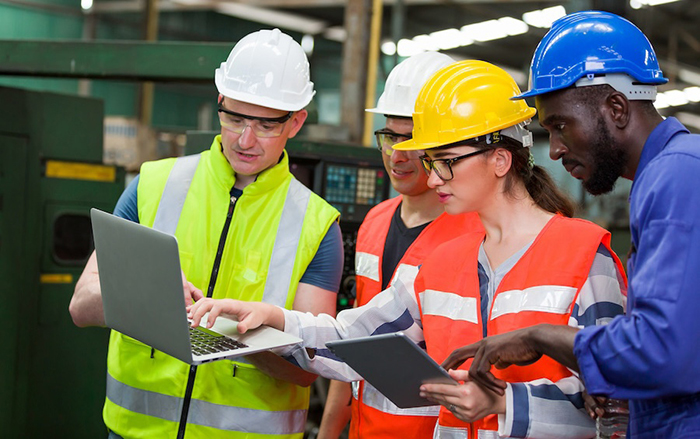
Companies are facing a critical need for new collar workers like robotics technicians, industrial automation workers and engineers qualified to implement, operate and maintain new technologies and advanced equipment. That being the case, increasingly, organizations are integrating investment in advanced manufacturing technologies with workforce training initiatives.
For example, the two 2025 National Metalworking Reshoring Award winners, GE Appliances and Marlin Steel, each leveraged automation technology and workforce initiatives in their reshoring strategies. Marlin Steel earned the award by repeatedly demonstrating that automation, engineering, quality, and delivery can enable reshoring, even of high-volume commoditized products. Marlin Steel instituted worker training and upskilling with a partnership mix of national workforce organizations, government programs, and equipment vendors to provide hands-on training.
GE Appliances is reshoring by employing automation and AI technologies to fuel a more resilient supply chain. In August, 2025, GE Appliance, a Haier company, announced a plan to invest more than $3 billion over the next five years in its U.S. operations, workforce, and communities. The plan centers on reshoring production from China and Mexico to the U.S., creating more than 1,000 new U.S. jobs. GE Appliances is using AI to solve business challenges including, rapid shift summaries, intuitive data interaction, and real-time optimization.
GE Appliances’ people-first approach includes partnering with technical schools and universities to support apprenticeships and trade certification pathways, expanded employee benefits including on-site primary care clinics for staff and family, and flexible work arrangements including four-day work weeks and part-time shifts. GE Appliances contributes more than $30 billion annually to the U.S. economy and supports over 113,000 U.S. jobs across its operations, suppliers, and logistics network.
Manufacturers must incorporate lifelong learning into their business plans to develop the future workforce needed for “smart factories.” Emerging technologies are transforming work at an unparalleled pace, driven by cutting-edge innovations such as artificial intelligence, advanced robotics, cognitive automation, and advanced analytics.
New-collar “smart” workers must advance their technical and soft skills through nontraditional educational paths including community colleges, vocational schools, boot camps, technical certification programs, high-school technical education, and on-the-job apprenticeships and internships. Emphasizing vocational education, alongside traditional degree programs, can help close the skills gap and promote job growth in the United States.
A 2025 Deloitte study found that manufacturers think smart manufacturing will fuel competitiveness over the next 3 years, improving production and capacity, and requiring a highly- skilled workforce. The Reshoring Initiative’s Data concurs, finding that reshoring and FDI continue to add more High-Tech jobs than Low-Tech jobs. In 2024, 88% of job announcements were in High or Medium-High tech products, rising to an all-time record of 90% in 2025.
Advanced manufacturing technologies enable more reshoring and FDI, higher wages, better safety, and increased career stability — better for business, better for the economy, and better for technicians — a win/win/win.

The Manufacturing Institute’s 2026 survey Pictured left: Organizations are integrating investment in advanced manufacturing technologies with workforce training initiatives; Workers must advance their skills through nontraditional educational paths. estimates that manufacturers are spending $31.9 billion annually on training programs for new and existing employees. Companies must clearly define roles to ensure workforce alignment with learning pathways for workforce readiness. Tech-powered reshoring demands technical training for roles like maintenance technician, robotics programmer, data specialist and process engineer.
Companies are meeting the challenge. In 2025, global construction and mining equipment behemoth Caterpillar announced a five-year, $100 million workforce pledge as part of the company’s 2025 centennial celebration. The aim is to grow interest in advanced manufacturing careers and prepare U.S. workers for future quality jobs and industry-wide innovation.
The GE Aerospace Foundation’s newly launched workforce program aims to bolster the number of high-skilled manufacturing workers by 10,000. The $30 million commitment over five years is designed to assist local programs purchase new equipment, hire new instructors, expand curricula and reduce financial obstacles for students.
Sharpie’s parent company Newell Brands invested nearly $2 billion in automation and training at its Tennessee facilities to reshore manufacturing from China back to the U.S. Investment in automation and workforce-training, combined, led to a very successful reshoring effort. Automation boosted production speed and improved quality while lowering costs — without reducing employee count, and even increased wages.
We recommend beginning by doing the math correctly using our free online Total Cost of Ownership Estimator® (TCO). By using TCO, companies can better evaluate sourcing, identify alternatives and even make a case when selling against offshore competitors.
- Compare the TCO offshore vs. domestic.
Call on me for help if needed. - Pick those products where Ex-Works price is within 30% and TCO is within 5%.
- Calculate the productivity improvements needed to get domestic TCO favorable.
- Ensure supervisors are trained and confident with any new automation and understand the equipment performance metrics.
- Upskill technicians in preventative maintenance and diagnostics to prevent expensive surprises.
- Train leaders in real-time data-driven metrics i.e. build a culture where decisions are supported by actual data.
- Promote collaboration and continuous learning.
Click here to access the full list of Reshoring Resources offered by the Reshoring Initiative. To report your reshoring successes or to get help with reshoring, contact me at 847-867-1144 or email me at harry.moser@reshorenow.org.
Have you reshored a metal component or product? Apply for the National Metalworking Reshoring Award. The 2026 winner will be honored at IMTS 2026.
Participate in the 2026 Reshoring Survey. Your response will help influence national policy.

Harry Moser, Founder/President, Reshoring Initiative®