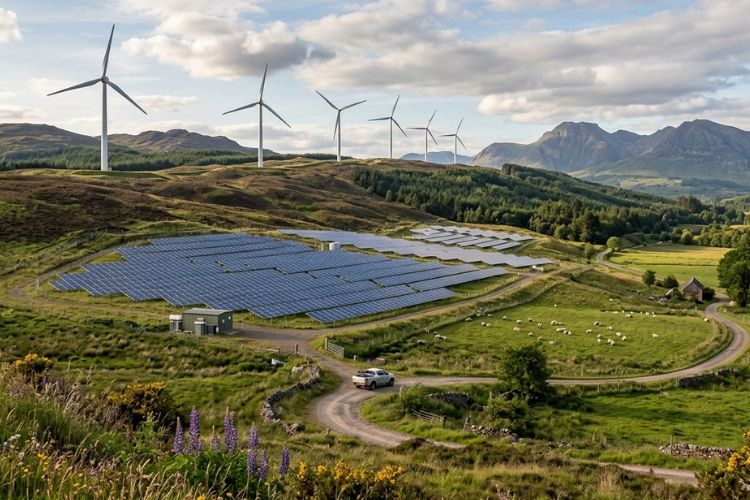

Developers, owners, and operators of inverter-based resources (IBR) across North America are entering a new age of North American Electric Reliability Corporation (NERC) compliance. As of May 15, 2026, many solar, wind, battery storage, and hybrid assets that were previously outside direct NERC oversight are subject to new registration and compliance expectations.
Stakeholders of IBRs with an aggregate capacity of 20 MVA or more (roughly 16 MW to 20 MW) connected at 60 kV or higher are now required to register as a Generator Owner (GO) and/or Generator Operator (GOP) under NERC Category 2. Developed in response to a 2022 Federal Energy Regulatory Commission (FERC) order, the initiative aims to improve visibility and oversight of previously unregistered facilities, providing a stronger foundation for planning, operations, and risk management.
For stakeholders unsure whether their assets are in scope — or know they are behind — the question is no longer whether to prepare, but how to close gaps quickly, defensibly, and without disrupting operations. Radian Generation, a global provider of comprehensive services and products designed to support the complete lifecycle of renewable energy facilities, recently shared its expertise on the topic in a live web event on Factor This. Register to watch it for free on demand.
Based on Energy Information Administration (EIA) data, 874 existing or operating IBR sites with a total capacity of 20 MW or higher, connected at 60 kV, are on the hook for compliance with NERC, plus another 156 projects in development. Many weren’t designed with NERC in mind.
That means Radian Generation has been busy lately. According to Desmond Adams, director of implementation and GOP services, making the grid more reliable and resilient means accounting for these smaller assets.
“There are a lot of facilities that were built out there, we’ll say in the past 10 to 15 years, where it made sense to build it in that smaller size because, at that time, they didn’t have to pay for NERC compliance and ensure that these assets had all of the different things that larger sites have,” Adams explained in the Factor This web event. “In total, those assets begin to make a big impact on the grid.”
In a 2021 incident known as the Odessa Event, a grid disturbance caused numerous resources in Texas to temporarily go offline.
“This caused a huge strain on the grid when these resources that ERCOT was counting on to be available, all of a sudden, just weren’t there,” Adams recalled.
To put it bluntly, the grid wasn’t happy- an outcome NERC and its six Regional Entities are hoping to avoid moving forward.
For owners and operators of IBRs who aren’t sure of their NERC compliance status, Radian Generation can help with the integral starting step of developing 30-, 60-, and 90-day plans.
“Conform scope, roles, asset lists, deadlines, and immediate gaps in the first 30 days,” suggested Adib Abdulzai, vice president of operational technology and security. “In 60 days, build a compliance plan, assign owners, collect evidence, and fix obvious control gaps. And then the last 30 days, that 90 days, test the process, review its quality, clean up vendors, operators, responsibility, and prepare for audit.”
It might sound simple, but for many, the process is far from it. Ultimately, it’s the stakeholders’ willingness to invest effort in the process that determines their success.
“Folks who aren’t successful with it are the ones who don’t give it the time and attention that it deserves,” shared Adams. “Ultimately, it has to have buy-in from the owners of the assets and the leadership at those companies. The most successful companies we work with, the VPs and even the CEOs, are calling us and asking: How do we get this done? What do you need from me?”
That sort of hands-on attention to detail is essential during periods of change, such as the one affecting IBR stakeholders right now. During the web event, Adams recounted a recent conversation with a client representing a 30-megawatt wind power project. Its owners didn’t think it was subject to Category 2 compliance, but it was, in fact, a Category 1 site.
“That’s not the only facility like that,” he added.
Although potential fines for non-compliance can be steep, a bit of good news is that NERC and its affiliates prefer to work with generators rather than penalize them, and heavy penalties are reserved for only the most egregious offenders. Plus, one cannot be held responsible for retroactive fines.
“It’s up to NERC or the Regional Entities to identify these sites and inform them of their obligation to register,” explained Adams. “So you can only be held responsible from the point that you register.”
The tricky part is that there needs to be compliance from that point onward, and it isn’t really a ‘set-it-and-forget-it’ kind of thing.
Kellie Macpherson, Radian Generation’s executive vice president of compliance and security, adds there’s a cybersecurity element to this conversation, too. IBRs can be weak points where the grid is exposed to external threats.
To learn more, register and watch the on-demand web event on Factor This.
Additional takeaways include:
- How operators can reduce uncertainty and adopt a more defensible, sustainable compliance program
- Assessing whether solar, wind, storage, or hybrid assets may be in scope for NERC Category 2 requirements
- What leadership should know about post-deadline risk
- Understanding what the Category 2 readiness process looks like from a real-world customer perspective
- What stakeholders should do if they think they are in scope but are not registered
- Which documentation matters most
- How to prioritize gaps when considering multiple assets