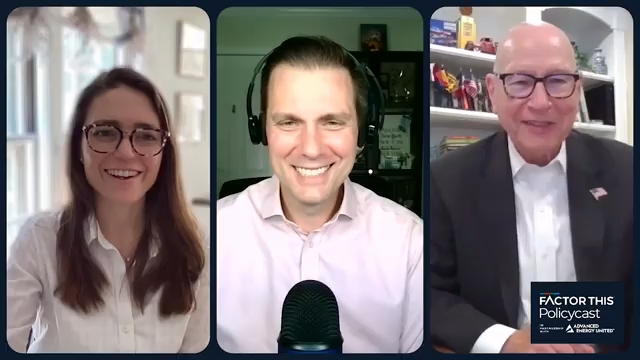
Welcome to the premier edition of the Factor This Policycast, a brand-new podcast partnership with national industry association Advanced Energy United, tackling the legislation, rulemaking, and market design that matter to clean energy leaders.
Hosted by Factor This content director and Emmy-Award winning journalist Paul Gerke, this series of discussions will feature voices from across the energy policy landscape and spotlight issues shaping the evolution of our electric grid.
The first topic is one that you may have spotted in recent headlines: competitive transmission solicitation. It’s no secret that large-scale, critical electrical infrastructure projects like high-voltage transmission lines cost a LOT to build and take some time to come online. The work is complicated and difficult, and not too many companies are qualified to do it.
About 15 years ago, the Federal Energy Regulatory Commission, or FERC, mandated that utilities competitively bid out such projects, but that mandate isn’t being enforced, for reasons we get into on the program. New data from the think tank R Street highlights tremendous benefits of competitive transmission, though, including billions of dollars ultimately saved by ratepayers. Detractors argue the bidding process delays timelines and subjects projects to hidden costs, and a group of Midwest utilities has even asked FERC to halt bidding in MISO and SPP.
This episode of the podcast stars Caitlin Marquis, managing director at Advanced Energy United, and Paul Cicio, chair of the Electricity Transmission Competition Coalition (ETCC). Both are advocates for competitive transmission and share findings to support their case. They discuss that utility request to ban competition outright, talk about FERC’s role in keeping rates affordable, and explore the finer points complicating broader transmission build-out- at a time we really need it.
Listen to the audio-only version of the episode:
New episodes of the Factor This Policycast go live at 6 am ET every other Thursday.
A loophole in FERC Order 1000 prevents transmission projects from being competitively bid
“We came down to the conclusion that, in a way, FERC Order 1000 is the law of the land, but FERC was not enforcing it,” ETCC’s Cicio shared on the podcast. “They had a small caveat that said, look, if a company needs a transmission project for reliability purposes, in other words, an emergency, then it does not have to be competitively bid. Well, guess what? That loophole went from a small loophole to a large loophole that the utilities have been using ever since to escape competition and the affordability crisis.”
“Building transmission lines is extremely profitable,” Cicio continued. “The utilities, for every dollar that they spend, will receive lucrative transmission incentives from FERC. There are 10 of them, and that results in a return on equity that is between 10 to 12% for the entire life of the project.”
Smarter transmission spending has broad benefits
“Transmission costs have gone up, but transmission, if it’s well planned, has a lot of consumer benefits. It can unlock more affordable generation resources that lower the cost of electricity and can result in net cost savings for customers,” offered Advanced Energy United’s Caitlin Marquis. “That’s if we’re building the right kinds of transmission, if we’re planning it regionally and independently.”
“Where competition has been enabled, it has resulted in all sorts of consumer benefits, cost savings, and innovation. But there are barriers to realizing those benefits, based on the way that transmission has been planned and built,” she cautioned.
Competition means consumer savings and speed-to-power
“On a cost basis in the MISO and SPP regions, competition delivers 30% cost savings relative to incumbent projects on an average basis, and even when you count the time for competitive solicitation (cited at 16+ months), competitively bid projects actually come into service faster,” detailed Marquis. “And if you think about the way that competition works, this makes sense, because there’s an incentive built into these opportunities for competitive developers as they’re trying to win a project to include cost guarantees and schedule guarantees that then they’re held to. And so they have a clear incentive to come in on time and on budget.”
“When you run through a competitive process, you have utilities that want the business competing, so they sharpen their pencil, and they put cost containment provisions in their bid quite often,” Cicio chimed in. “Instead of asking for a 12% ROE, they’ll ask for accept 11% or 10%, and as Caitlin points out, many of these competitive bidders will say, okay, I’m going to deliver this project on time, and if I don’t, I will take a cost penalty.”
“If you’re a monopoly incumbent utility without competition, you have zero incentive to reduce costs,” Cicio continued. “You have zero incentive to put in writing these cost containment and penalties, and that’s why we are seeing it’s contributing to higher costs.”
“All of these projects face the same permitting and supply chain challenges, but we’ve seen the competitive projects often coming in ahead of schedule despite those challenges,” Marquis concluded.