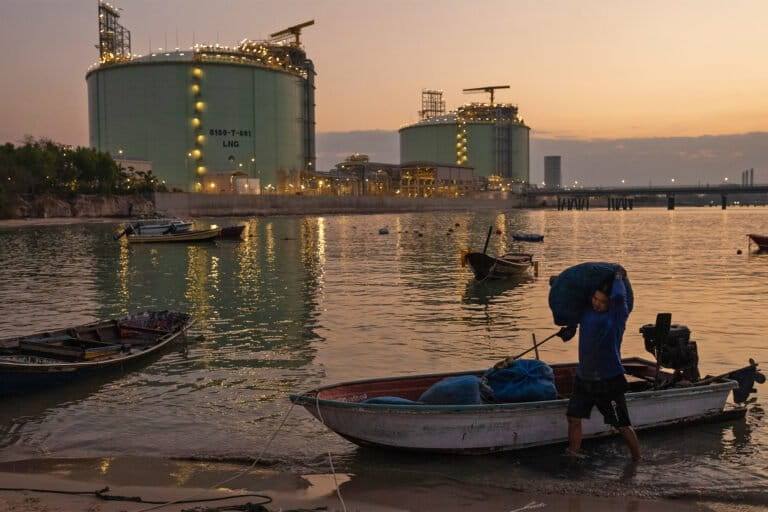
PHANOM SARAKHAM, Thailand — On a December afternoon, Suphut Hom Chunthit and his wife were tending to their 12 durian trees. Suphut showed reporters his homemade irrigation system, a series of pipes carrying water from the nearby Yang Deng canal. The durian trees were in their fourth year, Suphut said, so they should fruit and be ready for harvest later in 2026 — if they survive. “Last year, we could only water the durian trees for 15 minutes a day,” said Suphut, who also grows cassava, rice, plums, rubber and rambutan in Phanom Sarakham, a district in Thailand’s Chachoengsao province. “It’s barely enough to keep them alive.” Three kilometers, less than 2 miles, down the road from Suphut’s 8-hectare (20-acre) farm sits the 304 Industrial Park (Chachoengsao), home to electronics, automotive and food-processing plants, and a biomass power station. The park is also the site of the planned 600-megawatt Burapa power plant. But locals like Suphut say they fear the liquefied natural gas (LNG) facility could exacerbate water shortages and air pollution linked to the expansion of industry in Chachoengsao. The Burapa plant will need up to 12,000 cubic meters (424,000 cubic feet) of water daily, per its 2021 environmental impact assessment (EIA) — equivalent to the daily consumption of some 49,000 Chachoengsao residents, as measured by a 2024 study. Meanwhile, Phanom Sarakham district already faces a “medium-high” risk of drought, according to the World Resources Institute’s Aqueduct Water Risk Atlas. Suphut Hom Chunthit stands among durian trees on his…This article was originally published on Mongabay