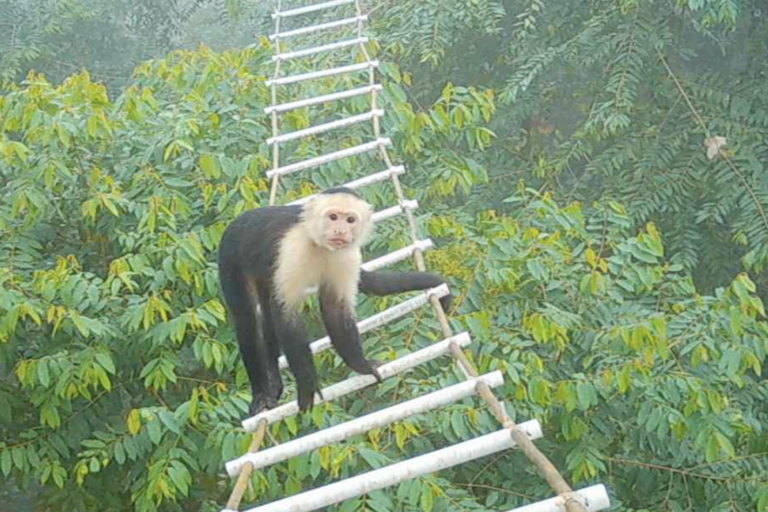
When roads cut through forests, they can become a death trap for wildlife. Canopy bridges, structures that connect trees on either side of roads, are considered a crucial lifeline for tree-dwelling animals, but few researchers have examined their long-term effectiveness. A recently published study did just that, by analyzing three years of videos from camera traps installed on bridges in Costa Rica. Researchers found that wildlife use of the bridges increased steadily with time, and animals showed preferences for certain bridge designs and length. Previously, most arboreal bridges had only been monitored for about a year at most, according to study lead author Marion Fischer, a Ph.D. student with the University of French Guiana. Without long-term data, it’s hard to know how useful bridges really are or what type works best, she told Mongabay in a video call. So, Fischer worked with the Costa Rican NGO Osa Conservation to analyze thousands of videos recorded by camera traps that the organization installed on either side of 17 bridges across the Osa Peninsula, a biodiversity hotspot. The team documented 2,231 animal crossings from December 2020 to June 2023. These included at least 13 species of arboreal mammals, including two species that are highly vulnerable to collisions with cars: The common opossum (Didelphis marsupialis) and the Mexican hairy dwarf porcupine (Coendou mexicanus). White faced capuchin monkeys (Cebus imitator) and squirrel monkeys (Saimiri oerstedii) frequented the bridges as well. However, larger-bodied howler (Alouatta spp.) and spider monkeys (Ateles geoffroyi) were not documented using them.…This article was originally published on Mongabay