Somewhere near the star Altair, one of the brighter stars in the northern summer sky, sits an object that has been quietly ejecting protons across the Galaxy at speeds and energies far beyond anything we could ever build on Earth. Astronomers have long suspected such places exist. Finally, thanks to a genuinely elegant piece of detective work, they have found one, and can prove it.
Cosmic rays are mostly just protons, the same particles sitting at the heart of every atom, but travelling at extraordinary energies, sometimes exceeding what physicists call a peta electron volt, or PeV. To put that in perspective, that’s roughly a thousand times more energetic than anything produced by the Large Hadron Collider, humanity’s most powerful particle accelerator. Somewhere out there in the Galaxy, nature is doing something we can’t yet replicate, and astronomers have spent years trying to work out exactly where.
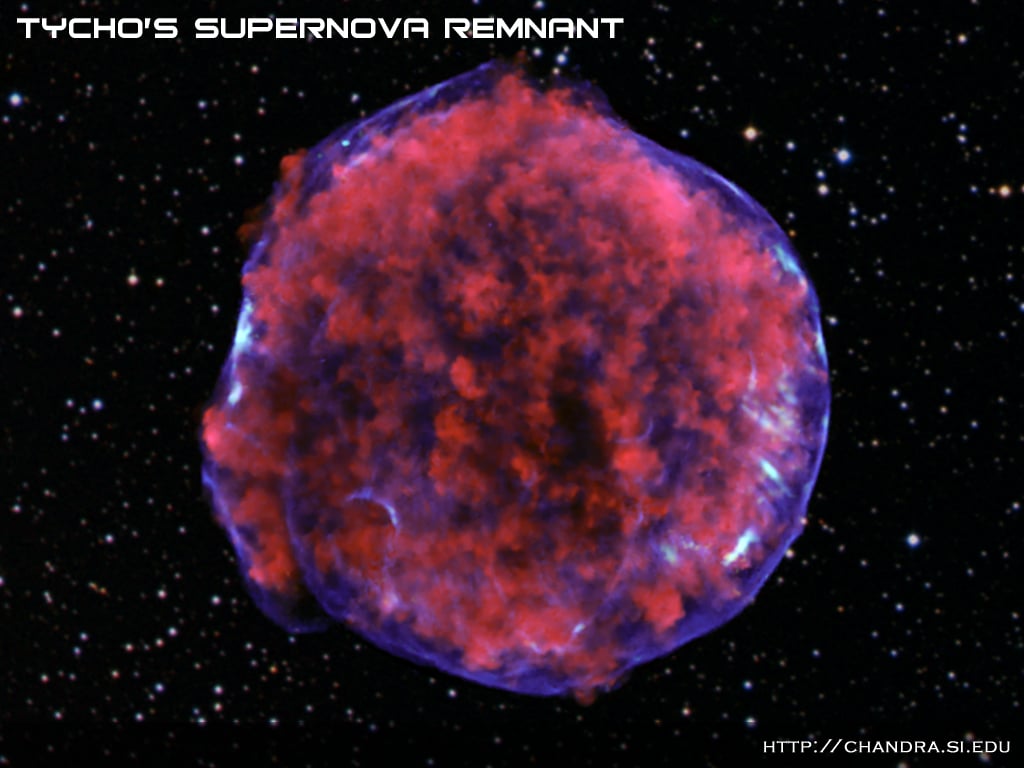 X-ray “stripes” in the blast wave of Tycho’s supernova remnant, seen by NASA’s Chandra X-ray Observatory. This was among the first direct evidence that supernova shock waves can accelerate particles to cosmic-ray energies (Credit : NASA/CXC/Rutgers/K. Eriksen et al.)
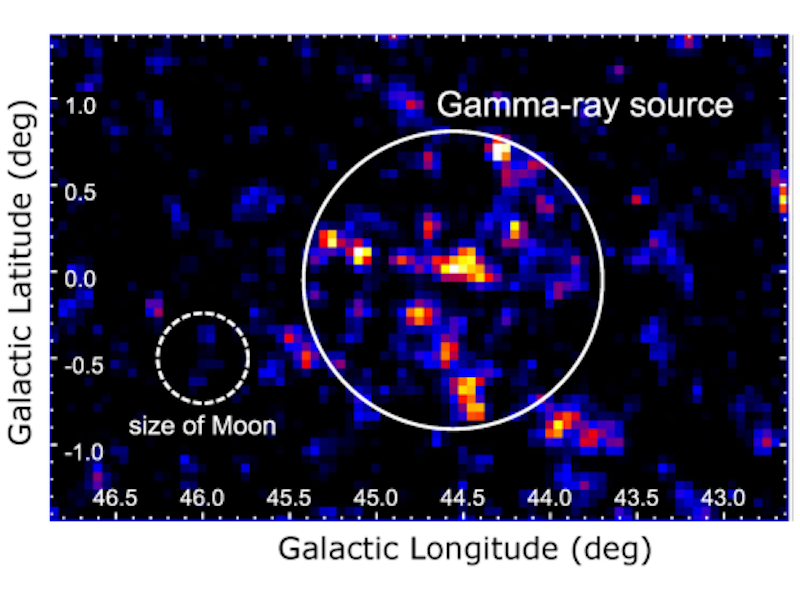
The object in question, catchily named LHAASO J1912+1014u, was first flagged in 2024 by ground based observatories in Tibet and China, which spotted gamma rays streaming from it at exceptionally high energies. Gamma rays are useful here because they’re produced as a by product when accelerated particles collide with surrounding gas, carrying roughly a tenth of the energy of whatever created them. Spot gamma rays at these energies, and you’re likely looking at the afterglow of a proton accelerator, known rather brilliantly as a PeVatron.
There was just one problem. Gamma rays at these energies can also be produced by fast moving electrons, not just protons, and the original observatories simply didn’t have the resolution to tell the two apart. LHAASO J1912+1014u might have been a genuine proton PeVatron, or it might have been something more mundane, like the leftover debris of an exploded star, doing something that only looked similar from a distance.
This is where a team led by Tsunefumi Mizuno from Hiroshima University, stepped in with a rather neat solution. Rather than relying on one observatory, they pulled together data from three entirely different instruments, each sensitive to a different part of the electromagnetic spectrum. NASA’s Fermi telescope supplied gamma ray data, Japan’s FUGIN survey offered radio observations tracing the interstellar gas nearby, and NASA’s Chandra Observatory added X-ray measurements. Individually, none of the three could settle the question but together, they could.
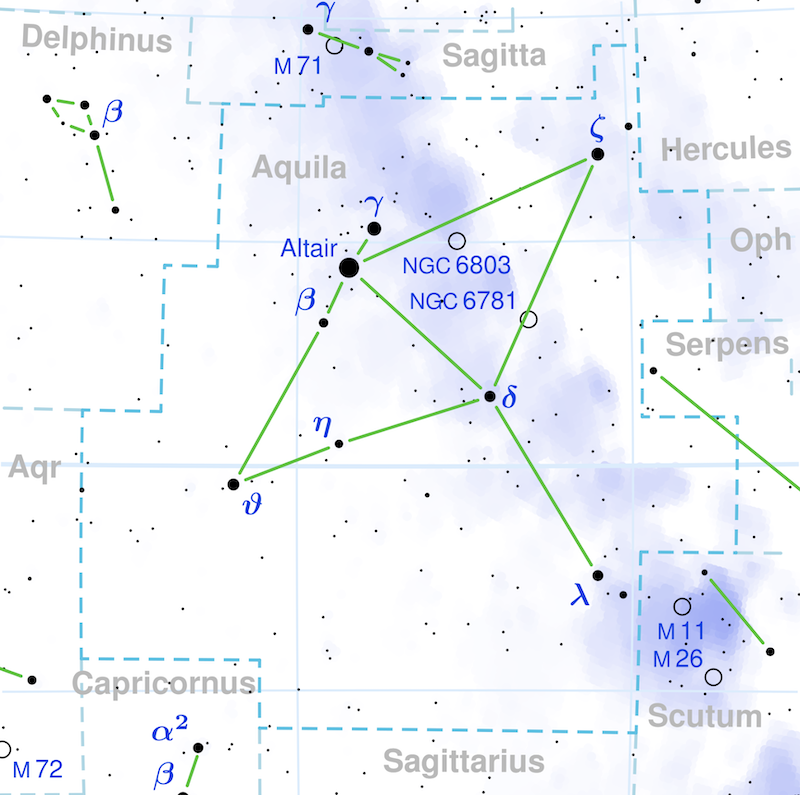
Altair, the brightest star in Aquila and anchor point of the Summer Triangle — LHAASO J1912+1014u sits nearby in the same patch of sky (Credit : Torsten Brongerderivative)
The combined picture was compelling. The gamma ray emission stretched smoothly across a vast energy range in a way that ruled out electrons as the source. The gamma ray glow lined up almost perfectly with the surrounding interstellar gas mapped by the radio data, exactly what you’d expect if protons were slamming into that gas. And the X-ray data showed barely any of the diffuse emission you’d expect from an alternative explanation. Mizuno likened it to an old Japanese proverb ‘one arrow snaps easily, but three bundled together do not.’
With dozens of similar PeVatron candidates scattered across the Milky Way, this result offers more than a single answer. It hands astronomers a genuinely reliable method for confirming the rest, one instrument’s data at a time, bundled together until the picture becomes impossible to argue with.
Source : A source of extremely high-energy particles in the Milky Way identified