
News about an initiative at ComEd called Voltage Optimization (VO) made recent headlines, as the company announced it delivered approximately 100,000 megawatt-hours (MWh) of energy savings to its customers in Illinois. It’s a development closely connected to the ever-present industry conversation around affordability, but the technical specifics of how ComEd has achieved this bottom-line impact for customers are critical to understand.
By dynamically controlling utility assets like substation load tap changers (LTCs) and line regulators, ComEd has been able to lower delivered voltage closer to the lower boundary of the standard ANSI C84.1 range. This allows customer appliances and equipment to run more efficiently, quietly reducing energy consumption by 2% to 3% without requiring any change in customer behavior.
As David Perez, executive vice president and chief operating officer at ComEd, highlighted in the release, what began as a targeted energy efficiency study has rapidly scaled into a utility-wide program integrating advanced automation and intelligent preventive maintenance. The technical specifics associated with that project baseline, as well as how the program scaled across the organization, are details that Jason Pozen, manager of distribution automation at ComEd, helped define in a big way.
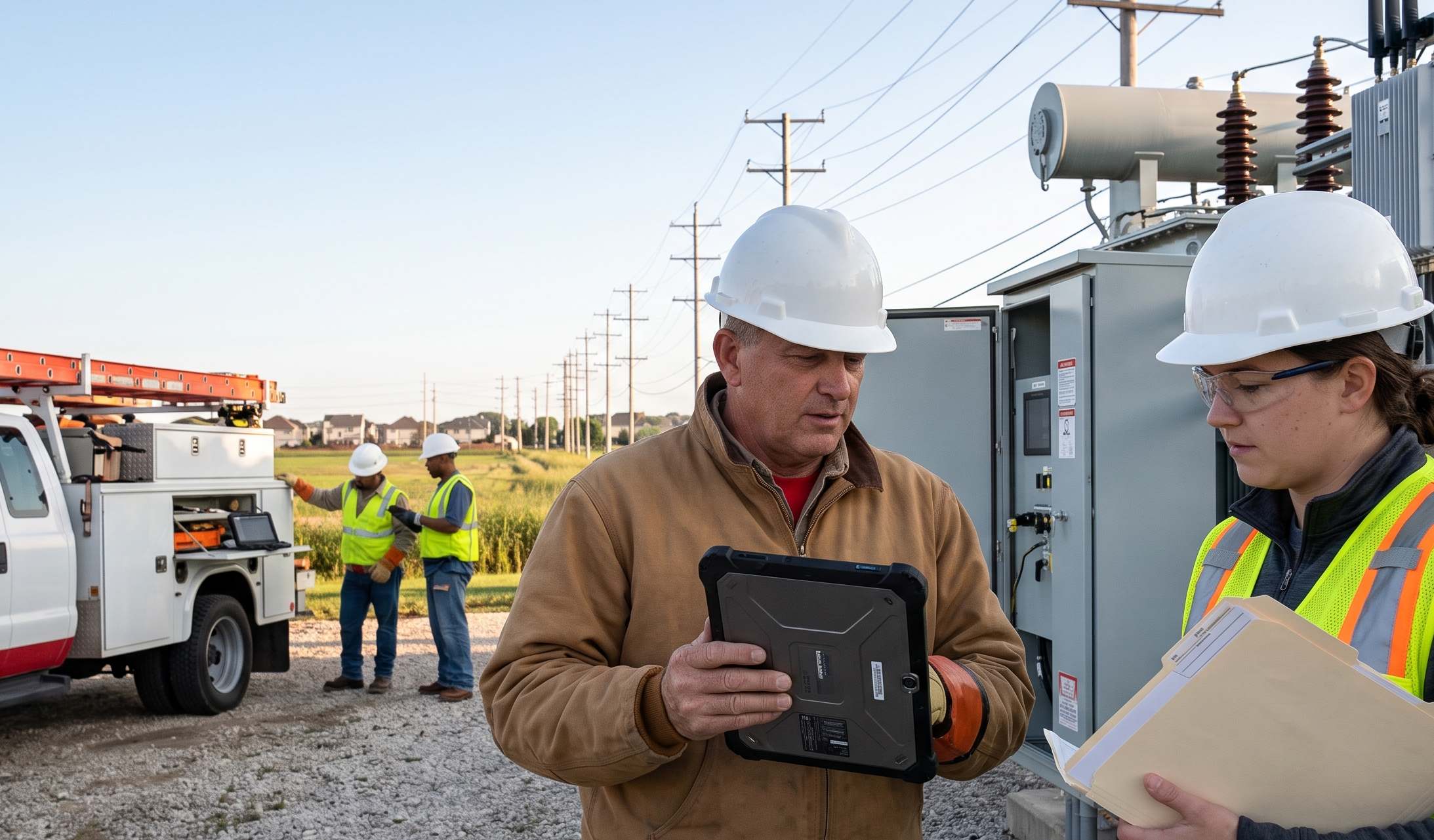
“Historically, our distribution-level capacitor banks, typically on 12 kV and below systems, operated completely without data communications,” Pozen said. “They relied on local settings, and we had to send out trucks for manual preventive maintenance inspections on all of them. With the rollout of VO, we enabled remote, two-way communications to these assets. Leveraging this new stream of SCADA telemetry, we wrote custom scripts to automate those functional tests remotely, which initiated what we call ‘Intelligent PM.’ It’s a system that allows us to use algorithms that continuously analyze voltage, current, and reactive power responses to detect subtle anomalies like blown fuses, failed switches, or controller damage.”
Because of this change, instead of blindly dispatching crews to inspect 8,000 capacitor banks every year, Pozen and his team can now isolate the 500 or so units that are actually creating issues. This shift from calendar-based reactive maintenance to condition-based proactive maintenance has reduced truck rolls and helped to optimize field resources, directly improving their SAIDI and SAIFI metrics by resolving equipment degradation before those assets can create major issues. It’s an approach that translates raw, real-time circuit data into verified, annualized MWh savings that can help lower monthly bills for ComEd customers.
This operational success compelled ComEd to upgrade 16 additional substations in 2025, bringing the total number of participating substations in the VO program to 292, with 245 of those operating full-time. Newly integrated VO substations run through an initial four-day-on, four-day-off testing cycle during their first year to capture precise baselines before they are converted to 24/7 continuous operations.
While the benefits of these upgrades can be measured on individual circuits, the biggest operational hurdles in scaling VO to a utility-scale infrastructure asset were network mapping and holistic system modeling. Pozen highlighted these challenges as the most critical lessons peer utility teams can leverage.
“Our critical lesson learned is that you have to conduct comprehensive, end-to-end studies,” Pozen told Factor This. “You can’t look at distribution in a vacuum, but instead, have to remodel the entire T&D interface. Scaling this technology successfully requires highly accurate GIS network maps and a deep, proactive understanding of how sustained lower-voltage profiles interact with the broader transmission system.”
The results of doing so are real and quantifiable. Between 2018 and 2025, ComEd invested approximately $550 million toward this VO deployment, which has driven a major cultural and operational shift across internal teams.
While Pozen’s team is responsible for the centralized VO platform, daily operations, and system maintenance, a program of this magnitude isn’t about a single team or department. Their success with VO meant relying on their transmission and substation teams to upgrade and manage substation-level assets, while their distribution engineering teams executed the critical feeder-line work in the field. They also coordinated closely with their AMI team to select and retrieve high-resolution data from bellwether meters at the grid edge. Additionally, their Energy Efficiency group plays a vital role in executing the verification needed to validate these savings.
This collective effort showcases a clear blueprint for how long-term affordability can be built on a foundation of rigorous engineering and cross-functional collaboration that utilities of all types and sizes can leverage.
“We’re backed by a centralized project management office that drives these complex distribution and substation capital projects on schedule,” Pozen said. “Ultimately, we’re just one piece of a highly collaborative, enterprise-wide machine.”