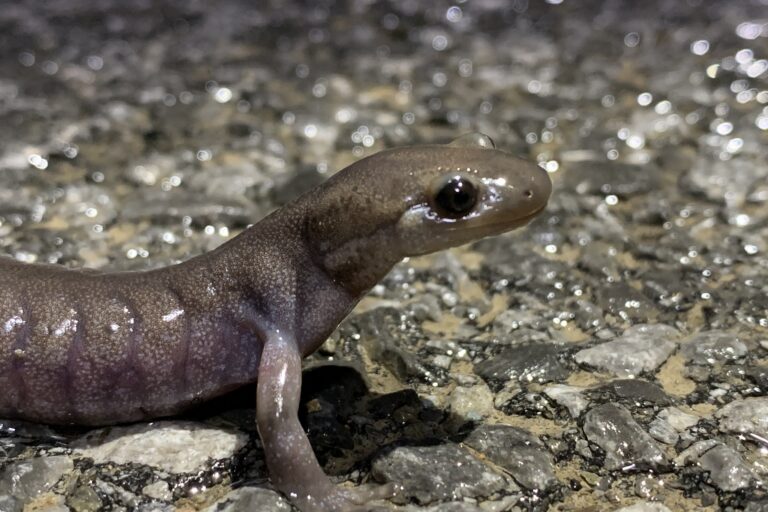
NEW HAMPSHIRE, U.S. — It’s a mild March night in Keene, New Hampshire, and the salamander brigade is out in full force. A constellation of flashlight beams wink and flash along a dark street, as rain falls onto the jackets and reflective vests of the assembled crew. Tonight, a veritable army of amphibians is trekking from the upland forests, where they spend the winter, toward the wetlands where they breed. In their path lies a two-lane asphalt road, North Lincoln Street. Animals need to move for a variety of reasons, but in a world crosshatched by motorways, that’s not an easy task. Each spring in Keene, wood frogs (Lithobates sylvaticus), spring peepers (Pseudacris crucifer), red-backed salamanders (Plethodon cinereus) and spotted salamanders (Ambystoma maculatum) must navigate roads to reach their natal spawning grounds. This particular road in Keene is routinely closed to cars during nights of amphibian migration. At other crossing sites in the region, volunteers are the only thing standing between these slow-moving critters and the danger posed by passing traffic. Carrying animals across the road by hand gets the job done, but it’s limited by human availability and energy. The hope has always been that “crossing brigades are the first step, not the last step,” said Brett Amy Thelen, who organizes these efforts and serves as science director for the Harris Center for Conservation Education, a regional nonprofit. That hope is being realized: Thelen and her salamander squadron are at the center of a new initiative to build small…This article was originally published on Mongabay