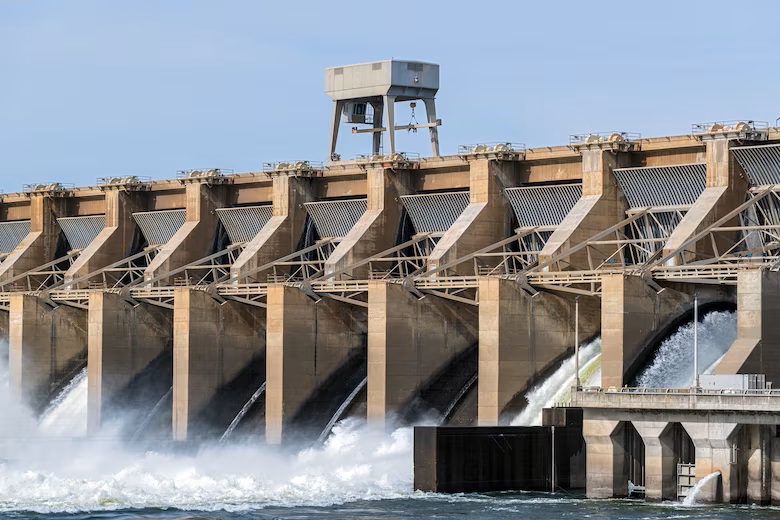

The Federal Energy Regulatory Commission (FERC) recently unanimously approved measures to simplify its National Environmental Policy Act (NEPA) review procedures for hydropower-related actions with what it describes as “minimal environmental impact.”
These regulatory changes are meant to increase efficiency and accelerate approvals while upholding environmental standards, FERC said.
“We must move important approvals forward quickly while ensuring we fully meet our NEPA obligations,” FERC Chairman Laura V. Swett said. “Today’s actions are practical, common-sense solutions that streamline our hydropower environmental review processes and allow us to better focus our efforts on reviewing large-scale projects.”
Congress has enabled federal agencies to create categorical exclusions, the use of which satisfies NEPA without the need to prepare an Environmental Assessment or Environmental Impact Statement, for certain types of actions that normally do not ‘significantly affect” the quality of the human environment.
According to research by the Columbian College of Arts & Sciences at George Washington University, under the FAST-41 framework categorical exclusion permits are typically completed in under six months, with a median of 0.95 months. Non-federal hydropower licenses have a median of 33 months to complete on the other hand.
In the first of two orders, FERC issued a final rule amending its NEPA regulations by expanding an existing categorical exclusion. The revised exclusion now covers terminations or revocations of hydropower licenses and exemptions that involve minor or no ground-disturbing activities and minor or no alterations to reservoir conditions and downstream flows. FERC hopes this changes helps streamline case processing and focus staff resources. A notice of proposed rulemaking was issued in February 2026 seeking public comment on these revisions.
In a second order, the Commission adopted two of the Tennessee Valley Authority’s existing categorical exclusions. These exclusions apply to development of recreation sites near hydropower projects to support activities such as hunting, fishing, primitive camping, wildlife observation, hiking, and mountain biking, as well as development of public use areas that generally result in physical disturbance of no more than 10 acres. These activities may include construction of parking areas, campgrounds, stream access points, and day use areas.