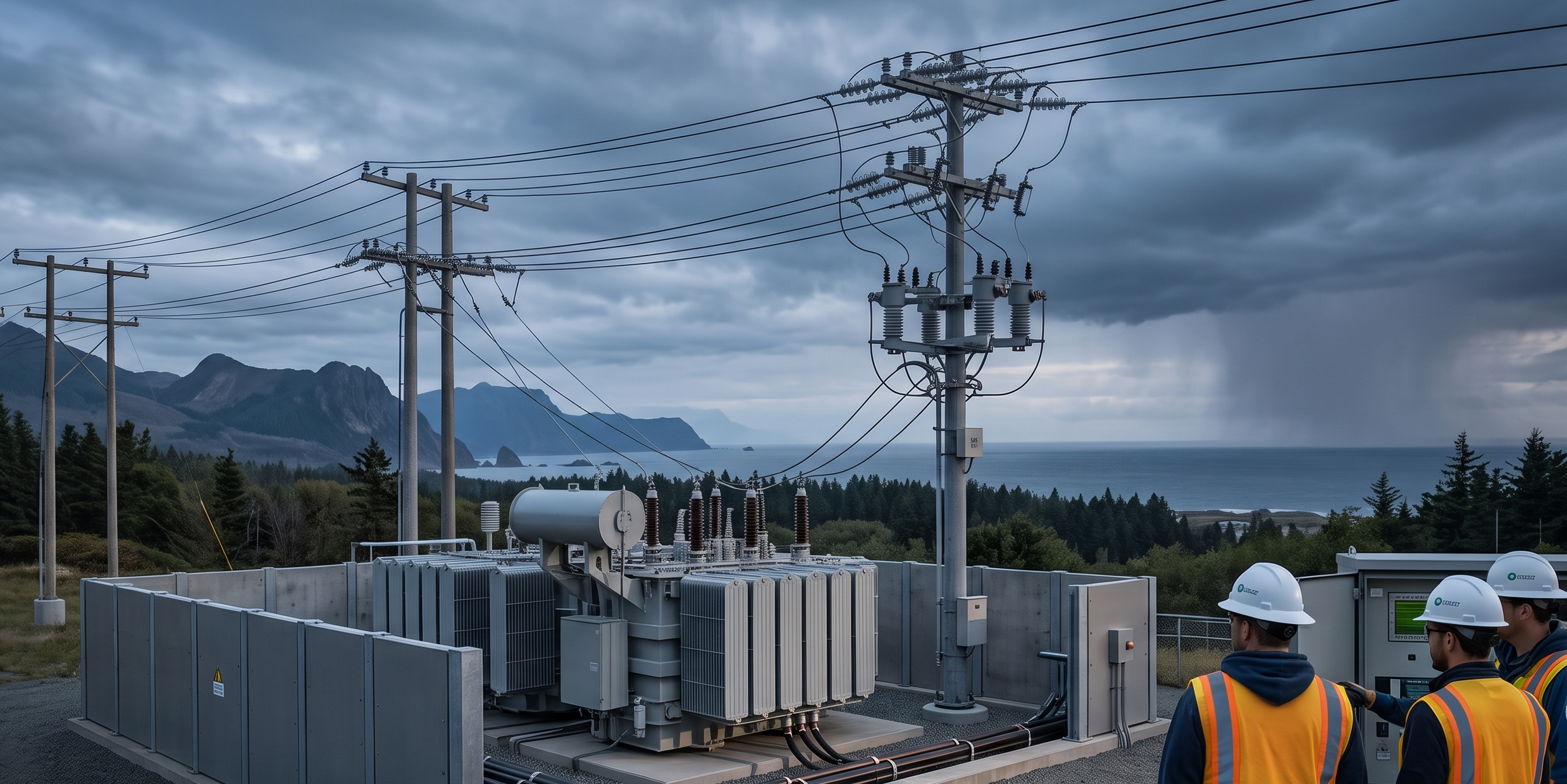

For decades, affordability, safety, and reliability were seen as the three-legged stool that defined the priorities for utilities of all sizes. Affordability is something that’s come into focus in a whole new way of late, while safety remains foundational to every single utility effort and endeavor. But what do we actually mean when we talk about utility reliability? In what ways is it connected to resiliency? And how are both of these terms changing and evolving?
Answers to those questions are deeply tied to the history of the power grid itself. For over a century, utility performance was defined primarily by keeping the lights on under normal operating conditions. Today, though, challenges related to extreme weather as well as ever-increasing demand growth are forcing a fundamental rewrite of reliability and resiliency.

Sorting out what these changes mean on a practical level is a daily reality for Joe Zerdin, Director of Distribution Large Customers, Sustainment, and Technical Services at Hydro One. Zerdin has previously talked about capacity, reliability, and resiliency as issues that he’s prioritizing in light of customer expectations that are at all-time highs as well as incredible demand pressure on system contingency levels. From a system perspective, this means utilities and their largest customers need to develop a mutual, deeper understanding of how their respective networks interact. That shift directly informs how Zerdin defines the evolution of reliability and resiliency.
“The core of reliability is still there in terms of the indices such as SAIDI,” Zerdin said. “What has become more prevalent is that momentary outages are becoming as impactful, and it’s usually not on a regulatory scoreboard such as SAIDI. There also seems to be a blend from a customer perspective between reliability and power quality events. All of that is further complicated by the fact that as an industry, we don’t have an exact measurement of resiliency from an industry perspective.”
Defining what it means to enable modern reliability is just the first hurdle that needs to be cleared, as today’s distribution grid is being transformed from a one-way delivery pipeline into a dynamic, two-way ecosystem. Modernizing this infrastructure means deploying advanced distribution management systems (ADMS), integrating distributed energy resources (DERs), leveraging customer-side assets, and hardening equipment against extreme weather events that are less predictable than ever.
However, such technical solutions can’t be deployed in a vacuum. Every capital investment, software rollout, and grid enhancement needs to align with regulatory constraints and customer economics. That’s where Zerdin sees the bigger hurdles associated with building a more dependable and adaptable grid.
“The biggest challenge is the integration of the multitude of systems in order to work seamlessly together to address capacity, reliability, and resiliency,” Zerdin told Factor This. “It starts with more integrated planning, acceptance of utilizing customer equipment from an operational and regulatory perspective, and also the scale of the integration. All of these challenges fall under the umbrella of maintaining affordability for all customers.”
Exactly how different utility teams and project stakeholders are approaching the integration of multiple systems to enable reliability is the baseline of every presentation and every conversation that will take place at DTECH Reliability & Resiliency. To move the needle, utilities and their customers need to step outside of these established silos in a way that enables collaboration on a whole new level. The more both sides can understand each other’s challenges and needs, the more effectively they can work together to drive the evolution of the wider energy sector.
That sort of collaboration is going to be a prime focus of the “We’re in this Together!” session at R&R, where Zerdin will detail how utilities and their commercial and industrial partners can successfully navigate these intertwined industry hurdles. He’ll highlight several active initiatives and real-world case studies from Hydro One’s journey, sharing the practical successes, lessons learned, and ongoing challenges of building a modern distribution network. However, attendees will come away with much more than a technical understanding of these challenges, as there’s something even more valuable that they’ll get by being in the room.
“I’ll be discussing some of our plans as a utility in addressing capacity and DER integration, but also how we’re working with and understanding our customers to enable affordability on a whole new level,” Zerdin said. “The more we understand each other’s needs, the more we can get done to achieve these goals.”
Learn more about “Reliability and Resiliency! We are in This Together! or register for the event.