
Why manufacturers are discovering that execution, not insight, has become the next competitive advantage.
By Timur Göreci, CRO and COO, Gieni AG
- Manufacturers have invested heavily in visibility, but execution remains a stubborn bottleneck.
- Manual handoffs between systems continue to slow decisions, even when data is available in real time.
- The next generation of AI is beginning to execute approved workflows rather than simply analyse them.
- Competitive advantage will increasingly come from reducing the time between insight and action.
- Organisations that redesign execution will be better equipped to respond to disruption and changing market conditions.
Production lines generate continuous data, suppliers can be monitored in real time, and operational dashboards now provide a level of transparency that would have been unimaginable only a few years ago. Yet something curious has happened. While businesses have become far better at identifying problems, they have not become proportionately better at responding to them. The technology has accelerated. The workflow often has not. This is why so many manufacturers still find themselves reacting too slowly, despite having more information than ever before. It is no longer about knowing what is happening, it is about turning that knowledge into action before the opportunity has passed.
“Manufacturers do not have an insight problem anymore. They have an execution problem. The businesses that solve it first will respond faster, absorb disruption more effectively and compete from a fundamentally stronger position.”
—Timur Göreci, CRO and COO, Gieni AG
For years, manufacturers competed by building better visibility into their operations. They invested in ERP platforms, connected machines, supplier monitoring and predictive analytics because seeing problems earlier meant making better decisions. That investment has paid off. Most medium and large manufacturers now have access to more operational intelligence than at any other point in their history. But visibility only creates value if it changes what happens next. In many organisations, the data arrives instantly while the response still depends on people moving between disconnected systems, checking information, requesting approvals and manually completing tasks. Each handoff adds another delay and on their own, they seem minor but together they determine how quickly a business reacts when conditions shift. The result is that many companies have solved the problem they set out to solve, only to uncover another one behind it.
Digital transformation has automated many parts of manufacturing, yet surprisingly little has changed between insight and execution. When a supplier signals a delay, someone still needs to assess the impact, find alternatives, update production plans, inform procurement and communicate changes across the organisation. Similar patterns appear in sales, sourcing and customer operations, where information flows quickly but action still relies on manual coordination. That gap is becoming more costly. A delayed shipment might be recoverable but lost production time is not. An idle machine cannot make up for yesterday’s output tomorrow. Likewise, a sales opportunity that sits in someone’s inbox while information is gathered may simply vanish. Costs rarely comes from one dramatic event, instead they build from small delays repeated hundreds of times across the business.

Much of the discussion around artificial intelligence has focused on its ability to generate insights. It can identify patterns, improve forecasts and help people make better decisions, all of which matter. According to McKinsey & Company, manufacturers applying AI effectively can reduce forecasting errors by up to 50 percent and lower supply chain costs by 15 to 20 percent. The next question, however, is what happens after the recommendation is made? In many organisations, the answer remains the same. Someone takes over, copies information into another system, drafts the email, checks the CRM, updates the spreadsheet. The analysis may be automated, but the workflow is still mostly manual. That is where the next phase of AI is starting to appear. Rather than acting as another assistant generating content for employees to finish, these systems are beginning to execute complete workflows across connected business applications, while keeping people firmly in control through approval and governance. The distinction is more important than it first seems. It moves AI from supporting work to completing work.
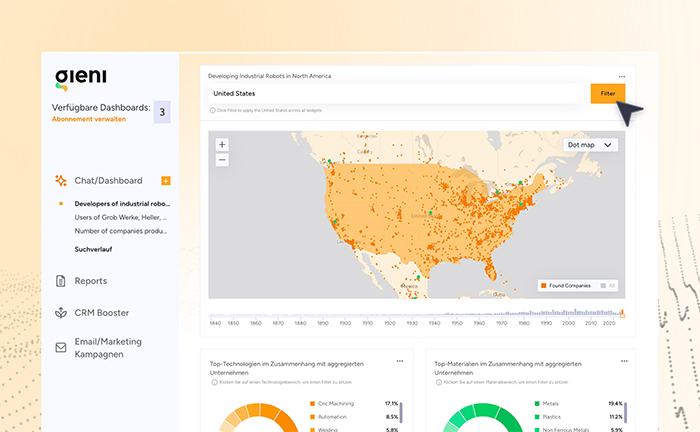
Manufacturing has always rewarded companies that respond faster than their competitors. Now, rather than investing purely in better information, it increasingly means investing in better execution too. At Gieni, this thinking shaped the development of Gieni ABX (Autonomous Business Execution). Instead of simply generating recommendations, the platform executes approved workflows across live business systems. In sales, for instance, it can identify promising prospects, enrich customer data, prepare personalised outreach and present the completed workflow for approval before anything is sent. Routine operational work no longer needs to pause every time information crosses from one system to another and people remain responsible for decisions. The repetitive coordination that has traditionally slowed decisions begins to fade and the way organisations scale changes with it. This is considered Generation 3 of AI – Autonomous Business Execution.
The truth is that competitive advantage is unlikely to come from another dashboard. Most manufacturers already have more data than they can reasonably act upon and the organisations that move ahead will be those asking a different set of questions. Where does work stop waiting for a person? How many routine tasks still exist simply because information sits in separate systems? How much time is spent coordinating work rather than completing it? These are operational questions rather than technology ones, but answering them may have a greater effect than another investment in analytics. The companies that respond fastest over the next decade are unlikely to be those with the most information. They will be the ones that have removed the greatest amount of friction between knowing and doing.
Because visibility has improved dramatically across manufacturing. For many organisations, the limiting factor is no longer identifying issues but responding quickly enough to influence the outcome.
No. Its purpose is to automate repetitive operational tasks while keeping people responsible for judgement, governance and approval.
Look for processes that require multiple manual handoffs between systems. Those workflows often create the biggest delays and offer the clearest opportunity for improvement.

About the Author:
Timur Göreci is the Chief Revenue Officer (CRO) and Chief Operating Officer (COO) at Gieni AG, where he leads the strategic development of Partfox, the world’s largest AI-driven CNC network connecting buyers with manufacturers, and Gieni Explorer, a big data solution delivering in-depth market analysis and industry insights across various sectors.
With over a decade of experience in sales, digitalisation, and business development, Timur has successfully led international teams while managing strategic business and financing processes. Prior to his role at Gieni, he served as Head of Sales at Laserhub and Head of Brand Partnerships at store2be.
As the co-host of the podcast “Industrie ungeschminkt!”, he shares practical insights into the digital transformation of the machinery construction and manufacturing industry sector.