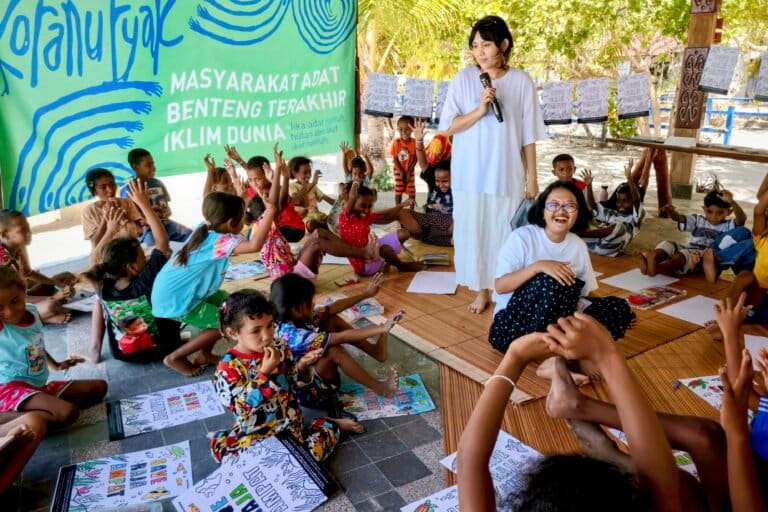
ARBOREK, West Papua, Indonesia — “Rockhead fish, salamander fish, starfish and coral.” That’s what dozens of children from Arborek, a small island in Indonesia’s Raja Ampat archipelago, said when asked what they see in nature that is yellow and orange. The children rattled off the fish and other marine life they encounter when they play in the sea, during a reading of a children’s book about Raja Ampat and the threat of nickel mining. A coral reef and marine life in the waters off Raja Ampat in Southwest Papua province, Indonesia. Image courtesy of Econusa. Research suggests that children who grow up closely connected to their surroundings can develop sophisticated understandings of their local environment. A 2014 study of children in 22 villages in Indonesian Borneo, for example, found that they recognized relationships among forests, rivers, wildlife and other environmental changes. So Sekar Bestari, the book’s illustrator, wasn’t surprised by the children’s answers. “Most of the time when we read the books to children, they understand them, so don’t underestimate children’s knowledge,” she said after the reading in Arborek. “We’re not surprised anymore today.” The reading was part of a three-day gathering of Indigenous communities in Arborek that brought together representatives from 20 Indigenous subtribes in Raja Ampat, as well as Indigenous people from other parts of Indonesia and abroad. The gathering, organized by Greenpeace Indonesia and local NGO Institut USBA, was intended to strengthen solidarity among Indigenous communities in protecting their lands, waters and biodiversity. The children’s knowledge of…This article was originally published on Mongabay