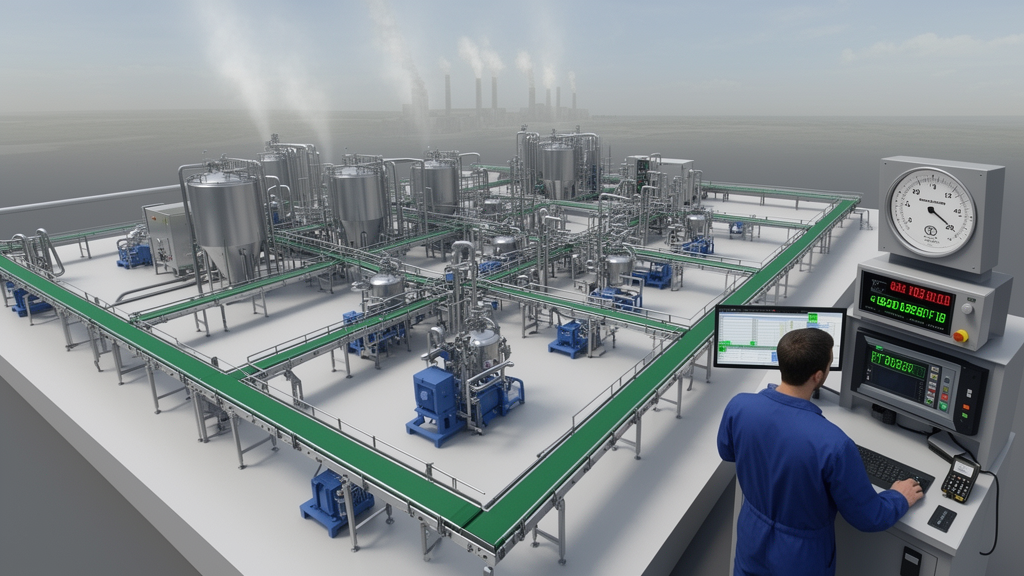

Production is at a four-year high. Every hour of downtime now costs more, because there is no slack left to recover it.
By Nick Haase, Co-Founder, MaintainX
Seven straight months of expansion. Production running at its fastest pace since late 2021. Factory employment growing for the first time in nearly three years.
Now go ask a maintenance manager how it feels.
The July ISM report was the best news American manufacturing has had in four years. The Manufacturing PMI hit 55.6, the highest since May 2022. The production index jumped 6.3 points to 58.5. Employment crossed into growth for the first time in 33 months. Much of it traces back to one source: the AI infrastructure buildout has pushed data center equipment into full manufacturing ramp-up.
Here is what did not make the headlines. Backlogs jumped 4.5 points. Customer inventories fell deeper into “too low” territory. Supplier deliveries slowed for the eighth consecutive month.
Read those three together and you get the real story. Demand is arriving faster than capacity can be added. Nobody is breaking ground on a plant that will serve this year’s order book. So the demand lands on the asset base you already own. And it lands as utilization.
Everyone in this business keeps a shortage list. Copper. Transformers. Switchgear. High-bandwidth memory. Turbine engines. Skilled trades. Every item on them is real.
Maintenance capacity is not on anyone’s list. It is already the binding constraint in more plants than their leadership teams realize.
Here is how it forms. Utilization climbs, so the same assets run more hours with fewer idle windows. Preventive work gets pushed because the line cannot come down while a customer is waiting. Every deferred PM is a loan against future uptime at a terrible rate. Failures then get more expensive rather than more frequent, because your spare part now competes with a data center order. And the knowledge to run equipment hot without breaking it sits undocumented in the head of a technician closer to retirement than to onboarding.
None of this is speculative. In our annual survey of 2,234 maintenance and operations leaders across the U.S. and Canada, 79 percent of teams saw unplanned downtime hold steady or increase last year. Thirty-nine percent said those events are getting more expensive, up from 31 percent. Half of all teams still spend less than 40 percent of their time on planned work.
That was the picture before production hit a four-year high.
Every maintenance leader has quoted a downtime number to a CFO. Our earlier survey work put the average hour near $25,000, and well past $500,000 for large operations. Those figures understate what an hour costs right now, and inflation is not the reason.
At 70 percent utilization, an eight-hour outage is a scheduling problem. You run Saturday. You pull from finished goods. The line catches up by Thursday and the quarter never feels it.
At full capacity with a backlog, there is no Saturday left to sell. You already sold it. The catch-up shift you were counting on as insurance is committed production. The finished goods buffer you were going to draw down is sitting at 40.7 and falling. That eight hours does not get recovered. It gets subtracted.
That is the difference between deferred revenue and lost revenue, and most downtime models cannot tell them apart. They were built when demand was the constraint and the plant had slack. Demand is not the constraint anymore. The plant is.
So run it again. Hourly contribution margin at current volumes, times hours lost, with no discount for recovery, because there is nothing left to recover into. Then add the cost nobody puts on a spreadsheet. A customer working against a committed date discovers you cannot hold yours, and starts qualifying a second supplier. You can win an order back. Winning back a slot on an approved vendor list takes years.
There is a line worth sitting with about this buildout. You cannot build a data center without electrical equipment and advanced cooling. You also cannot build one without paint and ball bearings.
This buildout is not confined to chip fabs and switchgear plants. It reaches through second and third tier suppliers who have never been on a hyperscaler’s critical path. Coatings. Fasteners. Bearings. Gaskets. Companies that spent three years fighting for orders are now single-source into projects with fixed commissioning dates.
Fourteen unplanned hours at a bearing plant in Ohio used to be an internal problem, absorbed somewhere downstream. There is no slack left downstream. That fourteen hours is a commissioning delay in Virginia.
Maintenance teams have spent decades defending their budgets on cost avoidance. That argument is over. Reliability is a delivery commitment now.
The obvious response is to invest in and buy predictive maintenance. I want that to be the answer, and it is part of one.
Predictive works. Condition monitoring catches the bearing before it takes the gearbox with it. AI reading across thousands of work orders finds failure patterns a planner would need a decade of tenure to see. Our data shows 58 percent of teams already using AI in maintenance, with 75 percent reporting measurable ROI inside six months. That is the fastest adoption curve I have seen in this industry.
And yet 79 percent of those same teams saw downtime stay flat or get worse.
Adoption is not the same as results. AI does not repair a maintenance program. It amplifies whatever program is already there. Point a model at an asset history full of blank fields and completion notes that read “fixed it,” and you get a confident recommendation with nothing underneath it. Do that twice and your team stops trusting the tool, which costs more than the license did.
The sequence is what matters. Capture the work. Structure the data. Then let AI find the pattern.
As utilization climbs, these tell you the truth before your production report does. Review them monthly.
Planned versus unplanned ratio. If output is climbing while planned work falls, you are borrowing against future uptime. That trade looks free on a P&L right up until it isn’t.
PM compliance on constraint assets. Not the fleet average. The fleet average hides the twenty assets that decide whether you ship.
Mean time to repair, with parts wait time broken out as its own line. That is where a tightening supply chain shows up first. Rising wait time means change your spares strategy, not lean harder on your technicians.
Knowledge capture rate. When your best technician solves something hard, does the fix get recorded where the next person finds it at two in the morning? If not, you are running an asset base whose operating manual walks out the door at shift change.
Then do the simple thing. Pick the asset where an hour of downtime costs the most. Instrument it. Write down what your best technician knows about it. Point AI at that data and let it find what a person would miss. Measure what changed. Move to the next asset.
That is it. The prescription is smaller than the problem sounds, which is usually true and almost never believed.
Manufacturing waited four years for demand like this. The order book is finally the easy part.
This cycle will be won by the plants that can run hard without breaking. Utilization is climbing. Make sure reliability climbs with it.

About the Author:
Nick Haase is a co-founder of MaintainX, an AI-powered maintenance and asset management platform now part of Autodesk. Over the past eight years he has helped scale MaintainX into a global platform trusted by more than 13,000 manufacturing and industrial organizations to increase production, reduce unplanned downtime, and build the data foundation that makes industrial AI work. He spends most of his time on plant floors with the maintenance and operations leaders who keep the physical world running.
Read more from the author:
How Maintenance Drives U.S. Manufacturing Performance | Industry Today, January 2026.
The AI Boom Is Driving Up Your Power Bill Too | Industry Today, August 2026.