A winner has been declared in humanity’s fight against climate change: climate change.
Calling for a “strategic retreat,” the United Nations admits we’ve missed the boat on preventing some of the worst impacts of a warming world. Soon, Earth will exceed the safe temperature threshold agreed upon in the 2015 Paris climate accord, 1.5 degrees Celsius (3.8 Fahrenheit) above pre-industrial levels across a 20-year average.
We’ve lost the battle, but there’s still the war to consider.
Rather than arguing over whether the 1.5-degree window is still open or lamenting our failure as a species, the UN suggests we focus on how to bring temperatures back to safer levels. In the meantime, living things will foot one hell of a bill for humanity’s infatuation with burning dead stuff, in the form of more frequent and powerful weather-related disasters, rising seas,mass extinctions, and melting glaciers over the coming decades.
As we take our licks, the plan is to curb fossil fuel use and figure out carbon capture. Every five years of delay in reducing emissions adds at least a tenth of a degree to peak warming, warned one of the co-authors of a grim first-of-its-kind report issued by the United Nations Environment Program last Wednesday. In an upcoming phase that the document designates “coping and containment,” governments should expect more people will die and get sick, food production will drop, people and animals will go hungry, water shortages will worsen, economies will crumble, and species like coral will disappear.
“This is among the bleakest U.N. climate reports I have read. It carries the unmistakable tone of desperation, frustration and urgency — but not resignation,” said University of Victoria climate scientist Andrew Weaver.
“The science leaves no room for doubt: the planet is in uncharted waters, and those waters are heating up,” U.N. Secretary-General António Guterres said in a statement.
If you can hear me over the whir of the modular behind-the-meter turbines cranking to power your local data center, perhaps we should reconsider some of our current priorities?
Happy Labor Day and welcome to the Factor This Brief, a weekly collection of energy industry finance and development updates, delivered straight to your inbox on Monday mornings and hosted in a not-so-brief fashion here on Factor This, featuring the people, projects, and technology driving our electric future.
Thanks for checking it out and for all your labor. If you like what you see here or want to recommend a story for next week, drop me a line. As always, here’s a jam for the journey. May your extra day off, if you’ve got one, be smoother than that first cup of coffee on the first chilly fall morning.
East Point Energy, wholly owned by Norwegian multinational energy company Equinor, has completed construction and begun operations at Citrus Flatts, a 100-megawatt (MW)/200-megawatt-hour (MWh) energy storage facility in Harlingen, Texas.
The project is East Point’s second to reach the operational stage, following the 10 MW/20 MWh Sunset Ridge site last year. Combined, Citrus Flatts and Sunset Ridge can supply enough electricity to power around 30,000 homes for up to two hours within Texas’ ERCOT power market. Both projects will operate on a fully merchant basis in ERCOT.
The Citrus Flatts Energy Center in Cameron County, TX. Courtesy: Equinor
“The start-up of these facilities underscores Equinor’s ambition to grow its integrated power business, delivering flexible and reliable energy solutions in attractive power markets,” assessed Christian Lie Hansen, Equinor vice president of onshore renewables Americas and chair of the East Point Energy board.
Equinor has now put five battery energy storage systems (BESS) into production over the last four years. Beyond Texas, construction is underway on the company’s battery storage portfolio in the PJM power market, specifically in Virginia. The four-project portfolio totals 80 MW/160 MWh. It is on track to reach commercial operation early next year.
Solar, storage, and gas lead new capacity additions in ERCOT; Sodium-ion batteries are coming to California, hybrid projects break ground in New Mexico, a renewable developer partners with Ford’s new battery manufacturer spinout, a data center developer is bringing its own gas power, and Avangrid finishes construction on solar in Oregon.
On this episode of the This Week in Cleantech podcast, Lana Ferguson from the Dallas Morning News discusses the booming agrivoltaics industry in Texas.
As data centers flock to Texas, Georgia Power installs a battery at an existing solar site, Antora Energy raises $550M, a key southeast Asian PV project comes online quickly, ComEd expands rooftop solar deployment, and Minnesota Power moves a little earth.
Scaled power platform MN8 Energy, zinc-based storage manufacturer Eos Energy Enterprises, and Google are collaborating on an innovative new project promising to support the PJM grid.
Owned and operated by MN8, Mammoth Solar in Kanawha County, West Virginia, will combine 86 MW of utility-scale solar, 10 MW/100 MWh of Eos’ Z3 zinc-based long-duration energy storage (LDES), and 70 MW/280 MWh of traditional lithium-ion energy storage. The integrated portfolio adds new clean, dispatchable capacity to the grid serving Google’s data centers in the region, including a planned project in West Virginia. The solar project is expected to reach commercial operation in 2028, with lithium-ion storage and long-duration storage following in 2029 and 2030, respectively.
Mammoth Solar was designed to be an integrated utility-scale solar system with short- and long-duration storage that converts intermittent renewable generation into a single, dispatchable resource. The multi-technology solution, the project’s developers contend, fills a critical grid need by delivering clean capacity matched to data center load profiles. It’s the first commercial-scale long-duration energy storage deployment in West Virginia.
Google will purchase the energy, capacity, and clean energy attributes of the project, advancing the company’s commitment to bring new capacity to the grids where it operates. The project is part of Google’s broader efforts to accelerate LDES technology commercialization.
A rendering of a solar project on the Mammoth Solar website. Courtesy: MN8 Energy
“This project reflects what MN8 does best: understanding a customer’s unique energy profile and building a solution around it,” offered Jon Yoder, president and CEO of MN8 Energy. “Because Google was willing to pair next-generation storage with utility-scale solar, we could engineer proven and emerging technologies into one dispatchable resource – and deliver clean, around-the-clock power where the grid needs it most.”
Built on a reclaimed coal mine, the project marks Google’s first to incorporate Eos’ American-made Z3 technology and the first project under the previously announced MN8-Eos Master Supply Agreement. The 10 MW/100 MWh system is designed to provide 10 hours of storage, extending the availability of solar generation beyond the shorter-duration energy storage resources and enabling the combined portfolio to deliver dependable capacity across more hours of the day. This project intends to prove how Eos’ aqueous zinc chemistry can support critical grid infrastructure.
“The grid needs more from every megawatt of new generation,” added Nathan Kroeker, CCO at Eos. “Our work with Google is focused on deploying American-made long-duration storage where it solves real grid reliability challenges. Z3 extends the value of clean generation across more hours, strengthens the overall portfolio, and delivers more dependable capacity when it’s needed most.”
Not to be confused with:Mammoth Solar, a massive, 13,000-acre Indiana endeavor by Doral Renewables that received its name from the woolly behemoth whose bones were discovered where the project broke ground.Learn more here.
When life gives you lemons, make lemonade. When life gives you cow $#!%, make… renewable natural gas?
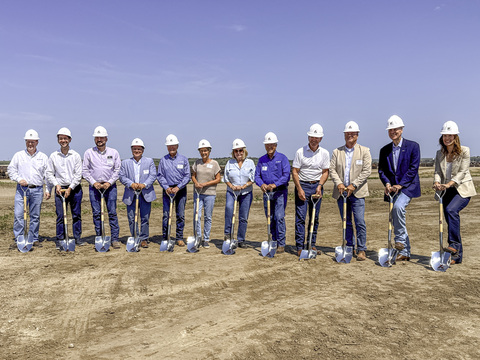
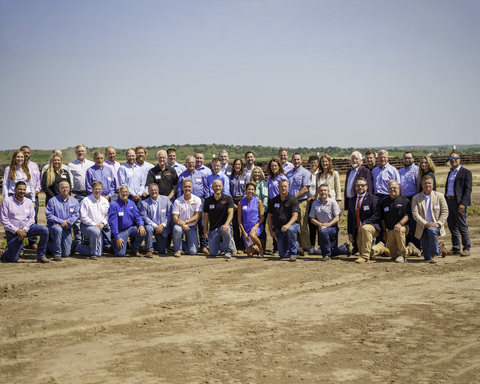
NeoGenyx, a subsidiary of energy infrastructure giant Ameresco, recently broke ground at a new facility that promises exactly such alchemy at the Adams Land & Cattle feedlot in Broken Bow, Nebraska. An August 26, 2026 ceremony assembled agricultural, energy, government, and community leaders to recognize the start of construction on Neogenyx’s first agricultural renewable natural gas (RNG) facility.
The project is designed to capture manure from the feedlot and convert it into renewable natural gas through eight anaerobic digesters capable of generating more than 4,400 SCFM of biogas. Once upgraded to pipeline-quality RNG, the facility is expected to produce approximately 1.2 million MMBtu annually for transportation and other energy applications. Process byproducts will be beneficially reused onsite as livestock bedding and agricultural fertilizer. The project is also expected to reduce greenhouse gas emissions by approximately 63,700 metric tons annually, equivalent to the carbon sequestered by roughly 63,800 acres of U.S. forest each year.
Ameresco senior vice president and chief marketing officer Leila Dillon says this demonstrates what’s possible when agriculture, innovation, and energy infrastructure come together.
“The Adams Land & Cattle project is not only transformational for the operation and the broader agricultural sector, but it also provides a blueprint for how American agriculture can play a larger role in the global energy economy,” she added.
“Through our partnership with Neogenyx Fuels, we are converting a resource we have always managed into pipeline-quality renewable natural gas, while creating a more consistent fertilizer product for local agriculture,” said Abram Babcock, CEO of Adams Land & Cattle, LLC. “It is an important step in advancing our sustainability goals and supporting our vision of building a business for generations to come.”
Big dog IPP Cypress Creek Energy has reached commercial operations at its Ostrea Solar project in Yakima County, Washington. The $180 million privately funded infrastructure project is interconnected to the Bonneville Power Administration transmission system, adding 104 MWdc / 80 MWac of new generation.
Microsoft, headquartered in Redmond, Washington, is the long-term offtaker of energy and environmental products generated by Ostrea Solar.
“Washington’s economy is growing, and that growth requires more electricity,” said Kevin Smith, CEO of Cypress Creek Energy. “Ostrea shows how we can responsibly bring new power online quickly and affordably, while creating lasting benefits for the communities where we operate, and caring for the land for generations to come.”
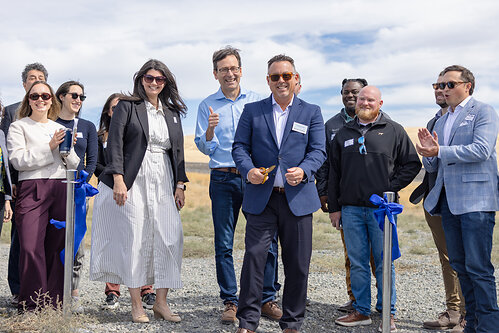
Washington State Governor Bob Ferguson, Cypress Creek Energy CFO Mike Discenza, and other guests cut the ribbon at Ostrea Solar. Courtesy: Cypress Creek Energy
Cypress Creek will own and operate Ostrea for up to 40 years. The IPP’s commitment to thoughtful land management began during development, when Cypress Creek worked closely with the Washington State Energy Facility Site Evaluation Council and the Washington Department of Fish and Wildlife (WDFW), including modifying the project design to conserve approximately 275 acres of critical shrubsteppe habitat.
Shrubsteppe, a dry, open natural ecosystem dominated by woody shrubs and perennial bunchgrasses, is one of Washington’s most diverse ecosystems, providing habitat for species found nowhere else in the state. It is also increasingly scarce, with an estimated 80% of Washington’s historic shrubsteppe lost or degraded to development and agriculture. Cypress Creek also contributed funding to WDFW to support additional conservation work elsewhere in the region. Ostrea was also designed with wildlife corridors to maintain migratory pathways through the project area, including those used by Rocky Mountain elk moving through the region.
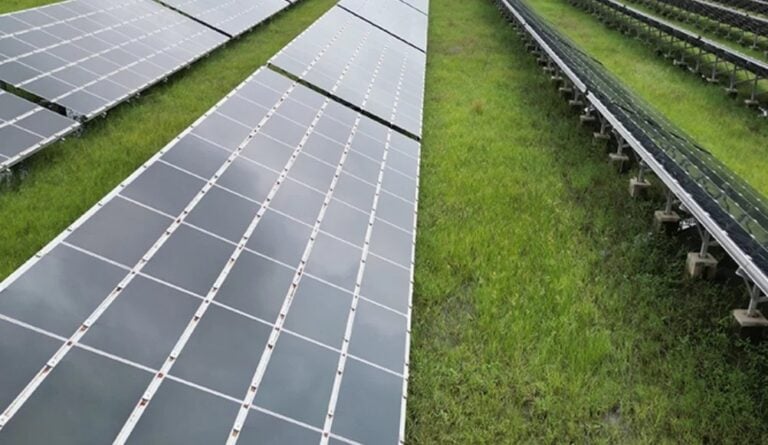
During construction, invasive plants that can threaten native habitats were removed, and disturbed areas were revegetated. The project was then seeded with carefully selected mixes of grasses and pollinator-friendly flowering plants. Beneath and around the solar arrays, lower-growing species were selected to establish healthy vegetation without interfering with the panels. Other restored areas include taller grasses and flowering species that provide additional habitat and forage for pollinators.
Ostrea is expected to generate an estimated $13.3 million in state and local tax revenue over its operating life. PCL Solar Constructors USA, Inc. served as the project’s engineering, procurement, and construction (EPC) contractor. Construction created approximately 300 jobs, all paid at prevailing wage rates, and included an apprenticeship program that provided opportunities for workers to gain valuable experience and develop skills for long-term careers in the construction trades.