
The most affordable web-based PDF tools for small medical offices.
A small medical office doesn’t have a budget line for enterprise document software, but it still needs merging and splitting to work correctly every time. A missed page in a records request or a botched split in a referral packet causes real problems downstream. A tool that lets you combine PDF files reliably, without a large monthly bill, is what a small staff actually needs.
- Per-seat pricing: even a small staff of four or five adds up fast on a per-user plan.
- Daily task caps on free tiers: fine for occasional use, a problem on a busy day.
- Reliability on larger files: a cheaper tool that fails on a big scanned packet costs more in wasted time than it saves.
Merge a records request or split a referral packet reliably, without a per-seat price that punishes a staff of four or five. The free plan covers occasional use, and paid plans start around $9 a month if volume grows.
- Best for: Reliable merging and splitting at a price built for a small staff.
- Standout: No per-seat cost, and no tight daily cap on the core tools most offices use every day.
- Free tier: Free plan available.
- Pricing: From around $9 a month.
- Note: A large batch of scanned records can take longer to process than a few standard forms.
A single quick merge or split runs through a simple interface with almost nothing to learn.
- Best for: Occasional, simple tasks.
- Standout: Fast for a straightforward job with a small file.
- Free tier: Limited daily tasks.
- Pricing: Paid plans for more volume.
- Note: The daily cap can run out during a busy week.
A wider toolkit sits alongside merging and splitting, useful if the office also handles conversion or compression regularly.
- Best for: A broader set of document tasks at a similar price point.
- Standout: More tools than a merge-only site, in one place.
- Free tier: Limited daily tasks.
- Pricing: Paid plans for more volume.
- Note: The daily cap applies across every task combined.
Merging and splitting stay free without the tight daily cap most competitors impose, which helps staff working through several patient files a day.
- Best for: Frequent use without paying for a subscription.
- Standout: Free core tools that hold up under regular daily use.
- Free tier: Core tools are generally free.
- Pricing: Free for core tools.
- Note: A newer tool than the long-established names here.
Business-level reliability handles larger files well, at a price below Adobe’s.
- Best for: Reliable performance on bigger files, without Adobe’s cost.
- Standout: Solid reliability at a more accessible price point.
- Free tier: Limited free tier.
- Pricing: Per-user subscription.
- Note: Per-seat pricing still adds up across several staff accounts.
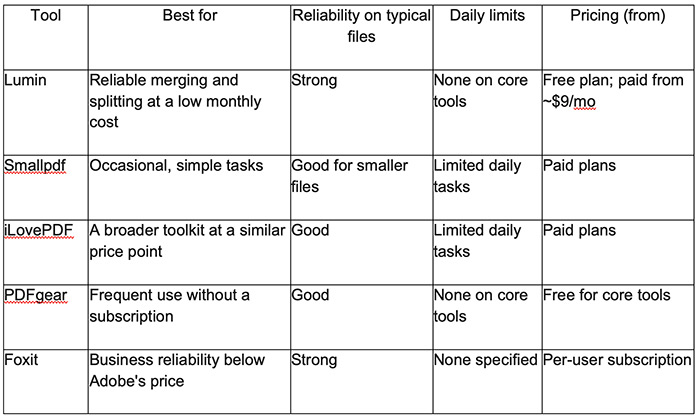
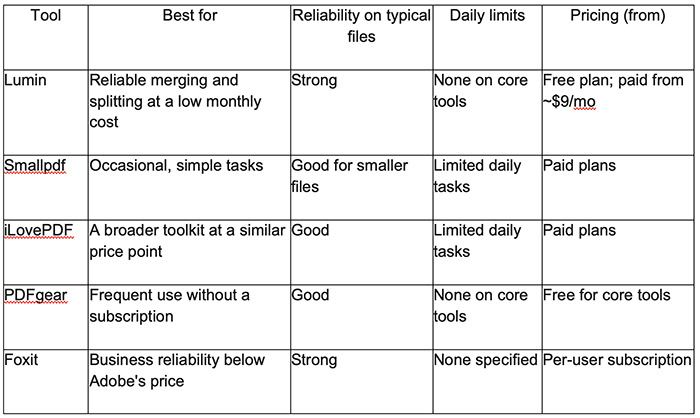
A small medical office needs merging and splitting to work correctly the first time, since a missed page in a referral or a records request causes real downstream problems. Lumin handles both reliably, and the pricing doesn’t punish a small staff the way a per-seat platform does. For most day-to-day merging and splitting on a tight budget, Lumin’s low monthly cost and lack of a punitive daily cap cover what a small staff actually needs.
Which PDF tool is both affordable and reliable for a small medical office?
Lumin and PDFgear both avoid per-seat pricing and tight daily caps, which suits a small staff’s typical volume. Foxit is a strong choice specifically for offices handling larger scanned files regularly, at a moderate per-seat cost.
Will a cheap PDF tool actually merge and split reliably?
It depends on the tool and the file. Lumin, PDFgear, and Foxit all perform reliably on typical medical office documents. Very large or heavily scanned files can slow down any browser-based tool, so testing with a real file before committing is worth the few minutes it takes.
Is a free plan good enough for a small practice?
For everyday use, yes. Lumin’s free plan and PDFgear’s core tools both cover typical merging and splitting at no cost. Confirm current free-tier limits before relying on either for consistently high volume.
Do these tools protect patient information adequately?
Check general security credentials like encryption standards before uploading anything sensitive. For documents containing protected health information, confirm HIPAA-related requirements directly with the vendor and your practice’s compliance officer.
How much does per-seat pricing actually cost a small office?
It multiplies directly by staff count, so even four or five accounts on a per-seat platform can add up to a real monthly expense. Lumin’s plan structure avoids that multiplication, which matters specifically for a small team.