
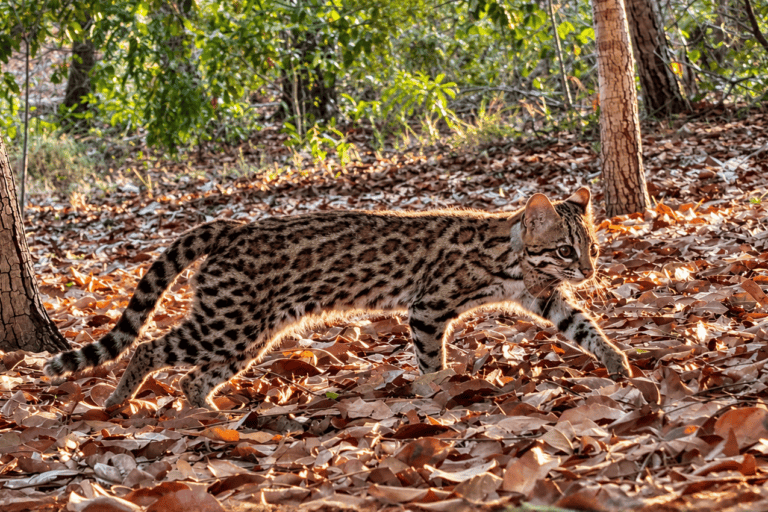
Editor’s note: Last week, the description of a “new” cat species from Bolivia made headlines around the world. The tilcayo (Leopardus tilcayo), a small spotted cat from Bolivia’s Yungas cloud forests, was described as the first new living cat species discovered in more than a century. Unlike several cats recognized as new species in recent years through taxonomic revisions, the tilcayo had never been formally described by science. Genetic analysis indicates its lineage diverged from other tiger cats around 1.4 million years ago. The discovery comes amid a broader reassessment of cat taxonomy. Several populations once considered subspecies or regional forms are now recognized, or have been proposed, as separate species. And there may be considerably more to come, according to Tadeu Gomes de Oliveira, a Brazilian wildlife biologist and conservationist who has spent several decades studying the small wild cats of the Neotropics. Oliveira is one of the co-chairs of the IUCN Species Survival Commission Cat Specialist Group. He is also a professor in the biology department at Maranhão State University (UEMA) in São Luís and a researcher and scientific adviser with Brazil’s Instituto Pró-Carnívoros. He leads the Wild Cats Brazil/Americas Conservation Program and is founder and chair of the Tiger Cats Conservation Initiative. Much of Oliveira’s work has focused on the tiger-cat complex, including Leopardus tigrinus, L. guttulus, and L. pardinoides. He has also been involved for many years in IUCN Red List assessments and conservation planning in Brazil. “The tiger-cat group is undergoing a genetic revolution,” Oliveira…This article was originally published on Mongabay