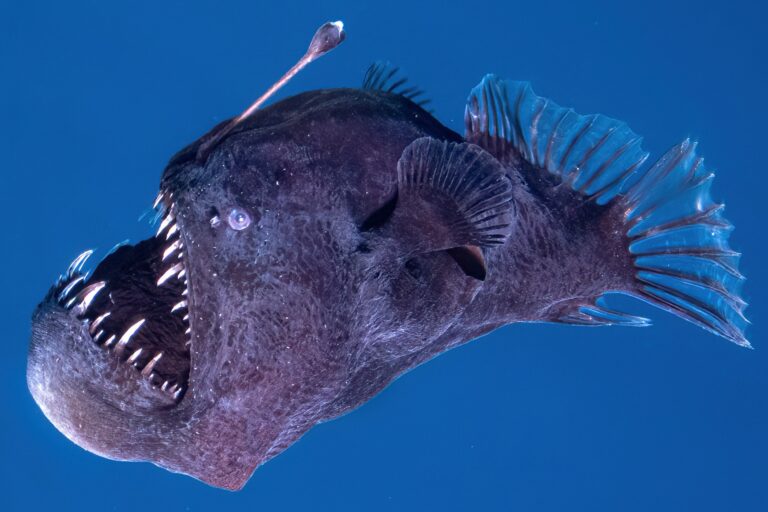
Plastic pollution could disrupt the bioluminescent light produced by deep-sea organisms, researchers warn in a letter in the journal Cambridge Prisms: Plastics. When deep-sea organisms ingest plastics, it could disrupt the chemical pathways that create bioluminescence and damage the tissues in their bodies, impairing their ability to find food and a mate, the authors said. In the deep sea, up to 80% of organisms with complex cells are believed to be bioluminescent, the only source of light in the darkest parts of the ocean. The light these organisms create is essential for their survival and reproduction, the letter notes. Disruption of their bioluminescence could negatively impact food webs and ecosystem functions in the deep sea, the largest and least-explored biome on Earth, the letter says. In an email to Mongabay, co-author Renjith VishnuRadhan of Amity University in India offered the example of an anglerfish. “It is widely recognizable from documentaries and films such as Finding Nemo,” he said. “Female deep-sea anglerfish have a modified dorsal spine ending in a luminous lure called the esca. Light produced by symbiotic bacteria helps attract prey and may also assist with recognition or communication in darkness.” It’s well-established that bacterial bioluminescence can be affected by pollutants, VishnuRadhan said, and ingestion of toxic plastic additives by anglerfish could disrupt the bacterial symbiosis in the lure, theoretically affecting its luminous signaling. The authors note there’s some evidence of plastic pollution impacts on deep-sea ecosystems, but scientists lack the high-quality data and observations needed to understand the…This article was originally published on Mongabay