
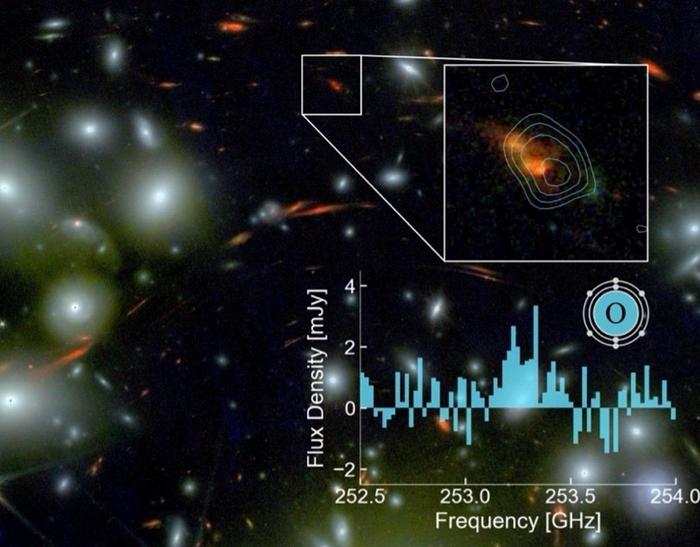
Approximately 13.8 billion years ago, the Big Bang is hypothesized to have occurred, kickstarting our universe and eventually life on our small, blue world. While the Big Bang has yet to be directly observed, scientists have worked tirelessly to piece together the events that happened immediately after the Big Bang, specifically the first billion years or less, with the goal of gaining insight into the how the first stars, and potentially planets, formed and evolved.
Now, an international team of scientists might be one step closer to unraveling the post-Big bang events as they used the Atacama Large Millimeter/submillimeter Array (ALMA) in Northern Chile to observe a star-forming gas known as neutral gas. This is a gas whose atoms have yet to be corrupted by solar radiation, hence its name and vital purpose in potentially forming the first stars in the universe. ALMA was used for this research since neutral gas does not emit ultraviolet, optical, or infrared light, meaning more powerful space-based telescopes like NASA’s James Webb Space Telescope (JWST) and Hubble Space Telescope (HST) can’t observe it. The findings were recently published in The Astronomical Journal and could shed new light on how the first stars formed within the post-Big Bang era.
A tight squeeze for the first stars
Using ALMA’s powerful spectroscopy instruments, the researchers measured spikes in specific wavelengths of the electromagnetic spectrum called emission lines to observe four star-forming galaxies that are estimated to have existed between 700-800 million years after the Big Bang. In the end, the researchers successfully identified neutral gas in all four galaxies from an emission line that emits neutral oxygen atoms, also called the [O I] 145 µm emission line. Additionally, they searched for ionized gas, also called the [N II] 205 µm emission line, to confirm their findings.
After identifying little to no evidence of this ionized gas, the researchers concluded that the four galaxies are comprised of neutral gas. After comparing this data with JWST data, the researchers ascertained these four galaxies exhibit high densities of stars compared to present-day galaxies, the latter of which exhibit widely dispersed stars. This suggests that galaxies during this time after the Big Bang exhibited very compact and dense star formations, meaning the stars formed much closer in distance to each other compared to stars we see today.
“We plan to extend these observations to a larger sample of galaxies and, by combining ALMA with JWST and other facilities, build a comprehensive picture of how galaxies formed and evolved from the cosmic dawn to the present day,” said Dr. Yoshinobu Fudamoto, who is an assistant professor in the Center for Frontier Science at Chiba University in Japan and lead author of the study. “Basic research of this kind addresses one of humanity’s most fundamental questions, namely how the Universe and our own Milky Way came to be what it is today.”
How are galaxies far, far away studied?
The distances the researchers observed the four galaxies are measured in what’s known as redshift (designated as z), which is calculated based on the expanding universe for objects moving closer to or away from the observer. In this case, Earth. Objects whose z value is greater than 0 are moving away from the observer while objects whose z value is less than 0 are traveling closer to the observer.
In the case of these four galaxies, the researchers measured them between z = 6.58 and 7.68, which translates to about 850 million years and 700 million years, respectively, meaning the universe was only about 5 to 6 percent of its current age. Redshift is measured from a combination of known elements (e.g., oxygen, hydrogen, and nitrogen), locating this element in deep space, then measuring the distance from Earth, with z telling researchers the speed at which it’s traveling away from Earth.
What new insights into the first star-forming galaxies will researchers make in the coming years and decades? Only time will tell, and this is why we science!
As always, keep doing science & keep looking up!