(This is Part 2 of a series on whether the universe can be cyclic. Read Part 1 first.)
Ah yes. Our good friend inflation.
I have done entire series on inflation, so I will be the first to admit it: the theory is awkward. So awkward that some people, up to and including a few of its own original architects, argue that it doesn’t even rise to the level of a proper theory. I’m not willing to go quite that far. But I understand the impulse.
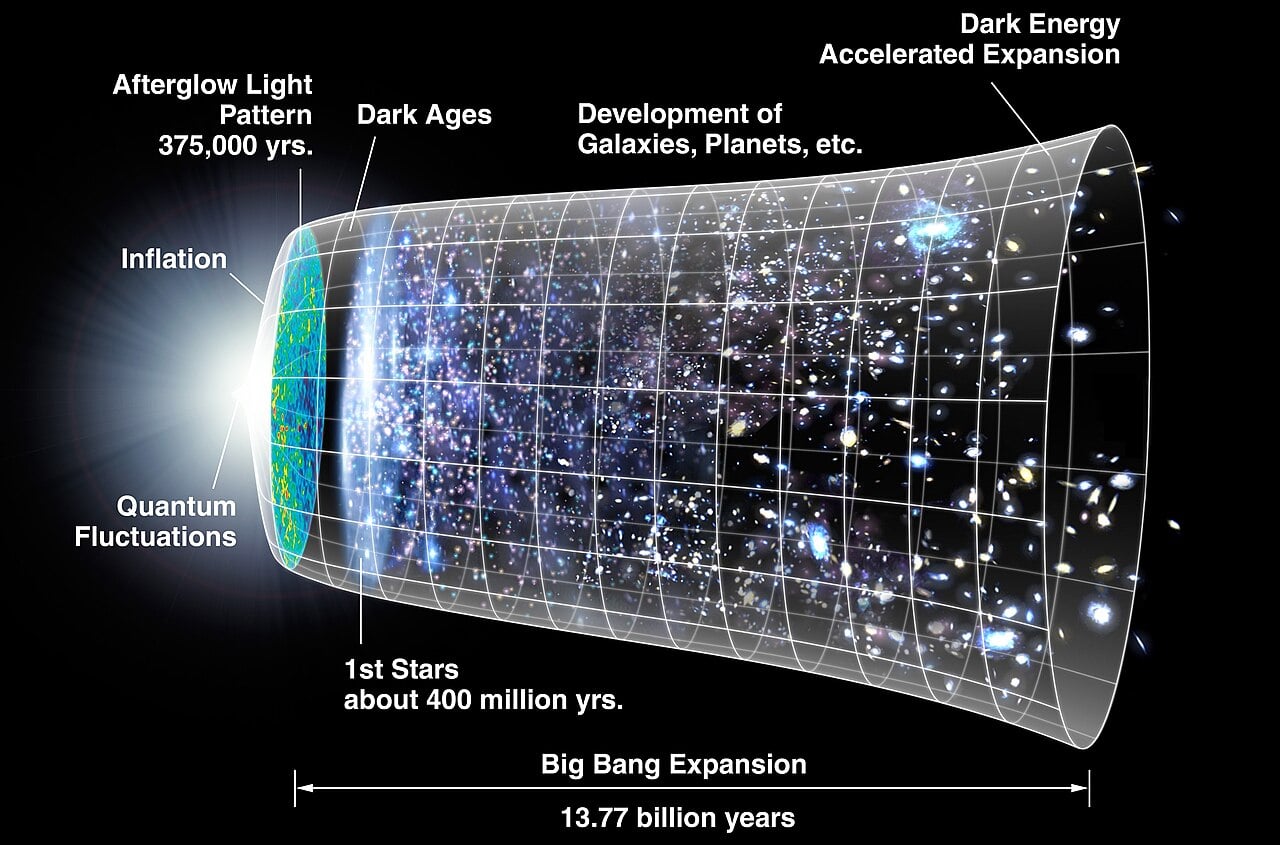
Here is what inflation says about the earliest moments of the universe, more or less in order. The universe was born. Don’t ask how. Singularity. The fundamental forces, merged together at first, came unstuck from one another as the cosmos expanded and cooled. That unsticking triggered a mysterious quantum field to drive a burst of exponential expansion, which is a polite way of saying the universe got unfathomably big unfathomably fast. By the time the dust settled, a patch that started smaller than a proton had ballooned to roughly the size of a solar system. And then that quantum field, its work finished, dumped the last of its energy into a flood of particles and radiation, handing the baton to the ordinary hot Big Bang we know and love.
If someone handed you that story on a sheet of paper with no context, you would be well within your rights to question my sanity. Fair. It sounds completely made up.
But inflation was not invented for fun. It was built to solve a set of very real, very stubborn problems with the plain vanilla Big Bang, and it solves them with almost suspicious ease.
Take the flatness problem. The geometry of the universe appears to be flat, almost perfectly so, balanced on a knife’s edge between curving in on itself and flying apart forever. In a standard Big Bang that balance is wildly unstable. Any tiny deviation should have grown enormous over billions of years, and yet here we are, flat as a board. Inflation fixes this by brute force. Take any curved surface and blow it up by a factor of a trillion trillion, and whatever little patch you happen to be standing on looks flat, the same way a basketball looks flat to an ant.
Then there’s the horizon problem. Look at one edge of the sky, then swing around to the opposite edge, and you find two regions that have never been in contact, that could never have exchanged so much as a single photon in the entire history of the cosmos. And yet they sit at precisely the same temperature, agreeing to one part in a hundred thousand. How did they coordinate? Inflation answers that they were once snuggled right up against each other, in cozy thermal contact, before that violent expansion flung them to opposite ends of the visible universe.
And the monopole problem. The best theories of high-energy physics insist the infant universe should have churned out a blizzard of magnetic monopoles, heavy exotic particles that, conspicuously, nobody has ever managed to find. Inflation simply dilutes them away, smearing whatever monopoles existed so thinly across the gigantic post-inflation volume that you would be lucky to stumble on a single one in the entire observable cosmos.
That is already a lot to get from one idea. But inflation then throws in a bonus it had no real obligation to provide. Those same quantum fields that drove the expansion were subject to tiny quantum fluctuations, little jitters bubbling up at microscopic scales. Inflation took those jitters and stretched them clear across the sky, freezing them in as faint ripples in the density of matter. Those ripples became the seeds. Give them billions of years and a little gravity, and they grow up into galaxies, clusters, and the vast cosmic web we actually observe.
And here is the part that should make you sit up. Inflation does not merely say “there were seeds.” It predicts the statistical fingerprint of those seeds: how many big ripples, how many medium ones, how many small ones, and how they all relate to one another across different scales. It makes a specific, checkable prediction. And when we went out and measured the real universe, it got that prediction RIGHT.
That, in a nutshell, is why this goofy, awkward, barely-a-theory has stuck around for nearly half a century. Not because it is elegant. Not because anyone particularly likes it. But because nobody has come up with anything better, and because it keeps getting the data right.
Which is not to say inflation is comfortable in its own skin. It has problems of its own, and they are not small ones. What actually powered inflation? We don’t really know. We bolt on a field with the right properties because the math demands it, not because we found one lying around. Worse, once inflation gets going, it has an alarming tendency to never fully stop, spawning an endless froth of other universes in a runaway multiverse that may be impossible to ever test. And for all its cleverness, inflation still needs a beginning. It still bottoms out at that very singularity it so carefully papered over. Don’t ask how the universe was born. Singularity. We are right back where we started.
So inflation reigns, but it reigns nervously, forever glancing over its shoulder. And a throne held that uneasily is an open invitation. All you need is a rival idea bold enough to walk up and take a swing at it.
Someone did.
In Part 3, a challenger arrives with a radically different story: no singularity, no inflation, and a universe that has quite literally always existed.