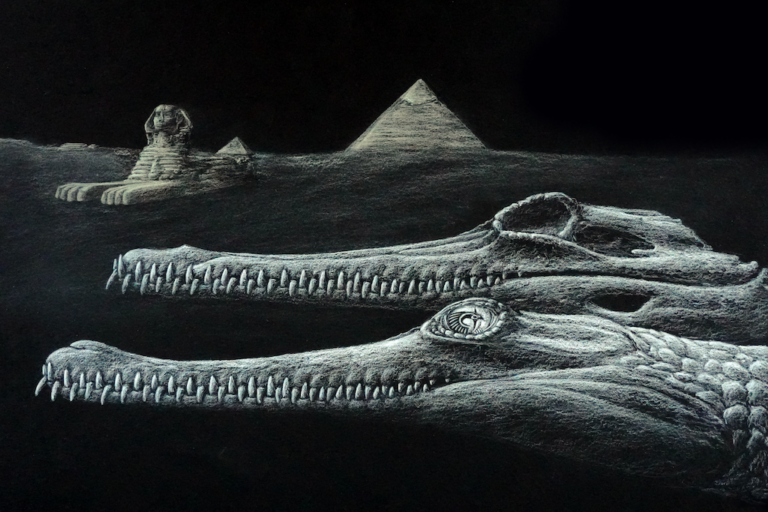
About 45 million years ago in northern Egypt, a long-snouted crocodile hunted in the warm, shallow sea. Its bones settled into the same limestone formation that ancient Egyptians would later carry and carve into the Great Sphinx. Now, a century after researchers first dug up the fossils, they say the animal is a species new to science. The extinct reptile, named Herugavialis cairensis, is described in a study published in Royal Society Open Science. Like the Sphinx, the fossil is missing the tip of its nose. “Given this coincidence with the famously missing nose of the Great Sphinx, we decided to name the new crocodile after the Egyptian god Heru, who was possibly the inspiration for this iconic monument,” Philip Mannion, a paleontologist at University College London who co-led the study, said in a press release. The fossils, including a nearly complete skull, were recovered in the 1920s from Egypt’s Mokattam Formation. At the time, scientists assigned them to Tomistoma, the genus of the living false gharial (Tomistoma schlegelii), because the two looked alike. An international team from the U.K., Sweden, Germany and Egypt decided to take another look at the fossils with modern tools. Led by Paul Burke of the Swedish Museum of Natural History in Stockholm, the researchers used CT scans to see inside the skull. They found several features that set the fossil apart from the false gharial. Herugavialis belongs to a group of long-snouted crocodilians called gavials. Fossils show gavials once lived nearly worldwide, and many…This article was originally published on Mongabay