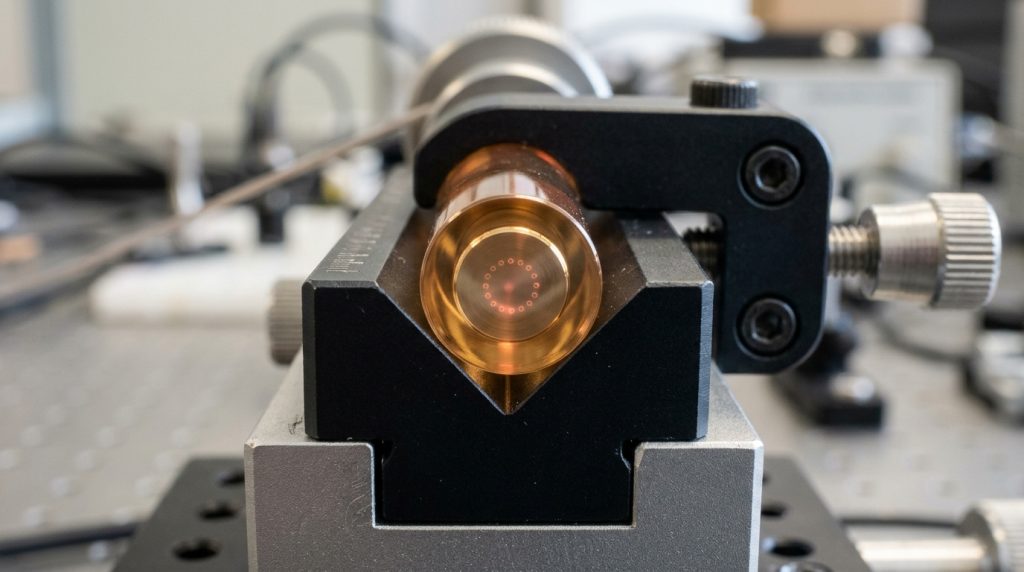
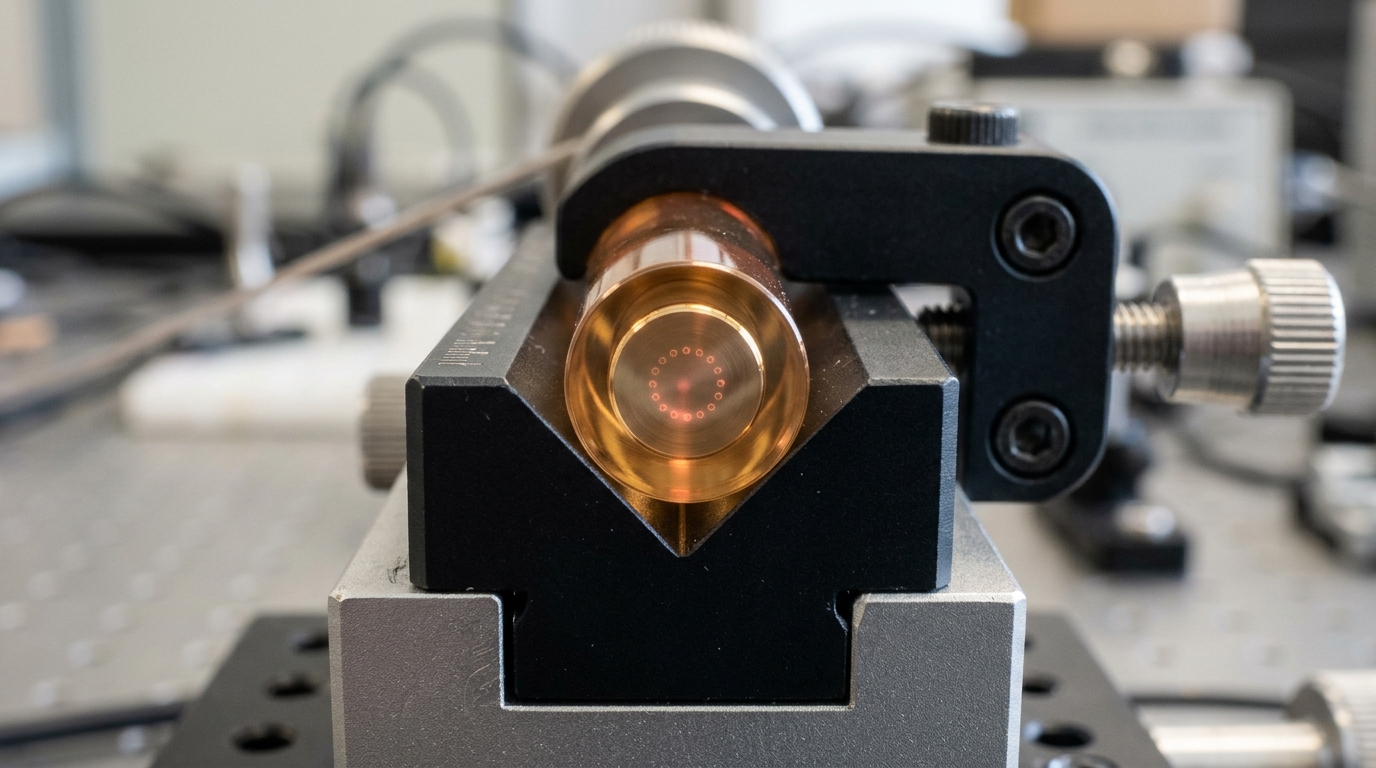
Soft-glass optical fibers promise unusually rich opportunities for packing several independent data channels into a single strand of glass, but a new numerical study shows that the physics of these fibers imposes hard distance limits on that ambition. Researchers modeled how light spreads among the many guided modes of a multimode lead-glass-core, borosilicate-cladding fiber and calculated how far two- and three-channel space-division multiplexing can survive before crosstalk destroys the separation between channels. Their answer is strikingly short compared with conventional silica fiber: roughly 25 meters for two channels and 17 meters for three channels under the narrowest launch conditions investigated.
The fibers at the center of the analysis, known as lead-glass-core borosilicate-cladding fibers, combine a lead-silicate or lead-oxide glass core with a borosilicate glass cladding. Because the core refractive index is much higher than that of the cladding, these fibers exhibit a large numerical aperture and tight optical confinement, and their nonlinear refractive index is several times higher than that of silica. Those properties make them attractive for nonlinear photonics, supercontinuum generation, ultrafast optical switching, and all-optical signal processing. The same high index contrast, however, also shapes how the many guided modes interact as light travels down the fiber, which is the crux of the new work.
Space-division multiplexing, or SDM, is a strategy for expanding transmission capacity by sending separate signals through distinct spatial channels within one fiber. In a multimode fiber, those channels can be defined by launching light at different angles relative to the fiber axis. The large refractive-index separation between guided modes in soft-glass fibers reduces modal degeneracy and suppresses unwanted intermodal coupling, and the strong confinement makes higher-order modes more robust against bending and structural imperfections than they are in conventional multimode silica fibers. These are precisely the qualities an SDM designer wants, which is why the authors describe such fibers as promising candidates for short- and medium-reach high-capacity links.
Modeling this regime is computationally formidable because a multimode fiber supports an enormous number of modes. The analyzed fiber, whose parameters were taken from previously reported experimental measurements, has a core diameter of 87.5 micrometers, a numerical aperture of 0.63, a core refractive index of 1.65, and a normalized frequency of about 273.63, corresponding to roughly 37,436 guided modes. Rather than tracking discrete modes, the team solved Gloge’s time-independent power flow equation, treating the modes as a continuum and using an explicit finite-difference method. The coupling coefficient, D = 4 × 10⁻⁴ rad²/m, was adopted from the earlier experimental work on the same fiber, where it was extracted from far-field beam-broadening measurements under microbending conditions.
The model assumes low-power, effectively linear propagation. Although lead-glass fibers have strong nonlinear coefficients, the study restricts itself to a regime where nonlinear intermodal interactions such as cross-phase modulation and four-wave mixing are negligible, so that the observed dynamics reflect microbending and structural micro-perturbations alone. Attenuation is treated as constant across guided modes, a standard approximation justified by keeping the maximum launch angle at 18 degrees, well below the critical angle where the highest-order modes begin to leak. Under these conditions, the power flow equation captures how angular power diffuses among modes as the light propagates.
The simulations launched Gaussian beams at distinct input angles to represent the spatial channels: 0 and 18 degrees for the two-channel case, and 0, 9, and 18 degrees for the three-channel case. In very short fiber segments, the output patterns remain ring-shaped, a signature that mode coupling is still weak and that the channels remain essentially independent. As propagation distance grows, microbending-induced power transfer gradually broadens the rings, blurs their boundaries, and shifts their intensity maxima toward the fiber axis. Eventually the distributions converge into a disk-shaped equilibrium mode distribution, at which point the far-field pattern no longer depends on the launch angle and the channels have merged in practice.
To quantify when a channel stops being distinct, the researchers defined a crosstalk threshold based on the spatial overlap between adjacent angular channels. When the normalized overlap integral reaches about 0.2, equivalent to roughly 20 percent optical power overlap or an inter-channel crosstalk of about −7.0 decibels, the effective optical signal-to-noise ratio is degraded enough that the uncoded bit error rate approaches the standard hard-decision forward error correction limit of roughly 3.8 × 10⁻³. In transmission schemes that operate without multiple-input multiple-output digital signal processing, this marks the practical boundary beyond which spatial channel separation collapses and eye diagrams close.
The calculated transmission limits depend strongly on how tightly the input beam is focused in angle. With a narrow launch-beam distribution of 1 degree full width at half maximum, two-channel SDM holds for about 25 meters and three-channel SDM for about 17 meters. Widening the launch beam to 5 degrees shortens those distances to roughly 20 and 13.5 meters, because a broader beam excites a wider range of guided modes and accelerates modal diffusion toward the equilibrium distribution. The coupling length at which that equilibrium is reached also shrinks with beam width, from 50 meters for the 1-degree launch to 40 meters for the 5-degree launch. Because the spatial evolution of the modal power distribution scales with the product of the coupling coefficient and distance, any increase in microbending severity proportionally shortens the achievable channel-isolation distance.
The comparison with conventional silica fiber is stark. Silica step-index fibers exhibit far weaker mode coupling, with coupling coefficients on the order of 10⁻⁷ rad²/m, and under equivalent modeling can sustain two-channel SDM over approximately 540 meters and three-channel SDM over about 120 meters. The lead-glass fiber reaches its crosstalk threshold tens of times sooner because its high refractive-index contrast, strong modal confinement, dense modal spectrum, and greater sensitivity to structural perturbations, fabrication imperfections, microbending, and thermal fluctuations all promote rapid energy exchange among neighboring modes. The authors frame this as an intrinsic trade-off: soft-glass fibers offer high numerical aperture and flexible thermal and optical tuning, but pay for it with stronger microbending-driven diffusion.
The study also probes the limits of channel density. Adding a fourth or more angular channel compresses the initial angular separation between adjacent beams so severely that crosstalk breaches the 0.2 overlap threshold within only a few meters, making high-density multiplexing in this fiber effectively impractical. The authors note that the angular launch scheme is conceptually aligned with center- and offset-launching techniques used in conventional multimode fibers, both of which control the initial modal power profile to preserve channel isolation. They caution, however, that the crosstalk level ultimately limiting performance cannot be determined from normalized output power distributions alone; a transmission-matrix approach incorporating receiver noise and system-level impairments would be needed for a reliable capacity estimate. Because direct experimental crosstalk measurements for these angular SDM schemes in lead-glass fibers are not yet available, the calculated boundaries of 25 and 17 meters stand as theoretical limits awaiting experimental validation, while the underlying coupling dynamics offer general design guidance for short-reach SDM systems built on high-numerical-aperture soft-glass multimode fibers.
Subject of Research: A numerical power-flow analysis quantifying the maximum propagation distances for low-crosstalk two- and three-channel space-division multiplexing in multimode lead-glass-core borosilicate-cladding fibers.
Article Title: Power-flow analysis of multichannel transmission in lead-glass-core borosilicate-cladding fibers
Article References: Savović, S., Savović, M., & Deng, X. (2026). Power-flow analysis of multichannel transmission in lead-glass-core borosilicate-cladding fibers. Results in Optics, Article 101195. https://doi.org/10.1016/j.rio.2026.101195
Image Credits: AI Generated
DOI: 10.1016/j.rio.2026.101195
Keywords: space-division multiplexing, lead-glass-core fibers, borosilicate cladding, power flow equation, mode coupling, inter-channel crosstalk, equilibrium mode distribution, soft-glass optical fibers, multimode fibers, launch beam distribution, microbending, short-reach communications
Tags: borosilicate claddingequilibrium mode distributioninter-channel crosstalklaunch beam distributionlead-glass-core fibersmicrobendingmode couplingmultimode fiberspower flow equationshort-reach communicationssoft-glass optical fibersspace-division multiplexing