
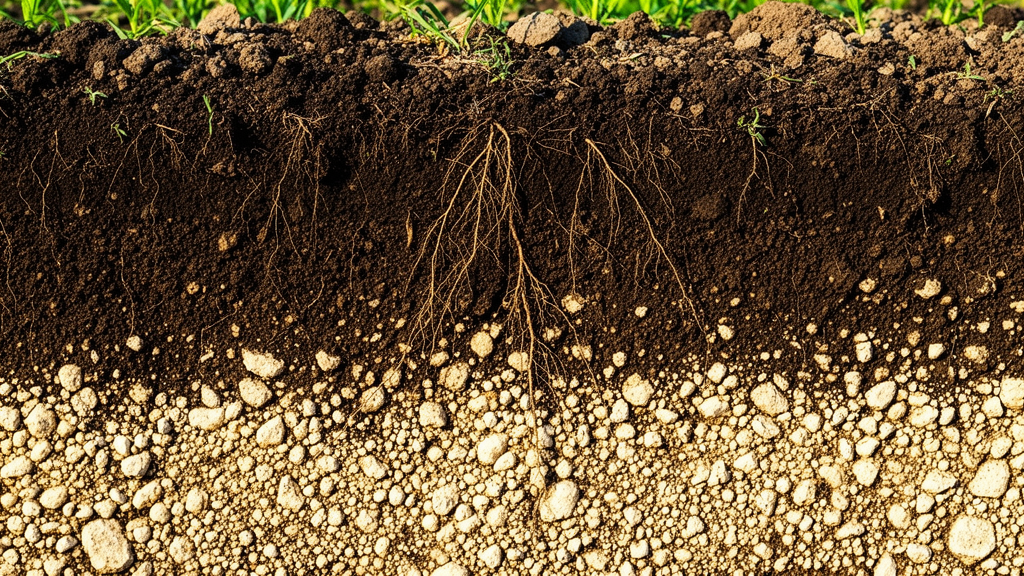
In an extensive comparative profile investigation across contrasting agricultural landscapes of Kazakhstan, researchers have determined that the quantity and fractional quality of soil humus fundamentally govern the distribution and availability of vital macro- and micronutrients. Published in the Journal of the Saudi Society of Agricultural Sciences, the study examined four agricultural soil profiles representing Calcic Chernozem from the northern steppe zone and Light Calcic Calcisol from the southern arid foothill plains. The research team evaluated how organic carbon reserves, distinct humic and fulvic acid fractions, and alkaline calcareous chemistry interact to dictate plant nutrient status. Their findings indicate that while organic-matter-rich steppe chernozems sustain robust reservoirs of humic acids and elevated concentrations of critical trace metals, the low-humus arid calcisols are characterized by a predominant fulvic acid pool and critically low levels of plant-available iron and boron. These baseline observations provide essential pedological evidence regarding regional nutrient dynamics, underscoring how specific humus fractions relate to persistent fertility constraints across vulnerable arable ecosystems.
Agricultural lands in Kazakhstan encompass roughly 222 million hectares distributed over extensive steppe, semi-arid, and arid regions that anchor the country’s primary crop production systems. Maintaining sustainable agricultural productivity across these expansive regions presents continuous agronomic challenges due to limited natural moisture availability, high climatic variability, and mounting anthropogenic pressures. Historical and current land assessments indicate that humus reserves across Kazakhstan’s cultivated soils have undergone substantial depletion relative to their baseline reserves, posing persistent threats to long-term crop security and rural economic stability. Although both the northern Calcic Chernozems and southern Light Calcic Calcisols represent pivotal agricultural resources, they develop under radically different pedogenetic and climatic settings. The northern steppe zones feature deep loess-like loam parent materials under cooler conditions, whereas southern arid soils form on Quaternary colluvial-proluvial foothill deposits under extreme evaporative demand. Despite these deep pedological divergences, intensive agricultural exploitation exposes both soil types to progressive structural deterioration, organic matter loss, and complex elemental imbalances that complicate fertility management.
To explore these interrelated dynamics, the scientific team formulated an analytical design examining three diagnostic soil components across full profile depths: instrumentally measured organic carbon and calculated total humus content, the fractional distribution of humic and fulvic acids, and depth-dependent concentrations of plant-available nutrients. Field investigations examined four observational soil profiles corresponding to specific soil and management settings. The northern site in the steppe zone experiences a mean annual precipitation of 320 millimeters, an annual average temperature of 2.7 degrees Celsius, and reference evapotranspiration of 820 millimeters per year. This location featured a sixteen-year four-field rotation of fallow, wheat, oil flax, and wheat, evaluated under an unfertilized control and a treatment receiving 20 kilograms of phosphorus pentoxide per hectare as ammophos. Conversely, the southern site on an arid foothill plain receives approximately 160 millimeters of annual precipitation against 1,300 millimeters of reference evapotranspiration at a mean temperature of 11 degrees Celsius, managed under irrigated cucurbit cultivation since 1994 with ammonium nitrate applied at 60 kilograms of nitrogen per hectare.
Pedological descriptions revealed contrasting morphological architecture between the two soil classifications. Calcic Chernozem profiles exhibited well-developed humus-accumulative layers, with combined A and B horizons spanning 60 to 70 centimeters in thickness. The surface A horizons displayed dark grey matrix colors with brownish tints that graded into lighter underlying B horizons, displaying visible carbonate spots and streaks starting from depths of 20 to 35 centimeters, violent effervescence with hydrochloric acid beginning at 5 to 10 centimeters, and gypsum crystals emerging below 90 centimeters. Mechanically, these northern profiles exhibited compact, fissured structures with particle-size distributions transitioning from sandy loam to medium loam in upper horizons and becoming coarser in parent materials. In contrast, Light Calcic Calcisol profiles possessed weaker genetic horizon differentiation, displaying sod-covered surface layers and total A plus B horizons measuring only 40 to 60 centimeters in thickness. Texturally dominated by weakly aggregated sandy loam across most horizons, these arid profiles exhibited carbonate accumulations in lower sections alongside deep groundwater tables situated 8 to 12 meters below the surface.
Laboratory determinations documented striking disparities in total humus content and humification pathways between the contrasting soils. Using elemental analysis alongside the Tyurin fractionation method modified by Ponomareva and Plotnikova, researchers partitioned soil organic carbon into humic acid fractions, fulvic acid fractions, and non-hydrolyzable residues. In Calcic Chernozem profiles, calculated total humus reached 2.70 percent in the surface horizon of the unfertilized control and 3.81 percent in the profile receiving ammophos, steadily decreasing to between 0.19 and 0.35 percent at depths near 120 centimeters. Humus fractional composition in the steppe chernozem demonstrated advanced humification, yielding humic-to-fulvic carbon ratios ranging from 1.2 to 2.0. By marked contrast, Light Calcic Calcisol profiles exhibited low total humus accumulations, measuring 1.05 percent in the unfertilized control and 1.45 percent under nitrogen application within surface layers, declining to between 0.39 and 0.61 percent in deeper horizons. Furthermore, calcisol humus was dominated by mobile fulvic acid fractions accounting for up to 73.2 percent of extractable humic substances, generating narrow humic-to-fulvic ratios between 0.1 and 0.2 that typify fulvate-type organic matter.
Chemical analysis of exchangeable cations and macronutrient forms further delineated the divergent geochemical behavior of the two soils. Calcic Chernozem profiles exhibited large reservoirs of exchangeable calcium and magnesium, with calcium concentrations fluctuating between 16.38 and 40.88 milligram-equivalents per 100 grams of soil and magnesium ranging from 4.00 to 13.75 milligram-equivalents per 100 grams. Exchangeable sodium remained consistently low across all horizons, spanning 0.19 to 1.25 milligram-equivalents per 100 grams. In Light Calcic Calcisols, exchangeable calcium reached only 2.81 to 5.56 milligram-equivalents per 100 grams, while magnesium measured 1.00 to 2.75 milligram-equivalents per 100 grams. Both soil types exhibited alkaline reactions throughout their profiles, with water pH spanning 8.06 to 8.77 in control chernozems and reaching 8.99 in subsurface calcisol layers. Mobile sulfate sulfur showed pronounced subsurface accumulation in both soils, reaching peak values of 48.12 milligrams per kilogram in fertilized chernozem and 53.68 milligrams per kilogram in control calcisol horizons, reflecting natural parent material inputs, downward salt redistribution, and potential contributions from irrigation water.
Pronounced divergences also emerged in available macronutrient distribution, reflecting distinct fertilization histories, cropping patterns, and sampling seasons. Nitrate nitrogen concentrations in Calcic Chernozem profiles ranged from 3.8 to 13.2 milligrams per kilogram in the control and 5.1 to 22.4 milligrams per kilogram in the phosphorus-fertilized profile. Conversely, Light Calcic Calcisol profiles exhibited substantially higher nitrate levels, spanning 5.4 to 38.9 milligrams per kilogram under nitrogen fertilization and reaching 58.9 milligrams per kilogram in the control surface horizon. Available Olsen phosphorus in surface layers measured 12.19 milligrams per kilogram in control chernozem and 27.61 milligrams per kilogram with ammophos, but reached 53.37 to 58.12 milligrams per kilogram in surface calcisols before decreasing sharply down the profile. Exchangeable potassium levels were high across surface layers of both soils, recording 394.5 to 445.0 milligrams per kilogram in chernozems and 382.4 to 431.1 milligrams per kilogram in calcisols. Researchers noted that elevated nitrate in the calcisols reflected warm August sampling under active irrigation, which accelerated microbial mineralization relative to rainfed May conditions in northern chernozems.
The most acute nutritional contrasts between the soil classifications appeared among mobile micronutrients extracted using diethylenetriaminepentaacetic acid solutions and hot-water extraction for boron. In Calcic Chernozem profiles, DTPA-extractable iron in surface horizons reached exceptionally high concentrations of 399.63 milligrams per kilogram in the control and 421.06 milligrams per kilogram in the fertilized profile. In sharp contrast, extractable iron in Light Calcic Calcisol profiles remained depressed between 0.66 and 1.06 milligrams per kilogram across all genetic horizons, falling severely below the established international deficiency threshold of 4.5 milligrams per kilogram. Hot-water-extractable boron displayed an analogous deficit, measuring 2.02 to 8.97 milligrams per kilogram in chernozems, whereas multiple calcisol horizons dropped below the 0.5 milligram per kilogram critical deficiency boundary to non-detectable traces. Manganese and copper concentrations remained above diagnostic deficiency levels of 1.0 and 0.2 milligrams per kilogram across all sampled profiles, although surface chernozem horizons maintained substantially higher absolute concentrations, while molybdenum and cobalt concentrations displayed site-specific vertical distributions tied to depth and alkalinity.
Multivariate statistical evaluations, including Pearson correlation matrices and principal component analyses, elucidated intricate associations linking humus groups to elemental solubility. In Calcic Chernozems, non-hydrolyzable residue and humic acid fractions HA1 and HA2 correlated positively with total humus, exchangeable calcium, available phosphorus, sulfate, and extractable iron, copper, and manganese, whereas the more mobile fulvic fraction FA2 showed inverse correlations. In Light Calcic Calcisols, the humic fraction HA3 along with fulvic fractions FA1 and FA3 correlated positively with total humus and micronutrients such as iron and boron, while exhibiting negative correlations with exchangeable cations and alkaline pH. Principal component analysis effectively captured these multivariate relationships, with the first two principal components explaining 82.5 percent of total variance in the Calcic Chernozem and 84.5 percent in the Light Calcic Calcisol. The ordination demonstrated distinct clustering between unfertilized profiles and those receiving mineral amendments, confirming that integrated organic fraction profiles closely align with overall nutrient solubility patterns.
The study authors emphasize necessary methodological constraints when interpreting these comparative findings across regional scales. Because each distinct soil and management scenario was represented by a single field profile, laboratory subsamples functioned solely as technical replicates to quantify analytical variability rather than independent field-level biological replications. Consequently, observed empirical differences reflect combined site-specific profile interactions rather than statistically generalizable treatment effects attributable solely to fertilizer application or soil taxonomy. Uncontrolled confounding variables include stark regional climatic differences, distinct irrigation regimes, crop species histories, and differing calendar dates of profile sampling. Nevertheless, the documented evidence confirms that low organic matter reserves and fulvic acid dominance in arid calcisols coincide with critical iron and boron deficiencies, whereas mature humic acid complexes in chernozems associate with broad micronutrient retention. These empirical insights indicate that agricultural sustainability in Kazakhstan’s arid zones requires site-specific management strategies focused on preserving organic carbon pools while actively correcting acute micronutrient shortages in alkaline soils.
Subject of Research: Soil humus composition and profile-level nutrient availability in contrasting calcic soils of Kazakhstan
Article Title: Humus quantity and quality control macro- and micronutrient availability in arid and semi-arid calcic soils
Article References: Kekilbayeva, G., Kassipkhan, A., Mikhailov, D., Nazarova, A., Zvyagin, G., Ramazanova, R., Saljnikov, E., Shoiynbaeva, A., Orynbayeva, B., & Beknazarova, R. (2026). Humus quantity and quality control macro- and micronutrient availability in arid and semi-arid calcic soils. Journal of the Saudi Society of Agricultural Sciences, 25(7), Article 97. https://doi.org/10.1007/s44447-026-00188-y
Image Credits: AI Generated
DOI: 10.1007/s44447-026-00188-y
Keywords: Calcic Chernozem, Light Calcic Calcisol, soil humus composition, humic acids, fulvic acids, micronutrient availability, soil organic matter, hot-water-extractable boron, DTPA-extractable iron, Kazakhstan agriculture, soil fertility management, soil profile assessment, exchangeable cations, principal component analysis, calcareous soils, soil agrochemistry
Tags: calcareous soilsCalcic ChernozemDTPA-extractable ironexchangeable cationsfulvic acidshot-water-extractable boronhumic acidsKazakhstan agricultureLight Calcic Calcisolmicronutrient availabilityprincipal component analysissoil agrochemistrysoil fertility managementsoil humus compositionsoil organic mattersoil profile assessment