
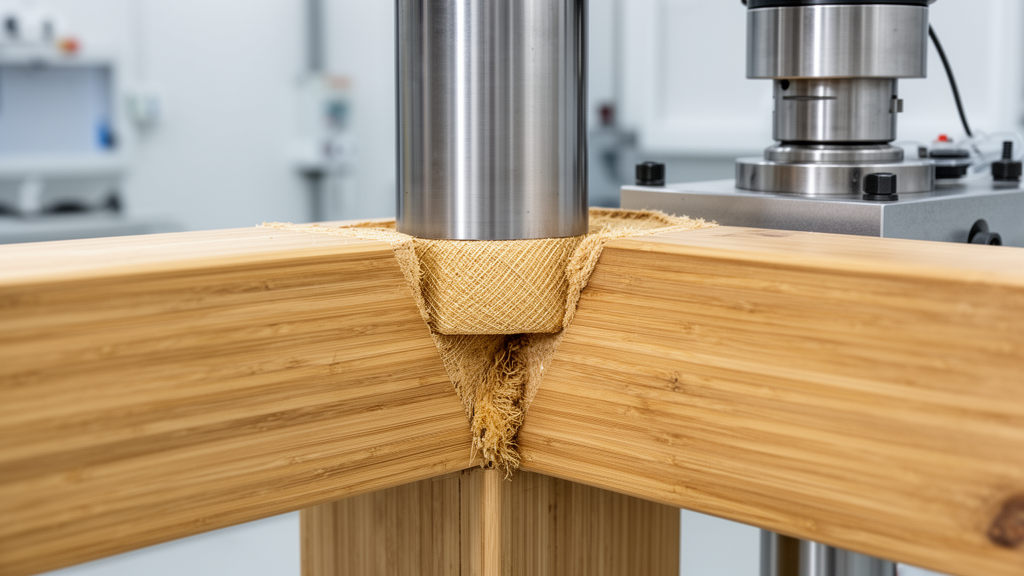
Engineered bamboo dowels demonstrate substantial potential as structural connectors within modern timber assemblies, with bamboo scrimber achieving markedly superior mechanical resistance compared to conventional thick strip bamboo panels. In a comprehensive experimental investigation evaluating bio-based connectors paired with Canadian spruce-pine-fir lumber, researchers established that bamboo scrimber dowels delivered an average bending yield strength of 68.29 megapascals, outstripping the 38.56 megapascals documented for thick strip bamboo panel dowels by approximately seventy-seven percent. The empirical evaluations, which combined standardized flexural trials with half-hole dowel-bearing tests, further identified stark behavioral divergences across grain alignments. When subjected to parallel-to-grain compression, the embedment strength of bamboo scrimber connectors reached 30.34 megapascals, nearly tripling the 10.76 megapascals achieved by thick strip bamboo dowels under the identical offset protocol. Conversely, when loads were oriented perpendicular to the wood grain, both bamboo varieties yielded nearly identical bearing performances around 10.8 megapascals, revealing that timber substrate limitations dictate cross-grain resistance regardless of dowel stiffness.
The structural motivation behind examining engineered bamboo dowels stems from the global imperative to transition toward sustainable, low-carbon building materials with lower ecological costs than traditional metallic fasteners. Steel dowels are conventionally favored for timber jointing due to their well-defined mechanical predictability, yet their manufacturing entails intensive energy consumption and high carbon emissions. Common structural alternatives like synthetic adhesives or metal plates present substantial practical hurdles, including poor economic efficiency, complicated on-site installation, and irreversible bonding that obstructs component disassembly and end-of-life material recycling. By contrast, renewable bio-based dowels provide cost-effectiveness, straightforward assembly, low environmental impact, and favorable mechanical compatibility with surrounding timber elements. Because connection regions represent the most vulnerable points within structural timber frameworks subjected to mechanical stress, accurate empirical data detailing dowel flexure and substrate bearing behaviors are critical. Prior engineering investigations frequently utilized steel rods or neglected fastener deformation when calculating joint capacities, highlighting an urgent technical need to characterize how distinct engineered bamboo microstructures transfer loads directly into solid lumber substrates.
To evaluate these joint mechanics, the research team prepared experimental specimens from spruce-pine-fir dimension lumber and two distinct structural bamboo formulations. The Canadian spruce-pine-fir lumber exhibited a mean elastic modulus of 9,953 megapascals, an ambient density of 0.434 grams per cubic centimeter, and an average moisture content of 11.12 percent, with lumber blocks machined to nominal dimensions of 70 millimeters by 70 millimeters by 38 millimeters. The dowels, all fabricated to a standardized diameter of 16 millimeters, represented fundamentally divergent processing approaches. Thick strip bamboo panel dowels were manufactured by laminating uninterrupted bamboo strips in a strict unidirectional alignment parallel to the longitudinal fiber grain, resulting in an average modulus of elasticity of 9,777 megapascals, a density of 0.631 grams per cubic centimeter, and a moisture content of 9.5 percent. Conversely, the bamboo scrimber dowels were produced by mechanically shredding bamboo culms into fibrous bundles, impregnating them with synthetic resin, and consolidating them under high pressure into dense, homogeneous boards, yielding a substantially elevated modulus of elasticity of 17,313 megapascals, a density of 1.190 grams per cubic centimeter, and an identical moisture content of 9.5 percent. Prior to testing, all specimens underwent environmental conditioning at 20 degrees Celsius and 65 percent relative humidity until reaching stable equilibrium mass.
Flexural properties of the bamboo fasteners were characterized utilizing a three-point bending configuration adhering strictly to the operational provisions of ASTM F1575-17. Although the standard mandates a minimum support span equivalent to 11.5 times the dowel diameter, corresponding to 184 millimeters for a 16-millimeter fastener, the experimental setup incorporated a span length of 200 millimeters between support rollers. Monotonic loading was applied under displacement control at a uniform speed of 2 millimeters per minute until complete physical rupture. The flexural sample cohort comprised fifteen thick strip bamboo specimens and ten bamboo scrimber specimens, each cut to a total length of 250 millimeters. To derive critical structural yield metrics, including the 5 percent diameter offset yield load, the yield bending moment, and the bending yield strength, researchers matched the initial linear slope of each load-deformation curve and translated it along the displacement axis by 0.8 millimeters, identifying the critical intersection point as the operative flexural yield threshold.
The three-point bending results demonstrated a decisive mechanical advantage for the bamboo scrimber connectors across all primary structural indices. Dowels fabricated from thick strip bamboo panels achieved an average flexural yield bearing capacity of 0.53 kilonewtons, an average yield bending moment of 26.33 kilonewton-millimeters, and a mean bending yield strength of 38.56 megapascals. In contrast, the bamboo scrimber dowels attained an average yield capacity of 0.93 kilonewtons, an average yield moment of 46.62 kilonewton-millimeters, and a mean bending yield strength of 68.29 megapascals, corresponding to an across-the-board mechanical improvement of approximately seventy-seven percent. Load-deformation histories highlighted an inherent structural trade-off between stiffness and ductility: bamboo scrimber exhibited a much steeper linear-elastic slope and sustained substantially higher loads throughout loading, but failed via brittle midspan rupture with minimal plastic extension. Thick strip bamboo dowels displayed lower initial stiffness and a more gradual load ascent, yet sustained significant post-yield plastic deformation prior to ultimate tensile tearing, dissipating strain energy through progressive internal damage along their aligned fibers.
Dowel-bearing interactions were evaluated using half-hole test configurations following ASTM D5764-97a protocols alongside secondary evaluations prescribed by EN 383: 2007. The experimental matrix encompassed four distinct specimen groups to isolate the coupled effects of bamboo dowel microstructure and wood grain orientation, using dowels measuring 16 millimeters in diameter and 100 millimeters in length pressed into 38-millimeter-thick lumber blocks. Testing proceeded monotonically under displacement control at a steady velocity of 1 millimeter per minute, utilizing a self-aligning bottom hinge support to maintain uniform load distribution along the contact interface. Monitored trials terminated automatically once dowel penetration reached 50 percent of the fastener diameter or when applied compressive force degraded beyond 15 percent of peak capacity. Bearing strengths were determined using both the 5 percent diameter offset method and the load corresponding to a 5-millimeter absolute deformation limit, enabling comprehensive comparison with standard theoretical embedment formulations.
The dowel-bearing experiments revealed that the internal microstructure of the fastener directly dictates joint failure modes and deformation stages under differing load directions. When loaded perpendicular to the grain, specimens pairing spruce-pine-fir lumber with either thick strip or scrimber dowels failed primarily through timber splitting along the growth rings, initiated by the weak transverse tensile capacity of wood fibers. The resulting embedment strength remained virtually identical between materials, averaging 10.91 megapascals for thick strip dowels and 10.76 megapascals for scrimber under the 5 percent offset criterion, and rising slightly to 12.36 megapascals and 12.08 megapascals under the 5-millimeter limit. Under parallel-to-grain compression, however, structural responses diverged sharply. Thick strip dowels deformed concurrently with the timber, experiencing localized shear, dowel bending, and wood crushing to yield embedment strengths of 11.91 megapascals at 5 percent offset and 17.55 megapascals at 5 millimeters displacement. Bamboo scrimber dowels remained essentially rigid and unyielding, driving severe compressive crushing into the wood beneath the hole before vertical splitting occurred, generating superior embedment strengths of 30.34 megapascals and 31.32 megapascals across the respective evaluation metrics.
To capture continuous deformation and localized strain concentrations without physical sensor interference, the testing apparatus incorporated digital image correlation utilizing an industrial camera recording 4,096 by 3,000 pixels at five frames per second. High-contrast speckle transfer stickers applied directly to the specimen surfaces permitted detailed post-test mapping of horizontal normal strain, vertical compressive strain, and in-plane shear strain at the critical yield point. For thick strip bamboo dowels loaded perpendicular to the grain, digital image correlation maps exposed deep bands of vertical compressive strain directly beneath the connector accompanied by lateral tensile strain bands radiating into the timber matrix. Under parallel-to-grain loading, thick strip dowels generated broad, uniform compressive strain zones with elevated shear strain concentrated along the dowel edges, confirming joint co-deformation. In stark contrast, bamboo scrimber specimens exhibited highly localized, intense compressive cores beneath the dowel contact boundary with sharp strain gradients extending along the fibers, confirming that the rigid scrimber prevents dowel bending and focuses interfacial compression directly into the wood.
A critical engineering finding of the research is that existing timber structural design provisions significantly overestimate the real-world load-bearing capacity of bamboo dowel connections. Theoretical predictions calculated using the American National Design Specification and European Eurocode 5 standards were compared directly against the empirical embedment values. Because both regulatory frameworks were historically derived from empirical data using rigid, isotropic steel fasteners, they assume the dowel experiences negligible cross-sectional deformation. Under perpendicular-to-grain loading, the American code predicted an embedment strength of 15.76 megapascals and Eurocode 5 predicted 18.78 megapascals, overestimating the actual experimental bearing capacities of 10.76 to 12.36 megapascals by 45 to 75 percent. Under parallel-to-grain loading, code predictions of 29.86 to 33.47 megapascals aligned reasonably well with bamboo scrimber, remaining within a 10 percent error margin due to the reconstituted material’s near-isotropic fiber dispersion. However, for thick strip bamboo dowels, codified equations overestimated actual performance by 90 to 180 percent, failing to account for dowel compressibility, cross-sectional contact flattening, and severe structural anisotropy.
The authors identified several inherent testing limitations that must be addressed before bamboo dowels can be broadly standardized in building codes. First, standard three-point bending tests introduce localized contact stresses directly beneath the loading anvil, which can cause premature contact crushing and alter the precise identification of yield thresholds. Second, natural biological variability in bamboo fiber density and minor fabrication tolerances create assembly clearances that contribute to statistical scatter in bearing responses. Nevertheless, the experimental results prove that reconstituted bamboo scrimber dowels offer exceptional flexural and embedment resistance capable of functioning as reliable structural connectors in green construction, provided that future structural standards establish specialized analytical models that explicitly integrate bio-based fastener deformation, contact geometry evolution, and anisotropic grain behavior.
Subject of Research: Mechanical performance of engineered bamboo dowels in timber structure connections
Article Title: Experimental investigation on the bending and bearing performance of bamboo dowels for timber structure connections
Article References: Qiu, Y., Chen, D., Hu, G., & Wang, R. (2026). Experimental investigation on the bending and bearing performance of bamboo dowels for timber structure connections. Low-carbon Materials and Green Construction, 4(1), Article 15. https://doi.org/10.1007/s44242-026-00111-2
Image Credits: AI Generated
DOI: 10.1007/s44242-026-00111-2
Keywords: engineered bamboo, bamboo scrimber, thick strip bamboo panel, timber structure connections, spruce-pine-fir lumber, three-point bending, dowel bearing performance, embedment strength, digital image correlation, structural engineering, Eurocode 5, National Design Specification, bio-based materials, green construction, strain localization, mechanical testing
Tags: bamboo scrimberbio-based materialsdigital image correlationdowel bearing performanceembedment strengthengineered bambooEurocode 5green constructionmechanical testingNational Design Specificationspruce-pine-fir lumberstrain localizationstructural engineeringthick strip bamboo panelthree-point bendingtimber structure connections