
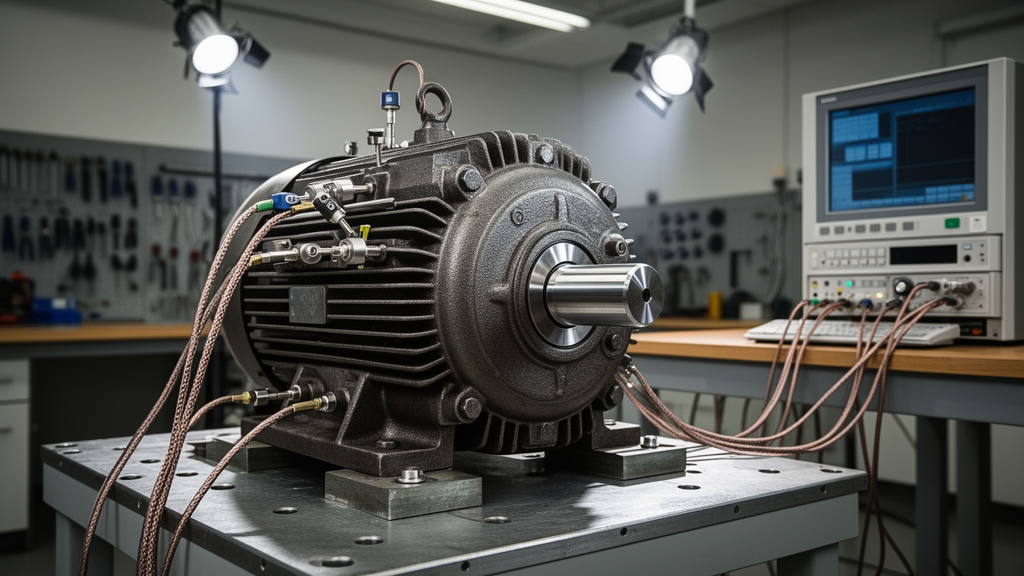
A computational diagnostic framework coupling finite element modeling with machine learning algorithms has achieved high accuracy in detecting and categorizing eleven distinct operating faults within saturated induction motors. Developed to address traditional diagnostic shortcomings where nonlinear core saturation and ambient acoustic or electrical noise can confound predictive models, the research demonstrates that tree-based ensemble classifiers deliver dependable condition monitoring across variable operational disturbances. By integrating magnetic saturation parameters extracted directly from finite element simulations into a dynamic two-phase reference frame, the methodology establishes an advanced simulation pipeline capable of differentiating internal mechanical and electrical defects from normal saturation harmonics without relying on oversimplified linear assumptions.
Industrial plants maintain an urgent operational demand for dependable, continuous fault diagnosis in electrical machinery, as minor operational malfunctions can rapidly escalate into substantial equipment downtime and production losses. Historically, Fourier Transform-based Motor Current Signature Analysis has served as a widely deployed diagnostic mechanism for induction motors across commercial facilities. However, existing literature indicates that signature analysis frequently suffers degraded performance under nonstationary operational conditions because of spectral leakage and the necessity of extended analysis windows. Alternative signal processing strategies, including Wavelet Transform approaches, offer heightened sensitivity to microfaults and transient phenomena, but selecting mother wavelets and decomposition levels generates high-dimensional feature vectors that require elaborate dimensionality reduction schemes to avoid statistical overfitting and preserve real-time computational throughput.
Electromagnetic techniques offer a physically grounded understanding of how evolving faults perturb machine behavior, yet purely analytical electromagnetic models consistently fail to capture the complex nonlinear dynamics and random operational disturbances encountered in practical factory environments. To bridge this divide, researchers have increasingly paired machine learning classifiers with electromagnetic models of electrical machines. Prior studies have applied varied classification models, such as Support Vector Machines, Gradient Boosting, Decision Trees, k-Nearest Neighbors, and Random Forest algorithms, achieving benchmark accuracies spanning modest baselines up to near-perfect detection rates under restricted test assumptions. Additionally, deep learning ensembles and combined convolutional and recurrent neural network architectures connected to finite element simulations have demonstrated high diagnostic accuracy in specialized motor configurations.
Despite these technical milestones, prevailing diagnostic frameworks documented across the literature routinely depend on simplifying engineering assumptions, notably linear magnetic core behavior, perfectly symmetric stator windings, and constant load profiles. Under real-world operation, magnetic saturation within the motor iron core generates specific harmonic components within the internal electromagnetic field. When an automated fault detection algorithm operates under the assumption of magnetic linearity, it can readily misinterpret normal saturation-induced harmonics as physical motor faults, resulting in false alarms or misdiagnosed mechanical failures. Furthermore, the operational resilience of these algorithmic pipelines under variable ambient noise environments has remained largely unquantified, creating substantial performance uncertainty when transitioning from tranquil test environments to noisy operating floors.
To overcome both operational hurdles, the researchers formulated an integrated diagnostic pipeline evaluated under variable noise conditions. The modeling procedure utilizes a two-dimensional cross-sectional Finite Element Method Magnetics simulation controlled via MATLAB to solve Maxwell fundamental equations directly across complex geometries and non-linear materials. The modeled motor architecture comprises a four-pole wound rotor configuration operating from a 220-volt source at a synchronous speed of 1500 revolutions per minute with a 4.3 percent nominal slip. Specific structural dimensions include an inner stator diameter of 150 millimeters, an outer diameter of 240 millimeters, an air gap clearance of 0.5 millimeters, an axial machine length of 140 millimeters, 36 stator slots, and 24 rotor slots, alongside a baseline mechanical loss parameter of 220 watts.
The structural simulation mapped vector potential contours and magnetic flux lines across the cross-section of the motor, emphasizing detailed spatial meshing within the critical air-gap zone. The numerical model extracted essential operational parameters across the motor saturation region, including mutual and self-inductances alongside direct-axis and quadrature-axis magnetic fluxes. These saturation parameters were subsequently inserted into a dynamic d-q reference frame derived via the Park transform, which converts balanced three-phase machine representations into an orthogonal two-phase formulation. The system of differential equations integrated stator and rotor voltage formulations with the mechanical equation of motion, linking electromagnetic torque, friction coefficients, moments of inertia, and shaft resisting torque to accurately trace variable rotor speed transients such as motor start-up, load adjustments, and abrupt braking.
Using this coupled simulation framework, the team modeled eleven operational fault regimes encompassing electrical, mechanical, and combined disturbances over five-second durations. The simulated conditions comprised phase-to-neutral short circuits, line-to-line faults, three-phase short circuits, open-phase occurrences, step load torque rejections, step load increases, overvoltage states, voltage sags, abrupt mechanical braking, supply frequency variations, and harmonic distortion injections. Each fault regime exhibited distinct electrical and mechanical signatures within the simulated data, ranging from rapid linear deceleration and current surges during phase-to-neutral short circuits to total torque collapse during three-phase disruptions and high-density torque oscillations accompanying sudden phase openings.
For feature extraction, the pipeline collected 40,000 samples per second across a total of 200,000 samples per operational parameter, applying a temporal sliding window comprising 80,000 samples with a 120-sample step size. This established a 99.85 percent window overlap with a frequency resolution of 0.5 Hertz, isolating the 50 Hertz fundamental power wave and resolving low-order motor fault sidebands such as 48 Hertz and 52 Hertz. Across 1001 temporal windows per fault simulation, the extraction protocol computed four frequency-domain metrics: dominant frequency, spectral energy, spectral centroid, and total harmonic distortion. To prevent data leakage, standard Z-score global normalization was applied exclusively within the training partitions of a repeated stratified five-fold cross-validation scheme using five distinct repetitions.
Nine distinct machine learning algorithms were trained and evaluated on the normalized feature dataset: Linear Support Vector Classifier, AdaBoost.M2, XGBoost, LightGBM, Logistic Regression, k-Nearest Neighbors, Random Forest, Extra Trees, and Gradient Boosting. Across clean operational conditions, tree-based ensemble architectures dominated overall performance benchmarks. LightGBM achieved the highest overall accuracy at 99.27 percent with a Cohen kappa coefficient of 99.2 percent, closely followed by Random Forest at 99.14 percent accuracy and 99.1 percent kappa, Extra Trees at 99.05 percent accuracy and 99.0 percent kappa, XGBoost at 98.91 percent accuracy and 98.8 percent kappa, and Gradient Boosting at 98.73 percent accuracy and 98.6 percent kappa. In contrast, linear algorithms registered comparatively reduced effectiveness, with Logistic Regression yielding the baseline accuracy of 88.64 percent and a kappa score of 87.5 percent.
Detailed class-level precision metrics confirmed that multiple classifiers achieved flawless 100 percent detection across specific fault categories, including overvoltage, step load rejection, and three-phase short-circuit events. However, certain conditions introduced differentiation challenges; for example, Logistic Regression dropped to 63 percent precision for phase-to-neutral short circuits and 75 percent for open-phase faults, whereas tree-based ensembles maintained precision levels between 98 and 99 percent for those same complex states. Confusion matrix analyses corroborated that tree-based algorithms consistently differentiated between subtle electrical disturbances and load variations without conflating core saturation harmonics with operational electrical failures.
To evaluate operational resilience against industrial background interference, the researchers conducted a comprehensive robustness analysis by injecting Additive White Gaussian Noise across signal-to-noise ratios ranging from 15 decibels to 40 decibels. The evaluation revealed that tree-based ensemble architectures sustained high performance, retaining classification accuracies above 70 percent even within highly corrupted 15 to 40 decibel environments. Conversely, the k-Nearest Neighbors classifier experienced rapid accuracy degradation as noise intensified, while AdaBoost exhibited severe performance instability characterized by erratic accuracy fluctuations across testing intervals. Support Vector Machines and Logistic Regression displayed continuous, near-linear declines in diagnostic precision as ambient noise levels increased.
The findings indicate that pairing finite element parameter extraction with modern tree-based gradient boosted models resolves major diagnostic barriers associated with nonlinear magnetic saturation and background noise interference in induction motor monitoring. By incorporating physical core saturation behavior directly into dynamic fault representations, the framework prevents false alarms while preserving high diagnostic resolution across complex multi-class failures. The research team noted that while numerical finite element modeling provides rigorous theoretical and practical verification of electromagnetic transients, future developmental efforts must validate the automated pipeline using physical experimental measurements collected directly from operational industrial induction machinery.
Subject of Research: Machine learning and finite element modeling for fault diagnosis in saturated induction motors
Article Title: Fault detection and classification in an saturated induction motor based on machine learning and finite element modelling
Article References: Yapele, D., Ngong, S. M., Maxime, F. S., Youmssi, A., Ngasop, N., & Kamgang, J. C. (2026). Fault detection and classification in an saturated induction motor based on machine learning and finite element modelling. Measurement: Energy, 11, Article 100108. https://doi.org/10.1016/j.meaene.2026.100108
Image Credits: AI Generated
DOI: 10.1016/j.meaene.2026.100108
Keywords: induction motors, fault diagnosis, finite element method, machine learning, magnetic saturation, LightGBM, XGBoost, Random Forest, Park transform, condition monitoring, Fourier Transform, signal processing, noise robustness, spectral analysis, electrical engineering, stator winding faults, electromagnetic modeling
Tags: condition monitoringelectrical engineeringelectromagnetic modelingFault Diagnosisfinite-element methodFourier transforminduction motorsLightGBMMachine Learningmagnetic saturationnoise robustnessPark transformRandom ForestSignal Processingspectral analysisstator winding faultsXGBoost