A comprehensive two-year microbiological investigation across all ten traditional cheese-producing microregions of Minas Gerais, Brazil, has revealed that environmental seasonality and operational scale selectively drive contaminant loads in pingo, the natural starter culture used in Minas Artisanal Cheese production. While the beneficial fermentative populations of lactic acid bacteria remained remarkably stable across contrasting seasons and production years, microbial groups associated with spoilage and hygienic risk fluctuated significantly under external pressures. Total coliform bacteria increased approximately tenfold during the wet season, whereas Staphylococcus aureus demonstrated a pronounced season-by-year interaction that caused counts to diverge substantially between consecutive years. These findings indicate that while the core fermentative capacity of natural backslopped cultures is naturally conserved, the microbiological risks to product safety and cheese quality are tightly coupled to temporal patterns and farm operational dynamics.
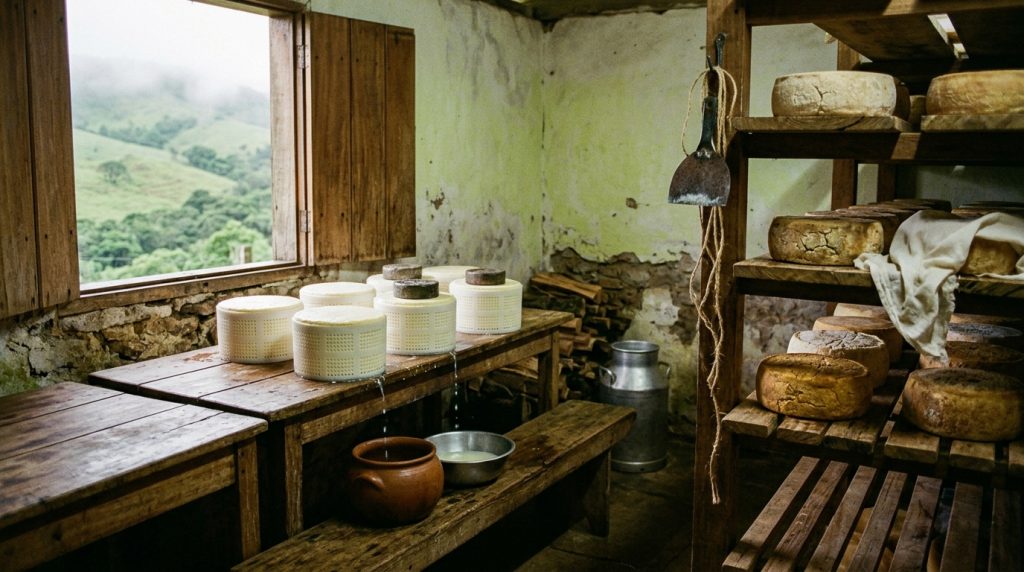
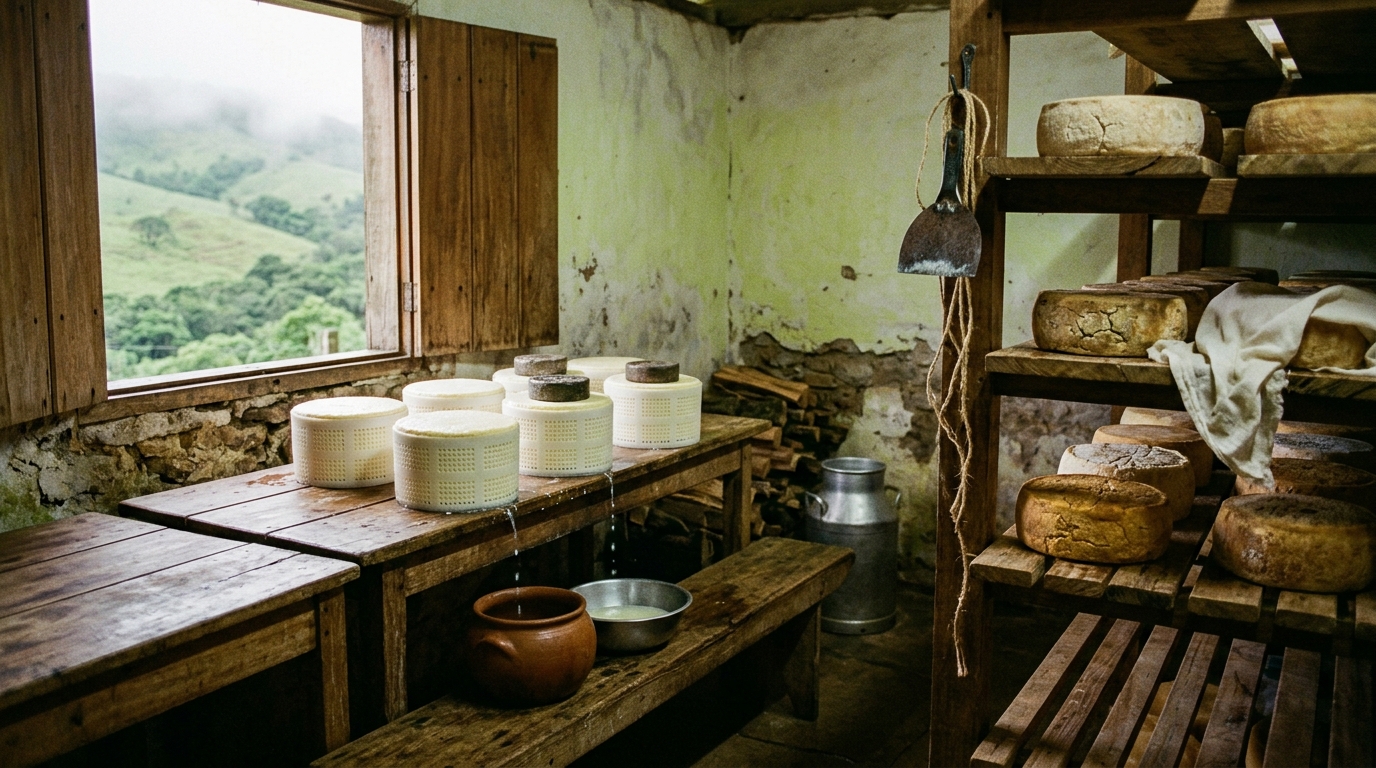
Minas Artisanal Cheese represents one of the most widely recognized and consumed traditional food products in Brazil, made from raw cow milk, salt, rennet, and pingo. In 2024, UNESCO inscribed the traditional manufacturing practices of this cheese onto the Representative List of the Intangible Cultural Heritage of Humanity. The starter culture, known locally as pingo, is an endogenous whey-based preparation obtained through daily backslopping. At the end of the second dry-salting step of cheesemaking, residual whey draining from the curd mass is collected and held at ambient temperature for approximately fifteen hours until it is inoculated into the following morning’s fresh milk. Chemically, pingo is an intricate nutrient broth composed of proteins, lipids, carbohydrates, mineral salts, and vitamins derived from residual whey, all of which sustain microbial growth. However, because pingo originates from open drainage, it inevitably concentrates both technologically beneficial fermentative strains and unwanted environmental contaminants.
To evaluate what governs microbial loads in this traditional starter, researchers executed a longitudinal survey sampling fifty registered cheesemaking units distributed throughout the ten officially recognized producing microregions of Minas Gerais. The study design sampled two hundred pingo collections across four discrete six-monthly campaigns spanning 2024 and 2025, capturing two distinct dry seasons characterized by mild temperatures and low humidity alongside two wet seasons marked by elevated ambient temperatures and rainfall. Each participating cheesemaking facility was sampled repeatedly to assess temporal and management factors, including daily production scale, milking-area hygiene infrastructure, herd size, and daily pingo volume. Units were classified by scale as either small, producing twenty or fewer cheeses daily, or medium-to-large, producing more than twenty cheeses per day, with each standard cheese weighing approximately eight hundred grams.
Laboratory enumerations were conducted under aerobic conditions using standardized selective media and validated alternative plate systems to quantify five key microbial groups. Lactic acid bacteria were enumerated separately on de Man, Rogosa and Sharpe agar to target lactobacilli and on M17 agar to target lactococci and streptococci. Total coliform counts were quantified using chromogenic coliform agar, while yeasts and moulds were enumerated on dry rehydratable film plates, and Staphylococcus aureus was evaluated using specific chromogenic dry plates. Decimal dilutions of fresh pingo aliquots were plated in duplicate, followed by manual colony counting expressed as log-transformed colony-forming units per millilitre. Concurrently, physicochemical parameters were measured directly from each collection, documenting wide naturally occurring variations across the fifty production units, with sample pH spanning from 3.51 to 7.00 and sodium chloride concentrations ranging from 5.4 to 26.5 grams per hundred millilitres.
Statistical evaluations using linear mixed-effects models, with individual cheesemaking units nested within their respective microregions as random effects, established that lactic acid bacteria maintained high and steady densities regardless of environmental fluctuations. Across all samples, median lactic acid bacteria counts reached 7.45 log10 colony-forming units per millilitre on MRS agar and 7.39 log10 colony-forming units per millilitre on M17 agar. These dominant fermentative counts exhibited no statistically significant differences between the dry and wet seasons, yielding seasonal comparison p-values of 0.463 on MRS and 0.457 on M17. Researchers attribute this persistent stability to the selective pressure maintained by daily backslopping cycles, where repeated fifteen-hour fermentations consistently enrich microbial strains that tolerate rapid acidification, high salinity, and tight incubation intervals, ensuring functional starter acidification throughout the entire calendar year.
Despite this general stability among fermentative bacteria, the two culture media revealed distinct associations with farm operational characteristics. Lactic acid bacteria enumerated on MRS agar were significantly associated with the combined effects of production scale and daily pingo volume, a relationship that became statistically evident only when both operational variables were evaluated simultaneously in the mixed-effects regression. Conversely, lactic acid bacteria enumerated on M17 agar showed no association with scale or volume, but differed across geographical microregions, reaching their highest levels in the Triângulo microregion and lowest in Canastra. Because counts between the two growth media showed only a moderate positive correlation with a Spearman coefficient of 0.32, enumerating pingo on a single agar medium provides an incomplete representation of the complex lactic community underpinning raw-milk cheese fermentation.
In sharp contrast to the stable fermentative populations, total coliform counts in pingo were strongly governed by seasonal conditions across both monitoring years. Total coliform densities rose by an estimated 0.99 log10 colony-forming units per millilitre during the wet season, representing an approximate tenfold expansion compared to dry-season baselines. Non-parametric paired testing confirmed this seasonal contrast at high statistical significance, and the pattern was reproduced across the wet-season campaigns of both 2024 and 2025. Two primary physical mechanisms explain this seasonal surge: seasonal rainfall increases muddy conditions in farm holding areas, accelerating mud accumulation and teat soiling during milking, while elevated ambient temperatures during the wet season promote rapid bacterial multiplication during the fifteen hours pingo is stored at ambient conditions prior to morning cheese inoculation.
Fungal populations, consisting of enumerated yeasts and moulds, demonstrated independent additive increases driven by both seasonal conditions and the calendar year. Yeast and mould counts were higher during the wet season, exhibiting an estimated fixed-effect increase of 0.48 log10 colony-forming units per millilitre, alongside a significant independent increase of 0.55 log10 colony-forming units per millilitre in 2025 compared to 2024. Bivariate correlation analyses also revealed a significant positive correlation between total coliforms and yeast and mould counts, with a correlation coefficient of 0.29. In artisanal cheese production, both coliforms and lactose-fermenting yeasts are primary biological agents responsible for early blowing defects, a condition that generates gas pockets, off-flavours, and textural degradation. The concurrent surge of both groups during warm, humid months makes the wet season a critical vulnerability period for commercial cheese quality.
The study’s most complex statistical finding was a substantial season-by-year interaction governing Staphylococcus aureus loads, showing an interaction estimate of minus 2.71 log10 colony-forming units per millilitre. During the 2024 sampling campaigns, S. aureus counts remained virtually identical between dry and wet periods, showing an insignificant difference of only 0.09 log10 units. However, in 2025, counts diverged dramatically by 2.62 log10 units, representing an approximate 400-fold difference in geometric mean counts, with dry-season counts exceeding wet-season levels. Incorporating this temporal interaction substantially improved statistical model performance, lowering the Akaike Information Criterion by 48.4 points and accounting for 39 percent of marginal variance. This interannual divergence indicates that short-term single-year studies cannot adequately characterize staphylococcal dynamics or establish generalizable seasonal risk patterns.
Beyond temporal interactions, Staphylococcus aureus counts were independently associated with operational scale, showing an average increase of 0.61 log10 colony-forming units per millilitre in medium-to-large cheesemaking units compared to small units. This disparity persisted despite herd size failing to improve model fit when added directly. Researchers propose that larger operational scale introduces management complexities, such as extended milking sessions, more extensive labour divisions, and larger milk pooling volumes, which collectively elevate the mathematical likelihood that milk from a cow shedding staphylococci from an intramammary infection enters the bulk batch. Notably, the physical hygiene infrastructure of the milking facility, such as concrete flooring, roof covers, or dedicated milking pits, showed no significant statistical association with counts of S. aureus, coliforms, or any other enumerated microbial group.
Physical and chemical characteristics of the pingo culture likewise exhibited no meaningful regulatory control over microbial densities within the observed production conditions. Natural variations in starter culture pH and refractometric sodium chloride concentration did not correlate with counts of lactic acid bacteria, coliforms, or fungal populations once hierarchical data structures were accounted for. An initial bivariate negative correlation observed between pH and S. aureus disappeared in adjusted mixed models, reflecting confounding by microregional and campaign factors. Because the analyzed samples exhibited wide physiological variation, ranging from highly acidic to neutral pH and spanning broad salt concentrations, these results demonstrate that ambient variations in acidity and salinity do not inhibit contaminant accumulation once undesirable bacteria enter the starter culture matrix.
The authors emphasized key methodological boundaries, noting that culture-dependent plate counts quantify the aggregate abundance of functional groups rather than resolving specific taxonomic shifts or strain diversity. Furthermore, while physical milking infrastructure did not correlate with contamination levels among authorized facilities, unmeasured operational practices such as pre-milking teat sanitization, wash water purity, and storage hygiene likely account for facility-level performance differences. For cheesemakers and agricultural inspection services, these findings indicate that pingo maintains its acidifying potential year-round without requiring recipe adjustments, but high lactic counts provide no guarantee of microbiological purity. Instead, technical support should prioritize seasonally targeted hygiene protocols during wet months and rigorous herd health management to safeguard this traditional artisanal cheese.
Subject of Research: Microbial dynamics and environmental determinants of natural starter cultures in Minas Artisanal Cheese
Article Title: Temporal and production-related determinants of microbial counts in pingo, the natural starter culture of minas artisanal cheese
Article References: Lacorte, G. A., Pereira, D. A., de Araújo, J. P. A., de Freitas, D. S., Silva, G. H. O., de Sá, J. F. O., e Silva Guimarães, J., das Dores, M. T., & Quadros, F. F. (2026). Temporal and production-related determinants of microbial counts in pingo, the natural starter culture of minas artisanal cheese. Brazilian Journal of Microbiology, 57(1), Article 295. https://doi.org/10.1007/s42770-026-02118-0
Image Credits: AI Generated
DOI: 10.1007/s42770-026-02118-0
Keywords: Minas Artisanal Cheese, pingo starter culture, lactic acid bacteria, Staphylococcus aureus, total coliforms, yeasts and moulds, backslopping fermentation, seasonal microbiology, raw milk cheese, food safety surveillance, linear mixed-effects models, dairy herd health, milking infrastructure, production scale, early blowing defect, Minas Gerais dairy
Tags: backslopping fermentationdairy herd healthearly blowing defectfood safety surveillancelactic acid bacterialinear mixed-effects modelsmilking infrastructureMinas Artisanal CheeseMinas Gerais dairypingo starter cultureproduction scaleraw milk cheeseseasonal microbiologyStaphylococcus aureustotal coliformsyeasts and moulds