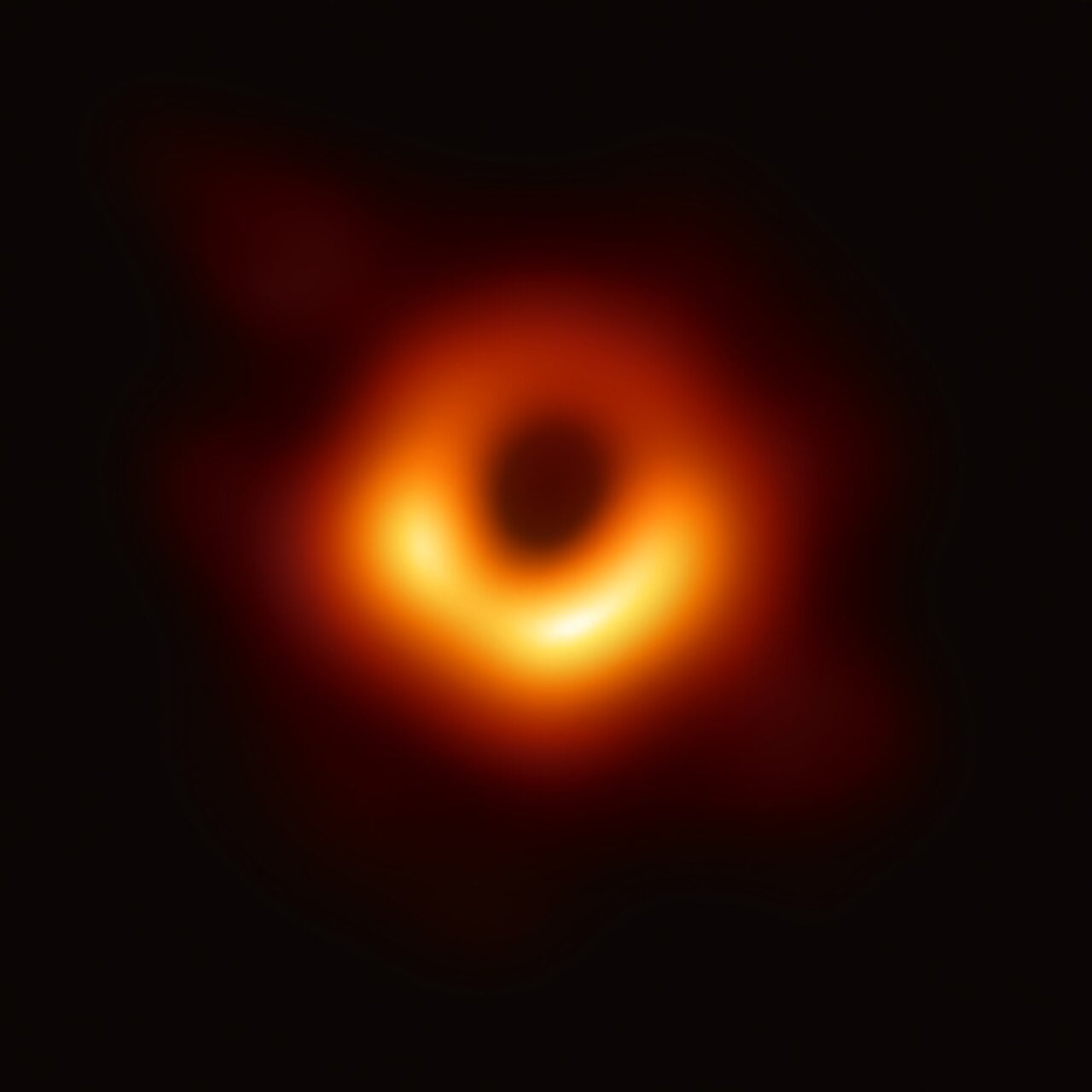
Here’s something that might stop you in your tracks. Black holes have a temperature! Just think about that.. We are not talking about the temperature of the material swirling around them, that’s just superheated gas. The black hole itself, the empty region of distorted spacetime, radiates heat. It was one of Stephen Hawking’s most startling insights, and it opened up a deeply strange question.. If black holes have temperature and entropy, do they also behave like ordinary matter? Can they undergo phase transitions, like water turning to steam?
The answer, it turns out, is yes. And a branch of mathematics you might not expect is now being used to understand why. That branch is topology.
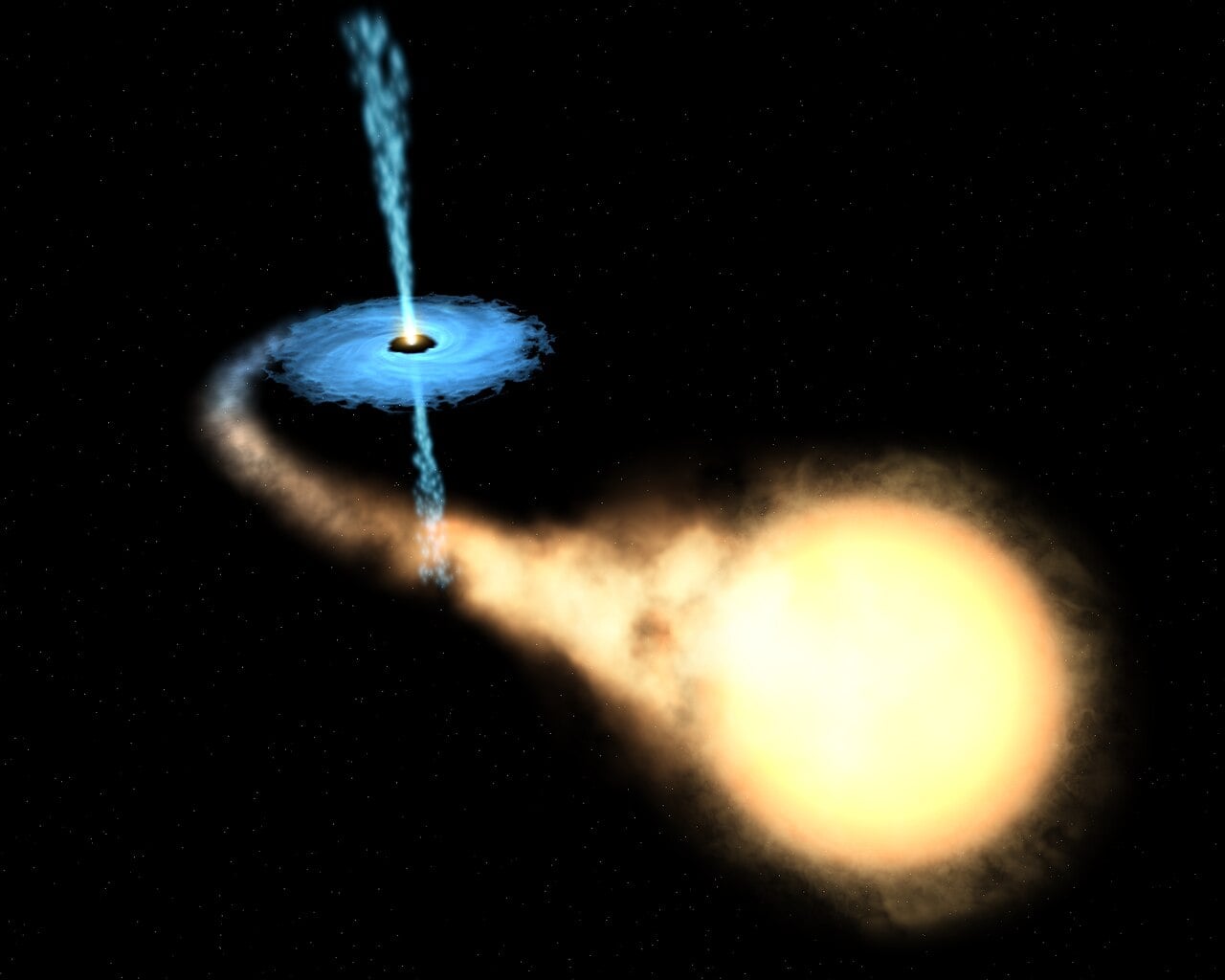 Artist’s conception of a black hole drawing matter from a nearby star, forming an accretion disk. The study reveals that the black holes themselves, not the accretion disks exhibit temperature (Credit : ESA/Hubble)
Topology is the study of shapes and their properties, but not in the way you might picture geometry. Topologists aren’t interested in precise measurements, instead they care about properties that survive even if you stretch, bend, or deform an object beyond recognition. A coffee mug and a doughnut are topologically identical because both have exactly one hole. A sphere and a cube are the same. What matters is the deep underlying structure, not the surface details.
Applied to black holes, the idea is both elegant and powerful. Physicists construct mathematical landscapes from the thermodynamic properties of a black hole: temperature, entropy, pressure. They then look for special points within those landscapes where the mathematics essentially zeros out. These zero points act like defects in the fabric of the thermodynamic description, a bit like the eye of a storm where the usual rules break down. By analysing how the mathematical field wraps and winds around each of these points, researchers can assign each one a topological charge, a number that captures something fundamental about its nature.
Add up all those charges and you get a single global number, a topological fingerprint that describes the black hole as a whole. And here’s where it gets interesting. Different types of black holes turn out to have different topological numbers. The simplest black hole, a Schwarzschild black hole with no charge and no rotation, belongs to a different topological class from a charged Reissner-Nordström black hole. These aren’t just mathematical curiosities, the topological class tells you something about the stability of the black hole, which branches of its behaviour are physically real, and how it transitions between states.
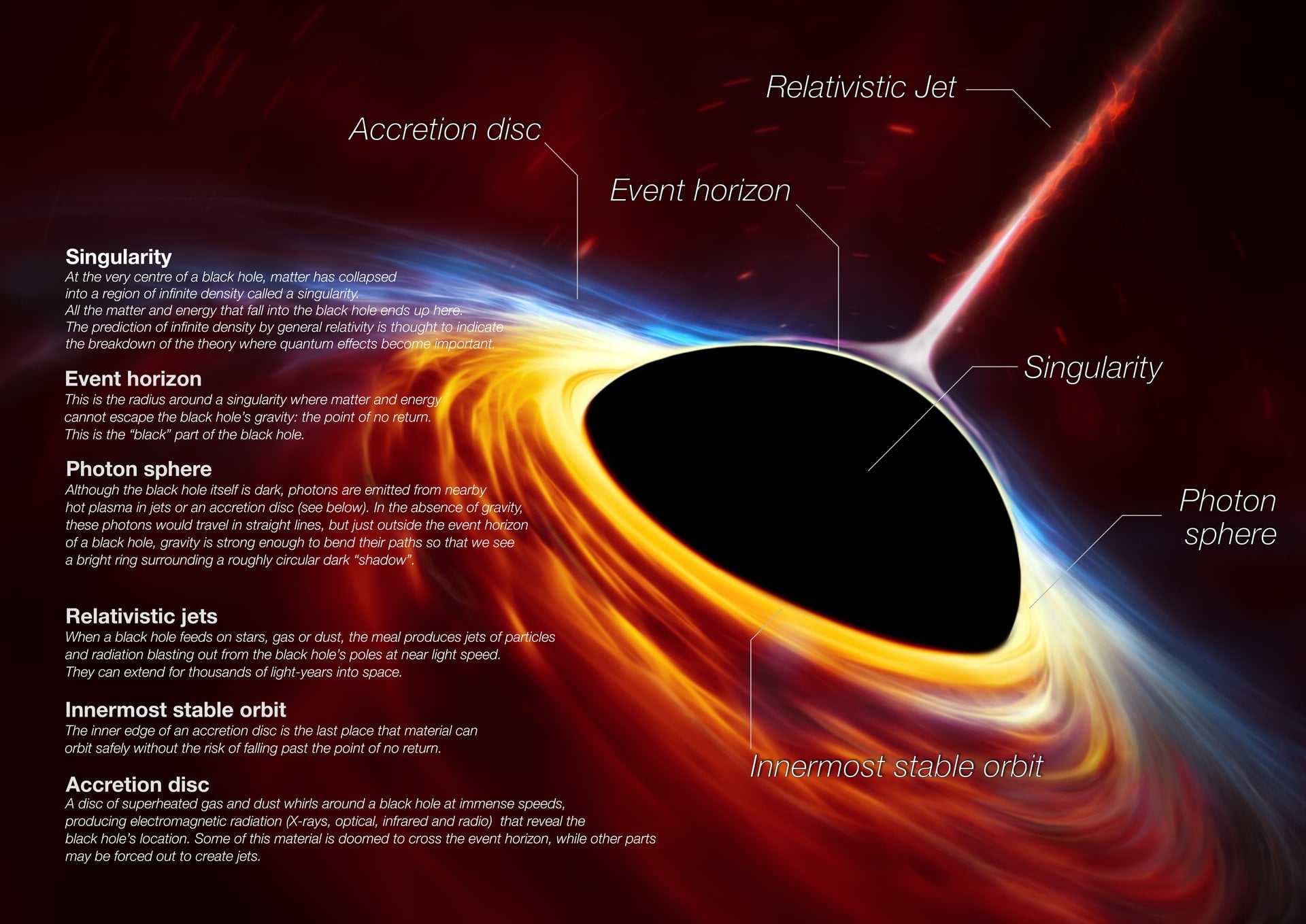 Illustration of the anatomy of a black hole (Credit : European Southern Observatory – ESO)
What makes this approach genuinely exciting is its robustness. Local details like the exact charge, mass, or rotation of a black hole can change without altering the global topological number. That universality suggests the topology is capturing something deep and invariant about the nature of black holes, something that persists regardless of the specifics.
The same mathematical tools have since been applied beyond black holes themselves, to the rings of light that orbit them, to the way they bend passing starlight, to the temperature of their radiation. Each time, topology reveals structure that other methods miss.
The ultimate prize is quantum gravity, a theory that reconciles general relativity with quantum mechanics, two frameworks that currently refuse to fit together. Black holes sit precisely at the boundary where both theories are needed and neither fully works. If topology can help map that boundary, it may turn out that the shape of the mathematics is the key to unlocking the deepest physics of all.
Source : Topology sheds light on the nature of black holes