
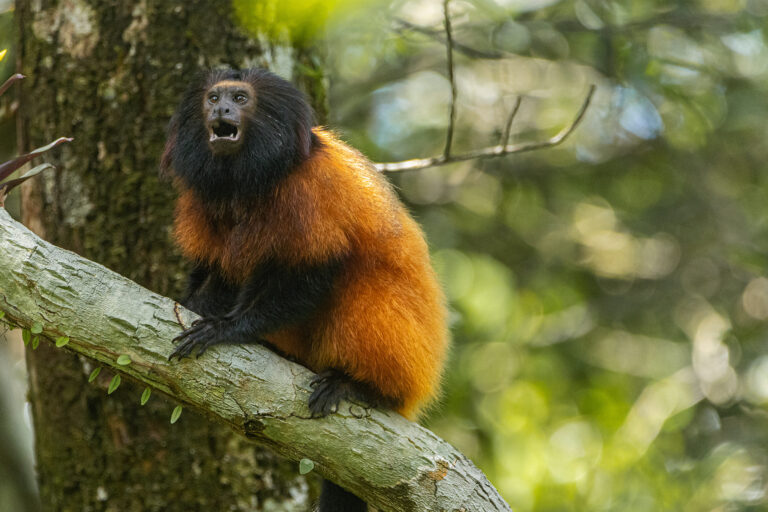
On a Wednesday in July, deep in a coastal restinga area of Brazil’s Paraná state, muffled footsteps broke through the chirping of manakins. Three field researchers from the conservation NGO Society for Wildlife Research and Environmental Education (SPVS) moved carefully along a trail, each carrying a small cage covered in a dark cloth. Each cage held a black-faced lion tamarin, known locally as the caissara lion tamarin (Leontopithecus caissara). Captured safely from the canopy, the three small primates — two males and one female — were carried to a makeshift tent in a forest clearing, where they would make history. Within hours, they would become the first of their species to be vaccinated against yellow fever. A team of researchers and veterinarians was waiting, quickly transferring each tamarin into a cotton bag to be weighed, starting a race against the clock to protect one of Brazil’s most threatened mammals. L. caissara is one of four lion tamarin species endemic to the Atlantic Forest; it ranks among the world’s rarest primates. First found and described by science in 1990, its wild population was estimated at just 392 individuals in a 2011 study. Most tamarins are confined to coastal restinga areas along the São Paulo-Paraná state border. A Society for Wildlife Research and Environmental Education veterinarian examines a sedated black-faced lion tamarin. Image by Gabriel Marchi. The species’ already restricted range has also been fragmented for decades. Part of the problems started with the Varadouro Canal, a 6-kilometer (3.7-mile)-long, 50-meter (164-feet)-wide artificial…This article was originally published on Mongabay