A black hole merger is one of the Universe’s more energetic, massive, and weird events. During such a collision, two black holes orbit closer and closer until they collide and become a much more massive black hole. The event can emit neutrinos, photons from energized gases, and, as it happens, gravitational waves. Those waves help tell the story of the two objects involved in the collision.
Recent gravitational wave detections show hundreds of such mergers in the Universe. Many probably came from collisions of black holes created when massive stars died in supernova explosions. That’s the standard story we all learn about the deaths of supermassive stars—the creation of stellar black holes. But what happens to them afterwards? Those “smaller” black holes can merge again, creating a more massive black hole. And it could happen again, making larger and more massive objects in a process called “hierarchical merging.” It’s most likely happening in very crowded regions of galaxies.
A team of scientists including MIT’s Salvatore Vitale and Cailin Plunkett, Thomas Callister of Williams College in Massachusetts, and Michael Zevin of Chicago’s Adler Planetarium, is studying gravitational wave signals to see if this pathway is legitimate. According to Plunkett, the data show some intriguing results. “We’re finding that, for some of these merging black holes, it’s not their first rodeo,” said Plunkett. “Overall in the Universe, black holes are merging all the time. The question of how often they are repeatedly merging was pretty uncertain. Now we’re seeing a relatively consistent picture where there’s a decent percentage of black holes that are coming from this repeated pathway.”
How To Tell If It’s a First Merger or Not
The clues to the provenance of black holes in a merger lie in their spins. Think of the spin of a disk around a newly forming star. It has angular momentum. Some black holes have spin; others do not. A “first-time” black hole created in a supernova event creates a black hole with little to no spin. That’s because when the progenitor star dies, it loses much of its mass as well as its own spin. The resulting black hole shouldn’t have much spin, either.
According to Vitale, the scene changes when two black holes merge. It’s a more energetic event, and the collision should result in a second-generation black hole with a definite spin. “They would be spinning very fast, at about 70 percent their maximum possible spin,” Vitale said. That spin reveals the new black hole’s lineage, from two smaller ones. So, astronomers might start out looking for a duo of black holes about to collide. If one has a very high spin rate than its dance partner, then observers are looking at a pair where one black hole came from a collision of two smaller black holes.
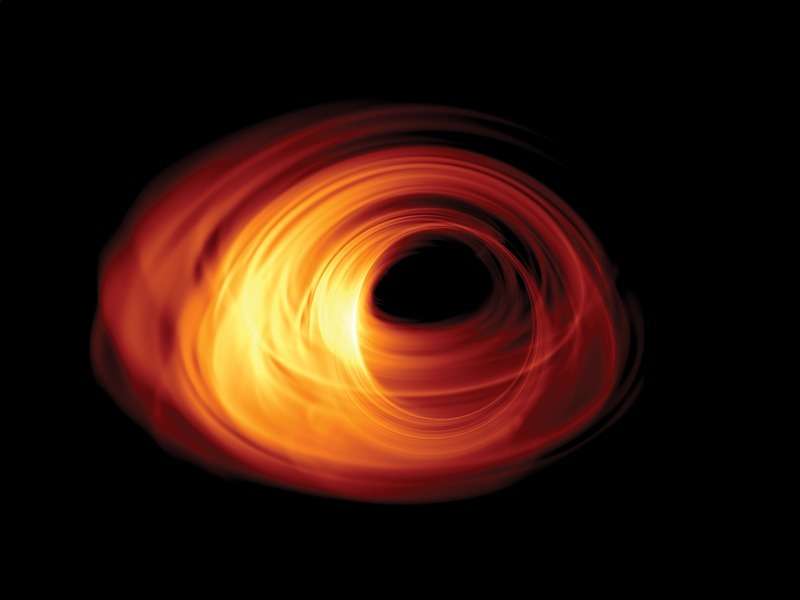
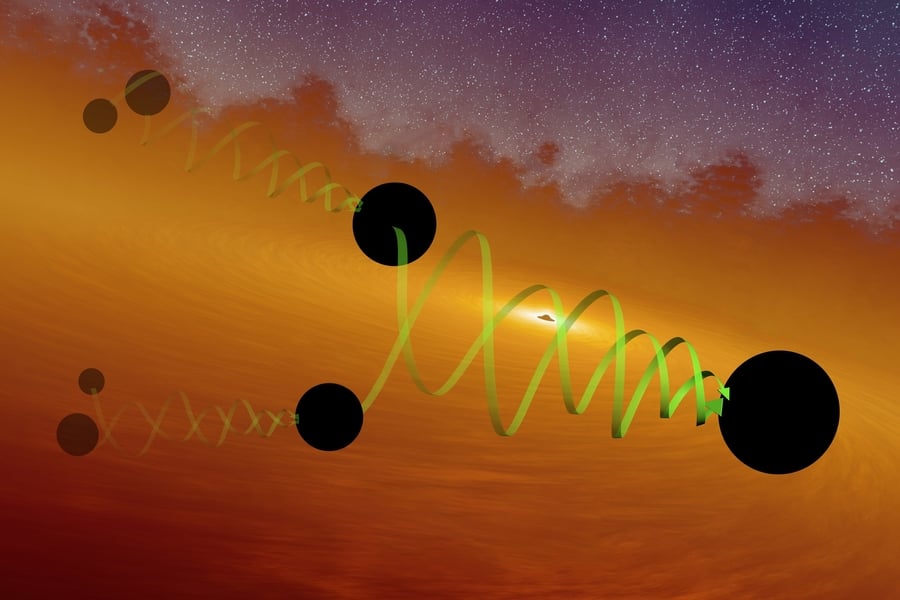 Some merging black holes may be second-generation black holes that formed from the previous merging of two smaller black holes, according to a new study. Here’s an artist’s concept of the hierarchical formation of black holes. Credits: Credit: LIGO/Caltech/MIT/R. Hurt (IPAC)
Where Does This Happen?
Stellar-mass black holes can happen anywhere supermassive stars are dying in supernova explosions. But hierarchical mergers likely occur in very crowded environments. These are regions where stars are packed closely together—such as in clusters. “You might have a ton of stars whizzing around each other, and if some are massive and explode, they become black holes. The black holes continue to whizz around, and can capture each other and merge,” explained Plunkett. “This process can repeat potentially ad infinitum, by virtue of the fact that you have a ton of stars and black holes in this really dense environment.”
To find evidence of hierarchical mergers, the team looked at data in the LIGO-Virgo-KAGRA Gravitational Wave Transient Catalog (GWTC-4.0). This is a collection of data tracing gravitational wave detections made during the combined observatories’ fourth observing run. They looked for signals typical of hierarchical mergers of black holes. Specifically, the team wanted to catch the action just before the merger actually happens. It’s an interesting time. The black holes are spiraling in toward each other in a disk-like orbital plane. If their spins are perpendicular to the plane, the process of merger is fairly steady. But if the spins aren’t perpendicular, the disk takes on a distinct wobble. The wobble reveals information about the balance of the masses of the two black holes and their spins.
What the Collisions Reveal
Analysis of the data revealed numerous mergers that showed orbital wobbling that was likely caused by the collisions between first-generation and second-generation black holes. Extrapolate that out to mergers throughout the Universe, and it looks like about 14 percent of merging black holes have been down the same collision road at least twice. It turns out that black holes that have masses about 10 and 30 times that of the Sun were probably stellar-mass black holes created in supernova explosions. Interestingly, those of 20 and 40 solar masses (and above) were most likely to be second-generation black holes made from collisions of previous black holes.
How does that play out with the evolutionary story of the supermassive stars that form black holes? Plunkett points out that the violence of the supernova explosions may play a role. “One of the reasons why the 40-and-above regime is interesting is, stellar evolution theory predicts you shouldn’t be able to form black holes in that mass range at all from just a supernova,” Plunkett said. “We think supernovae from really massive stars end up being so violent that they leave no black holes at all above roughly 45 solar masses. Yet, we have seen black holes that are that massive. And the question is: Where did they come from?”
That’s a question that remains to be answered. In the meantime, this hierarchical merging of black holes over time may well explain some of the weirder black holes astronomers have discovered. Linking the black-hole mass spectrum to features in the spin distribution is a good way to identify the history of potential merger candidates as well as to understand the characteristics of existing black holes that exhibit strange spins. In the long run, studies of these characteristics will help astronomers tell the story of black hole evolution across the Universe.
For More Information
Many Black Holes Had Past Lives New Research Shows
Signatures of a Subpopulation of Hierarchical Mergers in the GWTC-4 Gravitational-Wave Dataset
Signatures of a Subpopulation of Hierarchical Mergers in the GWTC-4 Gravitational-Wave Dataset