
How to phase labor management so the operation stays stable and people trust their numbers. For manufacturing, retail and supply chain operations leaders.
ITORIZON INSIGHTS
Labor comes up early in most of our design conversations, because of margin. Procter & Gamble’s Supply Chain 3.0 program targets up to $1.5 billion a year in cost-of-goods savings, and 60% of consumer-sector CEOs rank cost management as a top priority. Three pressures come up at most kickoffs:

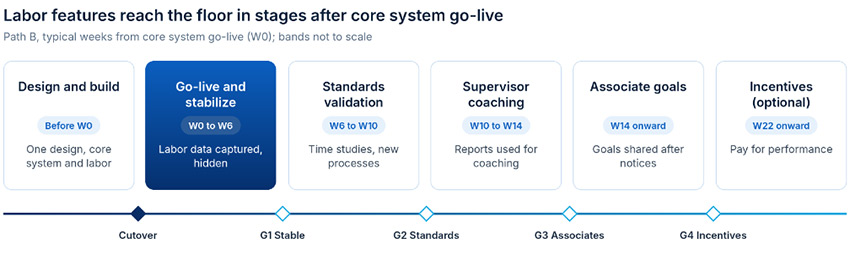
Design labor and the core system together, go live with the core system first, and bring labor management to the floor in stages. Turn data capture on at day one, and hold back associate goals until the operation is stable and standards are proven. Same answer on both platforms we implement:
- Distribution and retail DCs. Manhattan WMS runs the work, and Manhattan LMS sets and tracks engineered standards.
- Manufacturing. Oracle Fusion manufacturing modules run production and hold the routing standards, and Oracle Fusion WFM handles time, scheduling and labor tracking.
Every standard is built from transactions: picks in Manhattan WMS, work orders and changeovers in Oracle Fusion manufacturing. While those are still settling, the numbers are wrong.
New process, new standards. Directed work, new slotting or a new line layout make a different operation, and old standards won’t fit it.
Early data is noisy. People are still learning and exceptions run high, so early numbers understate the team.
Trust is slow to come back. Associates who see bad numbers in month one doubt the system long after.
- Too much at once. People are measured against goals they don’t trust while still learning. Recovery drags: missed OTIF in distribution, late orders in manufacturing, short store deliveries in retail.
- Too little, too late. Labor becomes its own project and loses its sponsor, and go-live shortcuts (usually missing activity codes) get fixed later at higher cost.
Either way it is one design and one program; only the timing changes.
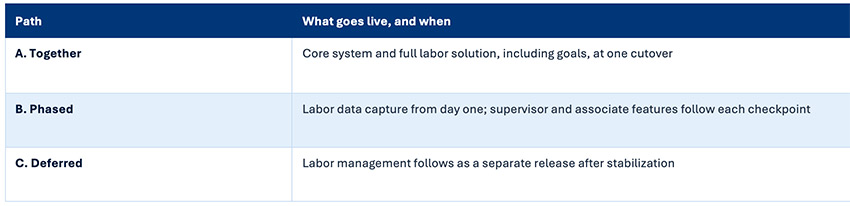
To pick a path, we score each site on nine readiness factors, from savings urgency and process change to labor relations and timing against peak.
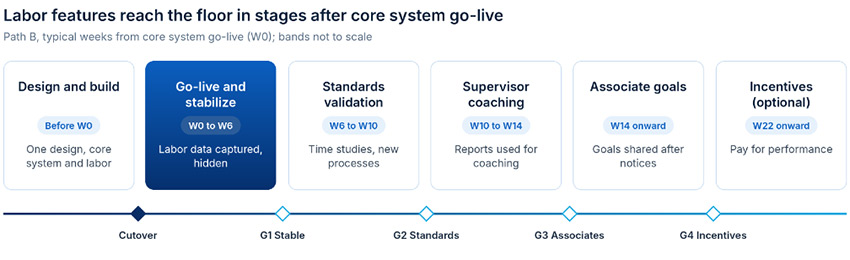
On Path B the core system goes live once, and each labor feature waits for its checkpoint.
- Fund one program with one design. Labor added after go-live means rework. Define activity codes, indirect labor codes and clock-in events in the design, and build the timekeeping and payroll interface alongside them.
- Capture labor data from day one, and share it in stages. The baseline builds while the site settles, so phasing costs weeks, not quarters. Turn capture on at cutover, let supervisors coach from reports first, and release associate goals as each checkpoint passes.
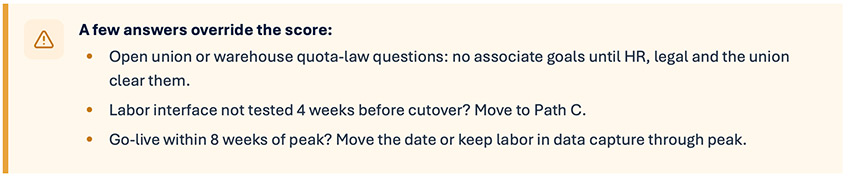
- Score every site. A proven template lowers integration risk, but every workforce is different. Score each site, rollout sites included, and let override rules win.
- Plan the people side from design. Acceptance, more than technology, sets the pace. Bring HR, legal and any union in during design, and check whether state warehouse quota laws cover your DCs (they generally exclude production floors). Start high-turnover sites with coaching-style goals, and set goals by crew on machine-paced lines.
- Plan backward from peak. Hypercare and time studies both need quiet weeks. Leave about 16 weeks between go-live and peak, and if the date slips, freeze labor features until after peak.
- Protect industrial engineering time. Time studies start around week 4, before standards sign-off, so keep engineers off the hypercare rota by then.
- Clean master data before cutover. Standards come from item dimensions, weights and pack configurations in DCs, and routings and cycle times in plants. Bad data there turns into goals associates see as unfair, and they will be right.
- Judge the program on trusted labor data. Agree checkpoint targets with the business up front (say, 99.5% inventory accuracy, standards covering 85% of direct hours, time studies within ±10%) and report against them.
About ITOrizon
ITOrizon is an Atlanta-based supply chain consulting and systems integration firm, founded in 2013. It implements Manhattan Associates, Oracle, Blue Yonder and Hardis Group platforms for more than 80 customers in over 15 countries.
Learn more at itorizon.com.
The goal is a workforce that trusts its numbers, not just a system that has gone live