
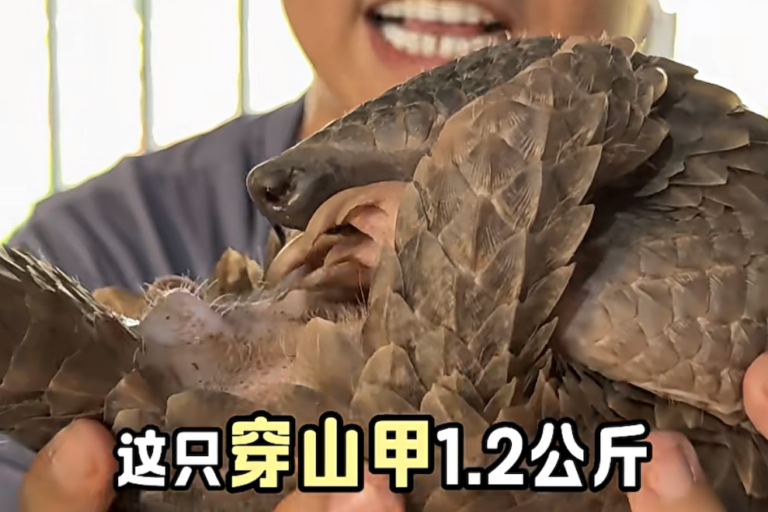
“The wet markets in Laos are like wildlife parks; however, while you can only look at the animals in our zoos back in China, the wild animals in Lao markets can be eaten.” So proclaimed a Chinese vlogger as he toured a wildlife market. As he explored, he filmed himself showing off bear paws, various birds, dried rats, monitor lizards, and a live pangolin in his hands. The Chinese Embassy in Laos has issued repeated warnings to citizens that “Lao law prohibits the sale of ivory, rhinoceros horns, pangolins, and other wildlife products. Violators will be punished by law.” But vloggers continue to imply, incorrectly, that such sales are legal. “Brothers, look at what this is. This is not a zoo, but a wet market in Laos. The owner just weighed it and said it’s 3.3 kilograms for 1,200 Chinese yuan [about $54 per kilo or $24.60 per pound]. Back in China, let alone 3.3 kilograms, even for a single scale, you would have to go to jail,” he added, referring to the pangolin. Videos like this are easily found on Chinese social media platforms — WeChat Channels (known as Weixin Channels in mainland China), Douyin, and Xiaohongshu — using Chinese search terms like 老挝穿山甲 (Laowo chuanshanjia or Lao pangolin); 老挝野味 (laowo yewei or Lao wild game); and 老挝熊掌 (Laowo xiongzhang or Lao bear paw). With the opening of the China-Laos Railway in 2021 and the lifting of China’s pandemic lockdowns in early 2023, Laos has become a top choice…This article was originally published on Mongabay