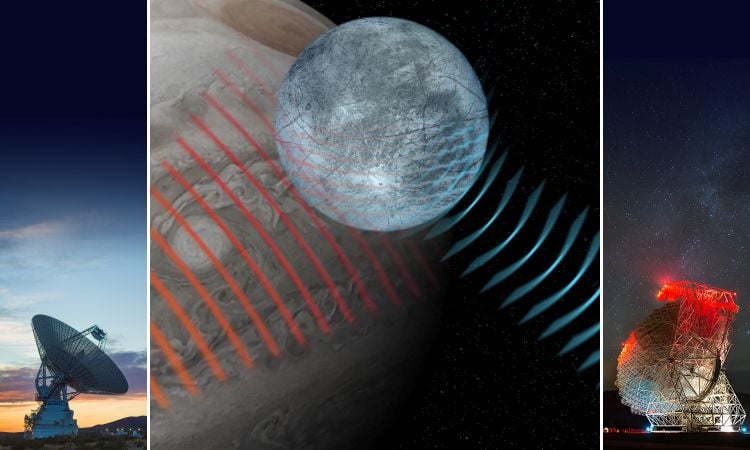
Jupiter’s moon, Europa, has become high-value real estate for astrobiologists and the search for life beyond Earth. This is because the small moon, which is slightly smaller than Earth’s Moon, boasts a massive subsurface ocean of liquid water that scientists estimate contains about double the amount of water of all Earth’s oceans combined. As seen on Earth, water equals life, so scientists are eager to continue to explore Europa in any way possible to determine if it could harbor life as we know it, or even as we don’t know it.
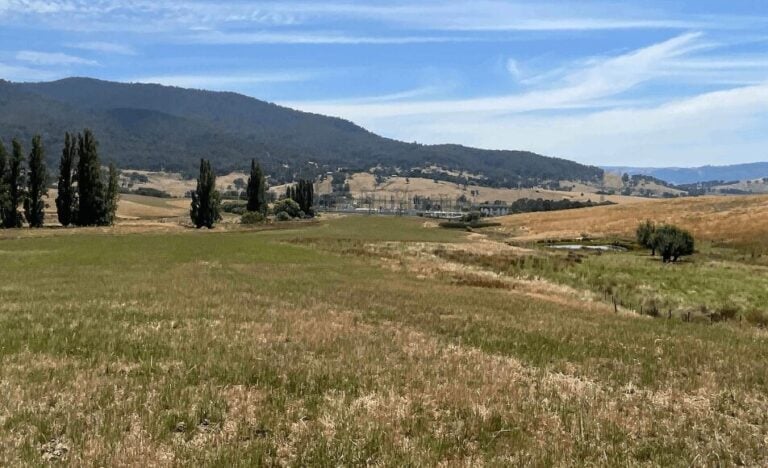
With NASA’s Galileo spacecraft being the last spacecraft to explore Europa in depth in 2003, scientists have had to rely on other methods for studying the small moon. This includes using ground-based instruments for studying Europa’s icy surface, which are discussed in a recent study presented at the American Astronomical Society’s 248th meeting earlier this month.
For the study, the researchers used a combination of NASA’s Goldstone Solar System Radar and the U.S. National Science Foundation Green Bank Telescope (NSF GBT) to conduct a 13-year study from 2011 to 2024 to ascertain how Europa’s icy surface reflects radar signals. The goal of the study was to address a decades-long knowledge gap regarding the radar properties of Europa, with the last study occurring from 1987-1991 also using the Goldstone Solar System Radar, but this time in combination with the Arecibo Observatory.
*Video discussing the Europa radar study, which begins at 11:14*
In the end, the researchers found that Europa’s surface brightness using radar, also called radar “albedo”, is much higher than other solar system planetary bodies, which also runs parallel with the 1987-1991 study. Additionally, the finding confirmed that Europa’s icy surface acts more like a mirror than a reflective surface as observed with other solar system planetary bodies.
Finally, the findings confirm the existence of an optical and radar phenomenon known as the coherent backscatter opposition effect (CBOE), which has been used to explain why Europa and other Galilean moons, specifically Ganymede and Callisto, have surfaces that are brighter than other solar system objects.
CBOE has been found to exhibit high radar reflectance signals when it passes through substances like pure water ice, thus increasing the evidence that all three of these moons potentially possess liquid water subsurface oceans. This study also demonstrated the accuracy and efficiency of using ground-based instruments to study planetary objects so far away.
“Future planetary science and space flight missions, like NASA’s Europa Clipper, could benefit from this type of radar science,” said Dr. Will Armentrout, who is a scientist at the Green Bank Observatory and a co-author on the study. “As the Green Bank Telescope’s radar capabilities evolve, with new technologies currently under development, we’re looking forward to providing even more radar capabilities for the scientific community.”
This study comes as NASA’s Europa Clipper is currently in its cruise phase towards Europa with an estimated arrival date of April 2030 after being launched in October 2024. Upon its arrival, Clipper will begin orbiting Europa in the spring of 2031 a science mission of almost 50 flybys, of which will be conducted through elongated orbits. This is to prevent the spacecraft from being exposed to Jupiter’s magnetic field, which emits powerful radiation that could damage spacecraft components. The primary goal of Clipper will be to determine if Europa contains the necessary ingredients for life, specifically liquid water, an energy source, and the chemical building blocks.
Discovered by Galileo Galilei in 1610, Europa was first imaged by NASA’s Pioneer 10 and Pioneer 11 spacecraft during their flybys in 1973 and 1974, respectively. This was later complemented by NASA’s Voyager 1 and Voyager 2 spacecraft during their flybys in 1979. However, it wasn’t until 1995 that NASA’s Galileo spacecraft orbited Jupiter, imaging Europa in incredible detail while obtaining data that confirmed the existence of a subsurface liquid water ocean based on readings from Galileo’s magnetometer instrument.
How will this ground radar study help Europa Clipper learn about Europa, and what new insights into Europa will researchers make in the coming years and decades? Only time will tell, and this is why we science!
As always, keep doing science & keep looking up!