
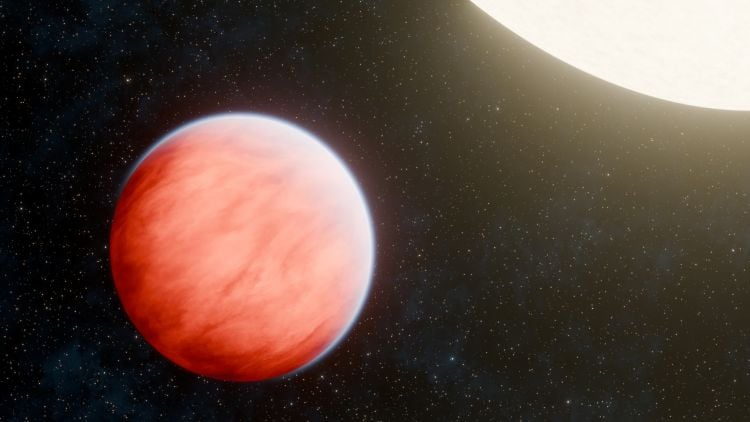
Hot Jupiter exoplanets have completely changed how we look at the universe. This is because before the first exoplanet orbiting a Sun-like star was discovered in 1995, 51 Pegasi b, astronomers theorized every solar system looks just like ours: rocky planets orbiting close to the Sun and gas giants orbiting farther away. In contrast, 51 Pegasi b, whose mass is half of Jupiter and radius is about one-quarter larger, was found to orbit its star in just over 4 days.
It is this low mass-to-radius ratio that puzzled astronomers since 51 Pegasi b’s atmosphere was bloated compared to its size due to the extreme temperatures. Also, due to their close orbits, hot Jupiters have also been found to be tidally locked to their stars, meaning their dayside and night sides are drastically different temperatures. They have also been found to have their heat focused on the dayside in a “hot spot”.
Now, a team of international researchers are giving hot Jupiters another reason to blow our minds. In a study recently submitted to The Astronomical Journal, they discuss the hot Jupiter CoRoT-2b which orbits a Sun-like star in just 1.7 days while being about 3.5 times as massive as Jupiter but a radius only about half as larger. Like 51 Pegasi b, CoRoT-2b puzzles astronomers due to its bloated atmosphere but heavy planetary size. Additionally, unlike the tidally locked characteristic exhibited by other hot Jupiters, CoRoT-2b is not tidally locked to its star, along with its hot spot being located on the opposite side of the planet, as discussed in a 2018 study published in Nature Astronomy.
For the study, the researchers analyzed data obtained from ground-based telescopes, most notably the European Southern Observatory’s Very Large Telescope (VLT) in Chile, to better understand the peculiar characteristics of CoRoT-2b. The researchers focused on collecting data during the time period when CoRoT-2b before and after the exoplanet immediately passes behind its host star, also called pre- and post-eclipse phases.
After careful analysis, the researchers concluded that CoRoT-2b is rotating backwards compared to typical hot Jupiters. Additional calculations determined that one day on CoRoT-2b is twice as long as its year, meaning its rotation is slower than its orbit. This hypothesis was one of three proposed hypotheses discussed in the 2018 study.
“Now we can see that a one-size-fits-all model does not work, even for planets that we’ve been studying for a long time,” said Dr. Aurora Kesseli, who is a staff scientist at IPAC at Caltech and lead author of the study. “Every time we look at another hot Jupiter, we learn something new to help refine our models, which are useful for understanding not only hot Jupiters, but for all types of exoplanets.”
As noted, hot Jupiters contradict and challenge our long-time understanding of solar system architecture, specifically since our own solar system features gas giants orbiting much farther away from our Sun. Almost immediately after 51 Pegasi b was first discovered more than 30 years ago, scientists questioned how hot Jupiters orbited so close to their stars?
The current hypothesis is they initially formed much farther out in their solar system and migrated inward while the solar system was still young and in its protoplanetary disk phase, meaning it’s comprised of a large amount of gas and dust that could eventually form other planets. The question then becomes why our own Jupiter didn’t migrate inward, with the simple answer being the formation of Saturn caused a gravitational tug-of-war between the two planets, essentially locking them in their respective orbits we see today.
What new insights into CoRoT-2b and other oddball exoplanets will researchers make in the coming years and decades? Only time will tell, and this is why we science!
As always, keep doing science & keep looking up!