
Artificial intelligence (AI) is a pervasive topic across the energy industry, and for plenty of good reasons. We’ve recently explored how to enable utility-grade AI and what it means to put the technology to work for solar, highlighting the value AI can unlock for modern utility workflows.
However, adoption requires teams and entire departments to answer practical questions about their individual usage of AI. How will the technology create operational efficiencies? What does it mean to avoid deploying tech for tech’s sake? How can AI reshape long-term grid planning? And how can teams automate certain processes while keeping humans in the loop?
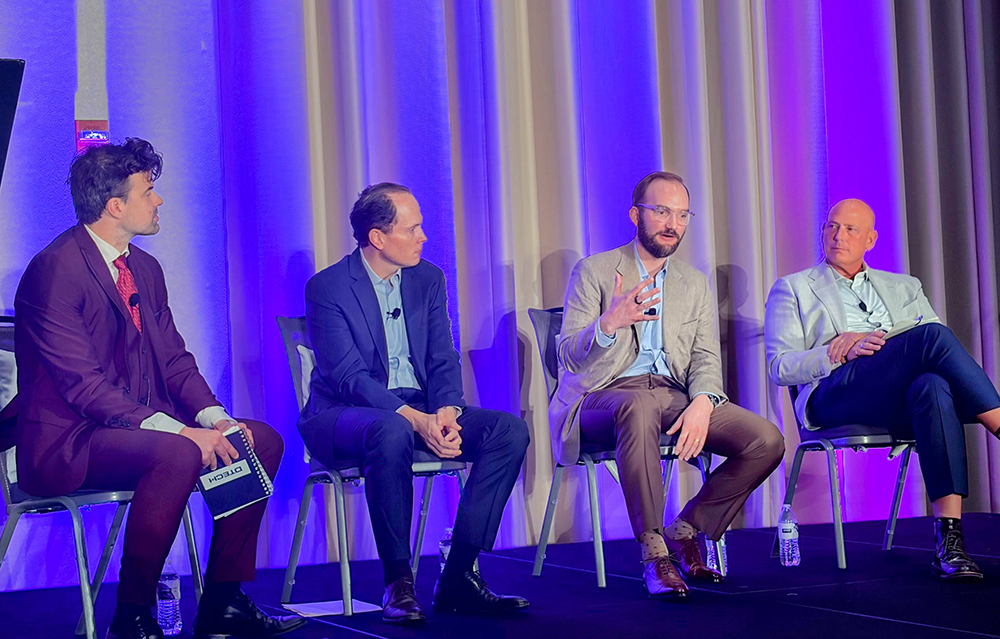
To answer those questions, utilities like Exelon are partnering with institutions like Argonne National Laboratory and solution providers like S&C Electric Company to deploy utility-grade AI in ways that are actively supporting established efforts- everything from weather prediction to resolving interconnection queues. They’re the sorts of specifics that defined the Thursday keynote on August 27th at DTECH Reliability & Resiliency in Chicago.
Tom Wall from Argonne National Laboratory, Joe Matamoros from S&C Electric Company, and Tim Krall from Exelon participated in a panel that outlined a roadmap for utilities of all sizes to operationalize AI. They detailed the practical processes and approaches that enable power providers to successfully leverage AI, showcasing how and why success with it is ultimately more about teams and people than it is technology and possibility.

In his opening address, Matamoros, chief product development officer at S&C Electric, explored why resilience is becoming the cornerstone of next-generation grid planning and investment. He outlined why building a resilient grid is about much more than prepping for the next severe storm, as it requires designing flexible infrastructure that innovations like AI can further augment. These efforts are transforming how utilities measure reliability to meet the shifting demands of today’s energy consumers.
“Reliability is the outcome our customers expect,” Matamoros said. “Resilience is the capability that allows the grid to deliver that outcome, even under difficult conditions. A resilient grid prepares for changing environments, adapts when things go awry, responds intelligently to disruptions, and recovers faster and safer.”
Achieving that level of resilience requires utilities to do more with less, and technology like AI can directly support such efficiencies. However, that success means being able to get specific with where and how the technology can make a difference, which can require a new way of thinking about established tasks or processes.
For example, advancements in AI have changed predictive weather modeling from short-term 14-day outlooks to 90-day seasonal forecasts, reshaping flood modeling and capital expenditure strategies. But what does it mean for teams to both use and trust these capabilities?
One of the most important breakthroughs for utility-grade AI is machine-learning algorithms that can augment modeling efforts. These predictive tools can extend planning horizons while simultaneously processing tens of thousands of probabilistic scenarios. Instead of evaluating just a handful of forecasts over a standard two-week window, researchers and engineers can now analyze thousands of climate and grid permutations across an entire season in a fraction of the time.
While power providers have historically been cautious about machine-learning forecasts, the speed and precision of these modern algorithms are reshaping industry perspectives.
“I’m a non-practicing meteorologist by training, and I used to be skeptical about AI from a modeling perspective,” said Krall, who is director of advanced analytics & AI at Exelon. “But I’ve seen how powerful these models can be, so I do think it’s going to be vital for us, not just for near-term applications like outage prediction, but for broader grid reliability. It’s why we’re adopting a seasonal lens for condition-based maintenance and broader asset health, and it’s very exciting to see where this technology is heading.”
Krall talked through what it has meant to prove the difference the technology can make with targeted use cases that can eventually scale. AI is being used for outage prediction efforts but can also optimize vegetation management by adjusting multi-year tree-trimming schedules based on 90-day rainfall and canopy growth predictions. Both of these applications have proven their value as part of smaller programs that can serve as a baseline for something much bigger.
They’re details that highlight how success with AI isn’t about forcing a complete overhaul but rather a phased evolution tailored to each utility’s unique environment.
To avoid overextending resources, many utilities adopt AI through a phased approach. Krall described this as a “crawl, walk, run” progression, in which an organization starts with simple advisory models before moving toward direct operational actions, while always maintaining human oversight. Eventually, teams and entire departments can feed automated model outputs into existing management systems or customer interfaces, fully embedding them in established processes and improving how teams operate.
The panelists discussed how these stages sound straightforward in theory, but turning them into reality is often a multi-year journey. Additionally, what defines the reality of one integration phase for a given utility can differ significantly from the same phase at another organization.
“Crawling for Exelon might feel like sprinting to a small co-op or muni,” said Wall, which is something he knows from experience as the infrastructure security and resilience director at Argonne National Laboratory. “That’s why it’s vital to assess a utility’s technical sophistication, resources, and overall maturity when evaluating these AI solutions.”
For large-scale utilities, effectively leveraging technology in one phase to unlock value in the next is critical, as these initiatives need to deliver concrete results to justify their continued operation. Exelon’s strategy showcases what it means for technology to create bottom-line value while also enhancing safety and the customer experience.
Ultimately, these distinctions highlight the details utility leaders at every level need to explore with their teams and across their organizations.
Throughout their discussion, Krall, Matamoros, and Wall detailed how and why AI needs to augment human expertise, rather than replace it. The primary barrier to scaling AI across the energy sector is more about building trust with existing teams than about something an entirely new department would need to define.
That focus on people defines what utilities need to ask to launch AI initiatives and maximize their long-term value. As executives evaluate vendors, internal roadmaps, and grid modernization strategies, three fundamental questions should guide these discussions:
- If my team starts using an AI tool, how will that directly benefit their work or our customers in the short and long term?
- Are we using AI because it’s the best tool for this specific problem, or could traditional models and approaches solve it more or as efficiently?
- Does using AI in this way support what it means to actively upskill our workforce to make their jobs safer and easier?
The answers define what practical AI adoption looks like for utilities of every size. By establishing this human-centered baseline, utility leaders can build out planning processes that enable the adoption of AI by individual teams and entire departments in ways that define scalable roadmaps for the wider energy industry.