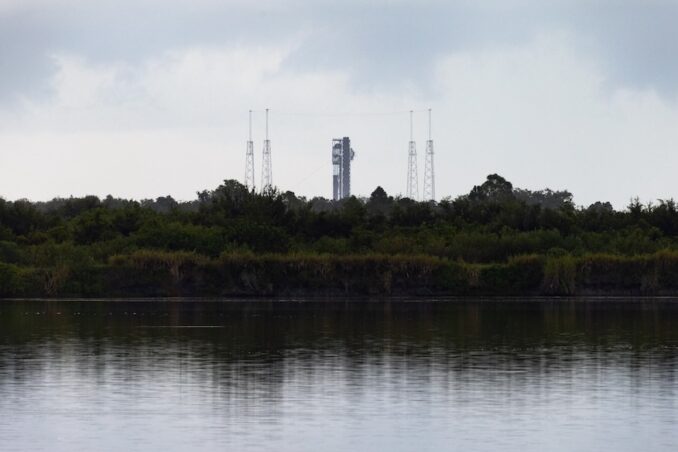
SpaceX hopes to launch its Falcon 9 rocket from Cape Canaveral Space Force Station on Wednesday morning, but poor weather may prove insurmountable.
The Starlink 10-43 mission will add 29 broadband internet satellites to the company’s low Earth orbit constellation. It consists of more than 10,000 spacecraft.
Liftoff from Space Launch Complex 40 is scheduled for 6:11 a.m. EDT (1011 UTC). The Falcon 9 rocket will fly on a north-easterly trajectory upon leaving the pad.
Spaceflight Now will have live coverage beginning about an hour prior to liftoff.
The 45th Weather Squadron forecast a 30 percent chance for favorable weather during the launch window. Meteorologists describe a south-moving “cool” front that is like to make “weather conditions tricky for launch.”
“Scattered marine showers will likely scrape the East-Central Florida coastline during the launch window, and plentiful mid-level cloud decks will create concerns for both the Cumulus Cloud and Thick Cloud Layers Rules, with Surface Electric Fields Rule being a distant third should any of the showers move ashore,” launch weather officers wrote.
“Latest hi-resolution guidance has provided a more pessimistic view of the shower and mid-level cloud coverage during the launch window; thus we have increased POV. Recovery weather will also be a watch item with elevated wave heights and fresh breezes along the eastern Atlantic.”
SpaceX will launch the mission using the Falcon 9 first stage booster with the tail number B1090. This will be its 12th flight after launching missions, like NASA’s Crew-10, CRS-33 and Bandwagon-3.
Nearly 8.5 minutes after liftoff, B1090 will target a landing on the drone ship, ‘A Shortfall of Gravitas,’ positioned in the Atlantic Ocean off the coast of South Carolina. If successful, this will be the 153rd landing on this vessel and the 618th booster landing to date.