
NASA is potentially less than a year away from the trio of rocket launches that will encompass the Artemis 3 mission and the agency’s leader said he is “extremely confident” that the mission will happen in 2027.
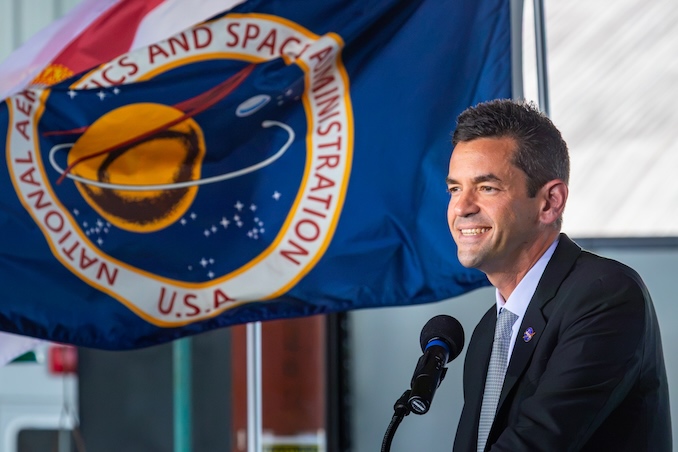
Isaacman made the statement alongside Brian Hughes, the Kennedy Space Center director, as well as members of the Florida congressional delegation on Friday. He was there to announce a new NASA-supported, privately run air and space show, called “Max Power” taking place in early November.
“I’m extremely confident that we are we are going to be able to launch Artemis 3 next year. That’s why we stepped into stacking operations,” Isaacman said, referring to the assembly of the Space Launch System (SLS) rocket happening in the Vehicle Assembly Building at KSC.
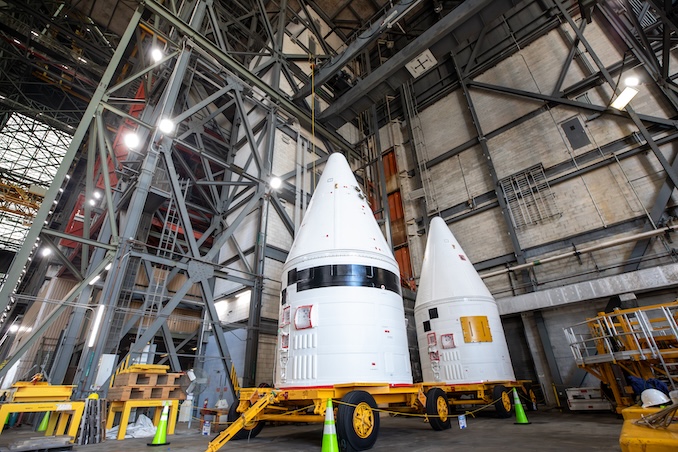
Earlier this summer, the Orion spacecraft’s crew and service module were mated together ahead of additional testing. Four out of the ten segments of the solid rocket boosters have been stacked inside High Bay 3 while engine integration onto the core stage happens inside High Bay 2.
The Artemis 3 mission will begin with the launch of Blue Origin’s New Glenn rocket, which will send a test version of its Blue Moon Mark 2 lander into low Earth orbit. That will be followed days later by the launch of the SLS rocket and Orion spacecraft, which will rendezvous and dock with Blue Origin’s vehicle.
“I had a chance to visit with the Blue Origin team earlier, walked the assembly line floor today, looking at components that will make their way into the Blue Origin test lander that we will be rendezvousing and docking with,” Isaacman said. “And I’ll tell you, if you spoke to Blue Origin, they would say the same thing. What we are going to learn from that mission, the amount of risk we’re going to be able to bring down in advance of Artemis 4 will be significant.
“I think in fact, if you coupled that with the uncrewed landing demonstration, you’d be very confident in what they’re going to be able to achieve potentially in 2028.”
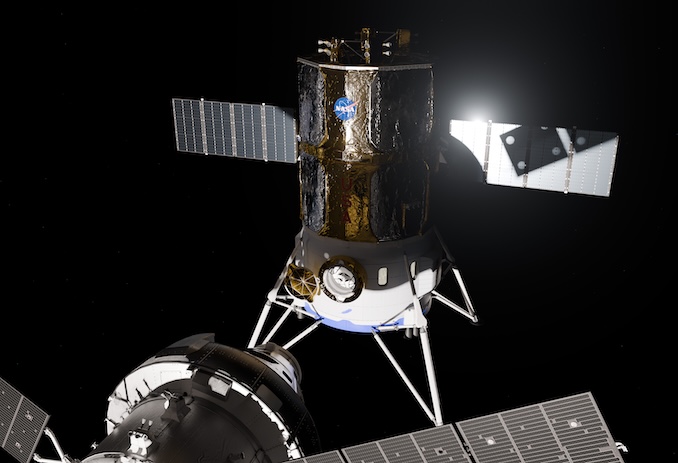
Blue Origin’s demonstration lander represents a number of the capabilities that will be featured in their Blue Moon Mark 2 lander, which will be used for crewed landings on the Moon’s south pole. The test lander doesn’t include the BE-7 engine of the Blue Moon Mark 2, but it does include a life support system and crew habitation area, which will allow the crew to live and work onboard while it’s docked with the Orion spacecraft.
After the two separate, SpaceX will launch its Starship Version 3 rocket, with a docking adapter on the nose of the upper stage. That Starship will be the target for Orion to dock, but because it won’t have a crew habitation area, the astronauts will remain onboard Orion while the two are mated.
“Now with respect to SpaceX, I think you’re what you’re witnessing, you’re seeing an increase in launch cadence, and that’s critical. If they’re able to launch again in early September after their last launch and continue to track inside the month, potentially every couple of weeks before the end of the year, that’s going to — we’re going to feel very good about their time to contribute to Artemis 3 next year,” Isaacman said.
“They’ve already started cutting hardware for that test vehicle. We track that every single day, so that’s the test lander. So we’re feeling very good about that, and I’d say more so with each step along the way that you get better about Artemis 3, you’re feeling that much better about Artemis 4 and its timeline in ’28.”
The Artemis 4 mission is planned to be the first crewed landing on the Moon as part of the Artemis Program. At this stage, NASA hasn’t named the crew flight that mission or which lander it will select to perform the landing operation for that mission.
Max Power coming to Kennedy
The event Friday wasn’t billed around an Artemis 3 update, but rather to announce and promote the Max Power air and space technology expo. Isaacman said that the event “is not something that NASA is going to be footing the bill for,” but rather managed by sponsors.
“These type of events do happen around the world, they’re sponsor-driven. We’re making available this great real estate, no different than you would see at other major events. Nellis (Air Force Base) has a show, Andrews (Air Force Base) and others,” Isaacman said.
“We’ll be contributing a lot of our talent and we’ll be contributing some of our aircraft from the NASA portfolio, which we fly around at various events at normal, well, they’re certainly becoming normal course and especially America’s 250th birthday.”
Those sponsors Isaacman referenced weren’t mentioned by name during the Friday announcement event, but NASA’s webpage for Max Power lists them as:
- Air Dot Show
- Delaware North
- Purpose Entertainment
- Space Florida
- UP.Summit
Even though they share the name “Max Power,” the event is split across three venues with separate tickets being sold by Air Dot Show, Delaware North, and UP.Summit. The number of tickets to each have not been announced and each event under the Max Power umbrella requires the purchase of a separate ticket.
“Because the event relies on the funding and structure provided by these external organizations rather than exclusively using NASA’s federally appropriated budget, ticketing is handled through their external sites so they can cover their costs of producing the event,” NASA wrote on its website under the “Frequently Asked Questions” section.
Delaware North, which manages the Kennedy Space Center Visitor Complex, is charging $69.38 per adult per day with taxes and fees ($58.68 per child ages 3-11). It will take place at the KSCVC and feature panels from NASA and other space companies; a space-themed parade; and hands-on activities.
UP.Summit is selling tickets for $53.50 per adult per day (including tax), but doesn’t mention the cost of children’s tickets on its website. Its exhibits and vendors will be set up at Space Florida’s Launch and Landing Facility (LLF) and will reportedly feature hardware from Astranis, Astroforge, Blue Origin, Stoke Space, Vast and more.
Air Dot Show, which manages the air show portion and will also have aircraft on the ground at the LLF, is charging $49.75 per adult per day for general admission. However, it stipulates that two, one-day tickets at that price need to be purchased together, which brings the total cost after taxes to $112.69. It also notes that this is an “intro sale” price, so the cost may increase as the event draws closer.
At those prices, for an individual adult to attend all three events on just one day would cost $179.23.
Asked what NASA would be contributing beyond the planes from its air show, Isaacman said some number of personnel would be on hand at the three venues, which will include both Apollo and Artemis astronauts.
“You’ll see rovers, you’ll see landers from the [Commercial Lunar Payload Services] program here, you’ll see a lot of hardware that either has adaptability to the early Artemis missions,” Isaacman said. “You might get a great view of Artemis 3 on its way out to pad 39B. You’ll also see a lot of critical components of the Moon Base that we’re building as well.”
The timing of the Max Power air show may very well coincide with the rollout for fueling demonstration of the SLS rocket.
“I certainly hope we have to work some deconfliction issues between the event and Artemis 3 rollout. That would be fantastic,” Isaacman said. “But I actually think, if our timing works out, it’ll be a fantastic way to compliment what should already be a rather extraordinary event.”
Isaacman said in response to a media question that while he hope Max Power can serve as an inspiration for future generations to pursue interests that will help NASA or potentially lead to a job at the agency, he said the goal isn’t to compete with industry.
“We’re not hosting the event necessarily to take talent away from others in industry. In fact, I think NASA, as I’ve said many times, is at our best because we are doing what no company or agency or other nation is capable of doing,” Isaacman said.