

Contributed by Joel Jean | Co-founder and CEO of Swift Solar
When Iran closed the Strait of Hormuz last month, choking off 20 percent of the world’s crude oil supply, it sparked what the IEA called the “greatest energy security threat in history.” The war could end tomorrow, but this demonstration of vulnerability in the global oil and gas market will reverberate for years. Already, we’re seeing real movement across much of the world to build more solar, wind, and batteries—which stepped up to meet a greater share of energy demand while global fossil generation fell by nearly 30 terawatt-hours in the first month of the war.
Many commentators have concluded that these trends all lead to China, given its commanding lead in clean energy manufacturing, which includes over 90% of global polysilicon, wafer, and solar cell production. But the US can upend China’s dominance if we can beat them to market with the next generation of clean technologies. The opening has never been clearer on solar.
For over seven decades, silicon has been the workhorse of solar. Today, silicon is approaching its efficiency ceiling—around 30%—just as the most promising new solar technology is emerging: perovskite-silicon tandems.
Stacking a thin perovskite layer on top of a silicon cell, perovskite-silicon tandem solar cells capture visible light with less energy wasted as heat. This pushes the thermodynamic ceiling higher, enabling tandems to surpass silicon in both performance and cost. Mass-produced perovskite tandems that offer 30–50% more power from the same panel, the same racking, the same land, and the same labor are within reach. At a time when electricity demand is rising, yet every major solar project faces a land-use negotiation, permitting fights, and lengthy interconnection queues, getting 50% more power from the same acre may well be the difference between a project that gets built and one that stalls.
China scaled the wrong kind of silicon for the tandem era. Most of the Chinese solar industry today produces a silicon cell architecture called TOPCon. TOPCon is harder to pair with a perovskite top cell than heterojunction technology, or HJT, the other major silicon architecture. The longer China runs on TOPCon, the larger its retooling bill when tandems hit scale. China has HJT too—but not a monopoly on the equipment that makes it, and no country has yet scaled tandem manufacturing. This is America’s opening.
The analysts and commentators may have left US solar for dead, but China hasn’t. Reports that the central government is exploring export restrictions on HJT manufacturing equipment to the US suggest they understand that perovskites could allow us to catch them.
The bipartisan 45X advanced manufacturing tax credit has already catalyzed billions in US factory investment, and tariffs on subsidized Chinese products have given domestic manufacturers room to scale. Recent investments in domestic module, cell, wafer, and polysilicon production are helping rebuild capabilities that had largely moved overseas, with manufacturers increasingly working to establish end-to-end U.S.-based solar supply chains. Today, more than 300 factories across 42 states produce components that power the solar economy, and the US now has enough domestic manufacturing capacity to meet national demand for solar modules—a remarkable shift after decades of offshoring.
But the cell—the power-generating engine of every panel—is still largely imported. We should address that gap with perovskites in mind.
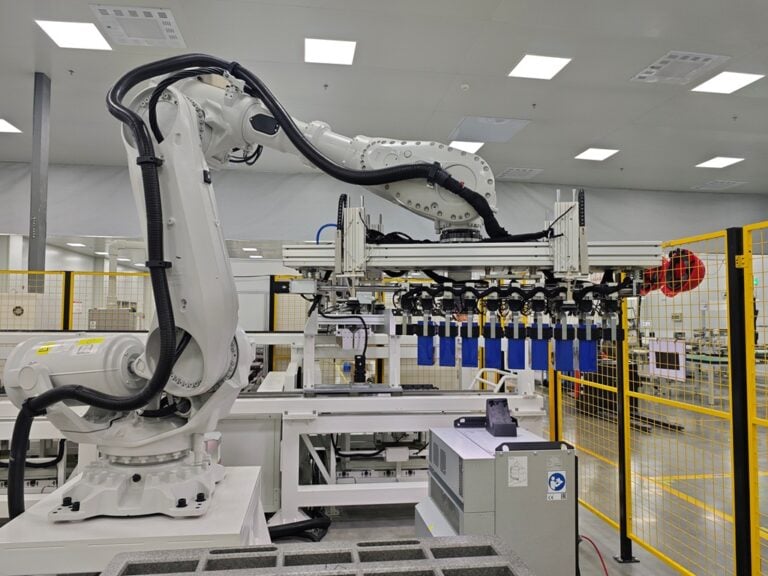
Encouragingly, the foundation of a tandem manufacturing ecosystem is already emerging in the US. Over the last several years, technical expertise and industrial know-how around perovskites and silicon heterojunction technology have increased significantly, creating a plausible path to scaling tandem solar manufacturing domestically. Swift’s acquisition of Meyer Burger’s HJT manufacturing assets and IP is one such example, giving a US company control of one of the few Western-developed HJT manufacturing platforms outside China. All that’s needed now is a dedicated effort to scale HJT-perovskite tandems as a reliable, bankable product.
To do it, the US can steal the comprehensive playbook China developed for silicon: long-term public financing, subsidies for American manufacturers building out the parts of the supply chain we don’t have yet, tariffs, sustained research funding, and favored procurement.
In practice, that means extending and strengthening 45X for upstream production on HJT cells, along with wafers and polysilicon, and adding a bonus tier for next-generation technology that can leapfrog Chinese incumbents. It means standing up federally-backed, low-cost factory financing options that can actually compete with the cheap capital Chinese manufacturers get from state-owned banks. It means directing the federal government—the single largest buyer of electricity in the country—to serve as an early customer base for US-made tandem technology that will guarantee demand for our own industry. And it means committing to real funding continuity for solar research at the national labs and our world-leading universities.
If one of the biggest lessons of the Iran War is “don’t let your energy supply depend on a single foreign chokepoint,” depending on silicon solar cells from China is the same strategic error in different clothes. In the fossil fuel era, energy independence hinged on controlling fuel supply. In the electric era, it comes down to controlling the factories, supply chains, and innovation behind the electricity we generate.
Nothing generates electricity faster or cheaper than solar, and perovskite tandems are the future of solar. Will America build that future, or will we import it?

Joel Jean is the co-founder and CEO of Swift Solar, a U.S.-based solar manufacturer developing next-generation heterojunction (HJT) and perovskite tandem solar technologies. His work focuses on building a domestic manufacturing pathway for advanced solar cells, with an emphasis on scaling technologies that can deliver higher energy output and improve project economics.
Joel earned his undergraduate degree in electrical engineering from Stanford University and later completed graduate work at Massachusetts Institute of Technology, where he co-authored MIT’s “Future of Solar Energy” study and helped launch MIT’s GridEdge Solar initiative. He has been recognized by Forbes (“30 Under 30”) and Business Insider (“Rising Stars of Clean Energy”).