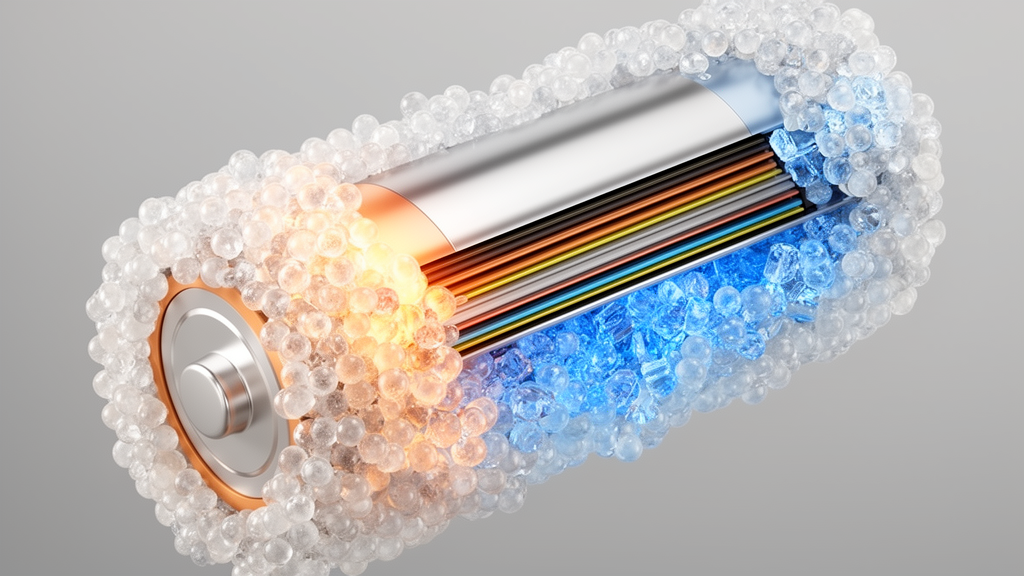
Researchers have developed a halogen-free, nitrogen- and phosphorus-flame-retardant phase change material for managing heat in lithium-ion batteries. The composite combined a covalently modified polyethylene glycol 2000 matrix with expanded graphite and reduced heat release in combustion tests. In battery-module tests, it lowered the maximum temperature to 43.9 °C and limited the maximum temperature difference to 3.33 °C during discharge at 2C, while also delaying thermal propagation under overheating conditions.
The study addressed compatibility, latent-heat loss and halogen contamination associated with physically blended flame-retardant phase change materials. Rather than physically mixing the components, the researchers synthesized a new phase change material, designated GPEG2000, through covalent bonding. Polyethylene glycol 2000 served as the phase change matrix, and sequential Schiff-base condensation and addition reactions involving 9,10-9-oxa-10-phosphaphenanthrene-10-oxide introduced the nitrogen- and phosphorus-containing flame-retardant functionality.
The resulting material was designed to combine thermal-energy storage with reduced combustibility. GPEG2000 exhibited a latent heat of 122.28 J g−1, enhanced thermal stability and improved char-forming capability. Combustion measurements showed that its peak heat release rate was reduced by 25.0% and its total heat release by 44.0% relative to the material used for comparison in those tests.
The researchers subsequently incorporated expanded graphite to produce a composite phase change material, or CPCM. This addition significantly increased the composite’s thermal conductivity while retaining the flame-retardant phase change matrix, creating a material intended for both heat management and thermal protection in lithium-ion batteries. Testing of battery modules showed that GPEG2000 with expanded graphite reduced both the maximum temperature and the maximum temperature difference during high-rate discharge from 0.75C to 2C.
At the highest tested rate of 2C, the maximum temperature was controlled at 43.9 °C and the maximum temperature difference at 3.33 °C. The composite also markedly delayed thermal propagation during overheating tests. These results support the potential of the halogen-free composite for battery thermal-management and thermal-protection applications, although the supplied research abstract does not provide the cell chemistry, module capacity, ambient conditions, test duration or absolute thermal conductivity.
Subject of Research: Development of a halogen-free N,P flame-retardant phase change composite for lithium-ion battery thermal management
Article Title: Preparation of N,P-synergistic flame-retardant phase change materials and their application for thermal management of lithium-ion batteries
Article References: Yong, C., Zheng, Z., Fang, C., Wang, H., Zhang, Y., Li, X., & Yang, X. (2026). Preparation of N,P-synergistic flame-retardant phase change materials and their application for thermal management of lithium-ion batteries. Journal of Materials Science, 61(40), 30992-31008. https://doi.org/10.1007/s10853-026-13553-7
Image Credits: AI Generated
DOI: 10.1007/s10853-026-13553-7
Keywords: phase change material, lithium-ion batteries, battery thermal management, flame retardancy, expanded graphite, polyethylene glycol, latent heat, thermal propagation, halogen-free material, Preparation, P-synergistic, flame-retardant
Tags: Battery Thermal Managementexpanded graphiteflame retardancyflame retardanthalogen-free materiallatent heatlithium-ion batteriesP-synergisticphase-change materialpolyethylene glycolpreparationthermal propagation