
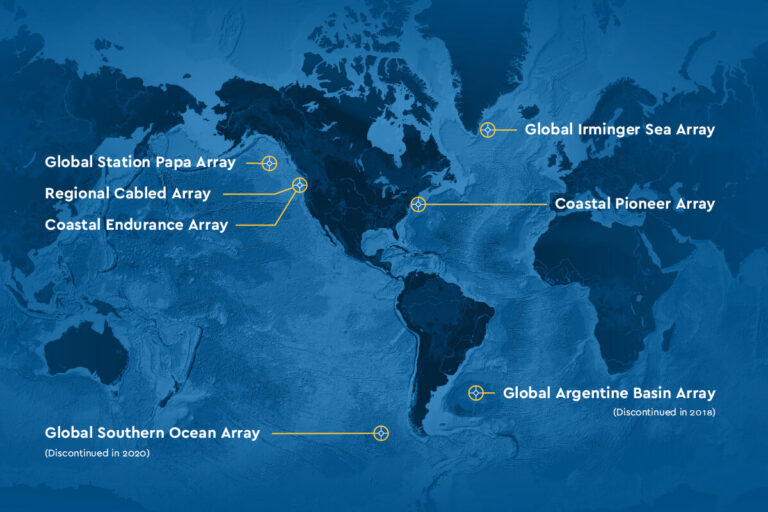
Over the next 15 months, major sensor arrays that have provided crucial, decade-long observations of the ocean, marine ecosystems and climate change will be dismantled. These sensors are part of the Ocean Observatories Initiative (OOI), a $386 million network of more than 900 instruments funded by the U.S. government’s National Science Foundation (NSF), which has provided real-time data on the world’s oceans for more than a decade. The sensors are distributed across both the Atlantic and Pacific oceans to monitor coastal environments, marine ecosystems, and ocean currents that influence the global climate. The decision to end OOI, described by the foundation as a “descoping,” will remove nearly all in-water infrastructure located off the states of Alaska, Washington, Oregon and North Carolina, and the Irminger Sea, an area between Iceland and Greenland. As the instruments are recovered, data streams from those areas will go dark, Jim Edson, principal investigator of the initiative, said in a statement. “However, all previously collected OOI data will remain accessible through the OOI Data Center.” The OOI was designed as a 25-to-30-year project specifically to capture long-term climate signals, which scientists say require at least three decades of continuous data to be meaningfully detected. The network has achieved just 10 years of observations. While satellites can monitor the ocean’s surface, the OOI arrays provided a rare look into the deep sea, measuring low-oxygen zones, carbon absorption, and currents critical to regulating weather patterns. The Associated Press (AP) reported that the removal comes at a particularly sensitive…This article was originally published on Mongabay