
As dwarf planet Pluto moves along in its distant, high-obliquity 248-year orbit, its atmosphere is changing. That’s because it’s beginning an 88-year march through colder, darker parts of the outer Solar System. As a consequence, the mostly-nitrogen atmosphere is expected to grow gradually thinner and eventually freeze out over the coming decades. When that happens, the atmosphere will shrink, but it may or may not completely fall to the surface.
Scientists led by Planetary Science Institute’s Senior Scientist Amanda Sickafoose are using the light from distant stars to track that thinning process by measuring how much starlight passes through the tenuous atmosphere. They’ve reported that recent observations show Pluto’s atmospheric pressure decreased by 16% between mid 2021 and July 2023. Before that and at the time of the New Horizons flyby in 2015, the pressure remained constant at about ten millibars with an occasional increase influenced by sunlight falling on the northern pole. By comparison, that 10 millibars is about 1/100,000 of Earth’s. The occultations also show changes in atmospheric structures between the upper and lower parts.
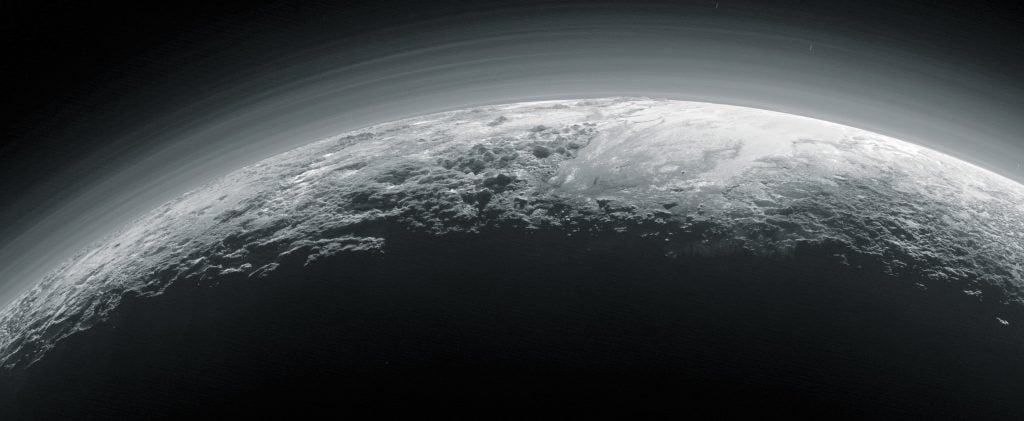 Pluto’s haze layers as seen by New Horizons in 2015. Starlight streaming through the layers can reveal details of their structure and changes over time. Credit: NASA/JHUAPL/SwRI
Tracking Starlight to Watch an Atmospheric Change
It’s difficult to study Pluto’s atmosphere from anywhere in the Solar System beyond Pluto itself. It’s a small world very far away. We know that as it approaches perihelion (its closest point to the Sun in its orbit), it receives more heat than it does at aphelion, which causes atmospheric variations over time. Planetary scientists once thought that as Pluto reaches aphelion, its atmosphere would freeze out and basically fall to the surface. That may not happen, and recent atmospheric models based on observations and flyby data suggest that it retains some part of its atmosphere throughout its 248-year “year”. So, observers have to rely on changes in whatever atmosphere exists as it travels through space.
There’s at least one handy observational clue that gives scientists some hope about observing changes in the atmosphere: the gases combine to form hazes. As the pressure drops, those hazes have begun to thin out. Eventually, they will settle lower to the surface (and possibly some of it could actually coat the Pluto landscape). The exact physics of the atmosphere isn’t well understood, but it is tightly coupled with the properties of Pluto’s surface ices, according to Sickafoose. “We’re at a particularly interesting point for Pluto,” she explained. “Our work suggests that the atmosphere has recently started decreasing in pressure. I am hopeful that we’ll be able to get more data in the next years to decades to specifically confirm or refute this trend.”
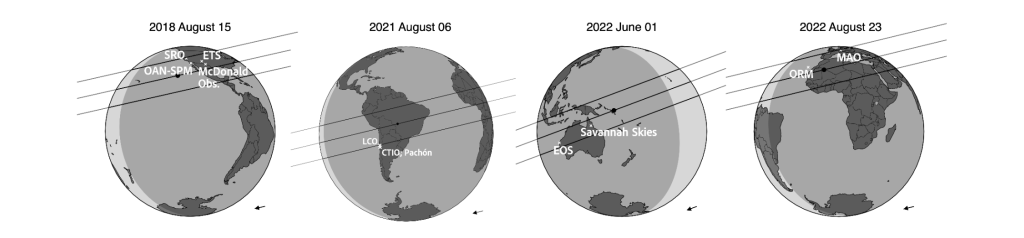 These maps show example paths of Pluto’s occultation shadows. Four of 10 occultations could be observed from multiple locations on Earth in the most recent studies. The solid lines indicate the top, middle and bottom of Pluto’s shadow on each date, and the arrows near the bottom of the image show the direction of motion of the shadow. White text indicates the locations of the successful observing stations. The black dots are the closest approaches of Pluto to the Earth in the centers of the shadow paths. Credit: A. Sickafoose
So, how to study a distant, thin atmosphere as it shrinks and freezes? The answer lies in events called “occultations”. These occur when Pluto (or any world) passes in front of (occults) a more distant star or other object. For Pluto, when it does this, the light from the distant stars can pass through the atmosphere. That trip through the tenuous blanket of gases changes the starlight. Some gets absorbed or deflected, and lost to our view. The “depth” of the hazes determines how much light is absorbed. If there’s a lot of haze, more light disappears than from areas where there’s little haze. So, the variations in light can give a map of the hazes and their thickness at any given time. Over repeated observations, scientists can measure how the hazes are thinning out and dropping lower toward the surface.
Pluto Presents Challenges
Occultations of distant stars by Pluto can be tricky. Faint as it is, when Pluto occults a star, that casts the planet’s shadow across our planet. It’s a faint shadow, to be sure, but with the right instruments, it can be picked up and measured. However, that also means the shadow can be spread out across thousands of miles of continents and oceans. So, teams of observers also get spread out across the shadow’s paths, just as we do for solar eclipses here on Earth. That makes gathering data about Pluto’s atmosphere a challenge, but it also has an upside: different observers in different regions will capture data about different parts of Pluto’s atmosphere. Sickafoose pointed out that the teams often look for paths that will take the shadow over places with good facilities for observing. “We often prefer to observe predicted occultations that have shadow paths over large observatories because that equipment and data have proven successful,” she said. “Then, we try to improve those datasets by collaborating with local observers in the shadow paths.”
Once the occultation begins, the teams look for distinct changes in the data about the Plutonian atmosphere and its hazes. What matters most in these observations is how bright the star appears throughout the event. The teams use telescopes to measure how much light is detected before, during, and after the occultation. That allows them to calculate how much the light fades (or is deflected by particles in the atmosphere), and how long it takes before the light comes back. That, in turn, gives a good idea of the density of the atmosphere in different regions.
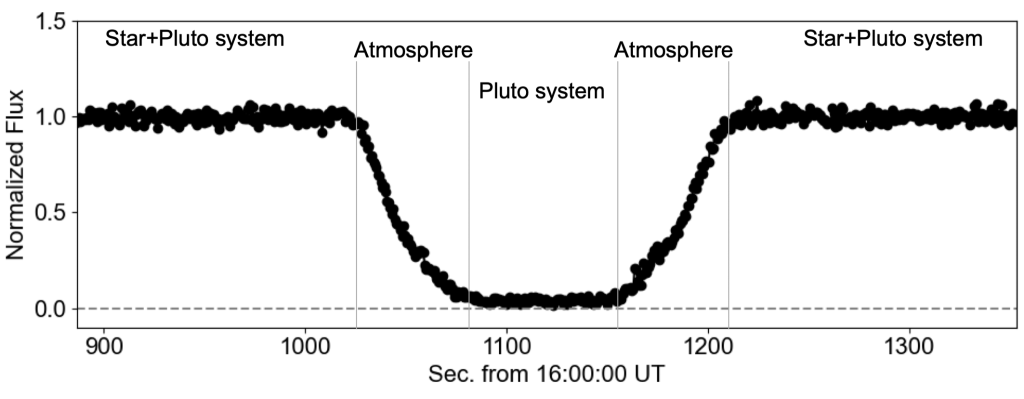 Light curve from the 2026 June 1 occultation, observed from Savannah Skies Observatory in Chillagoe, Queensland, Australia. The gray vertical lines indicate different stages of the occultation. The baseline flux level contains combined light from the star and the Pluto system (Pluto plus all of its moons). The flux drops gradually as the starlight bends and scatters in Pluto’s atmosphere, reaching nearly zero flux as defined by only light coming from the Pluto system. As the star appears on the other side of Pluto, the light gradually reappears in the atmosphere before returning to full strength. Credit: A. Sickafoose
“I’m constantly amazed at how the simple technique of watching starlight dim and reappear allows us to study a thin atmosphere – a few millionths of the Earth’s – on a world two-thirds the size of our Moon and 30 times farther from the Sun,” Sickafoose said.
Atmospheric Science via Occultations
Measuring multiple occultations is a painstaking way to indirectly measure a planet’s atmosphere and its changing pressure. In the team’s paper, they point out obvious changes at Pluto, including some variations between different regions of the Plutonian atmosphere. They wrote: “Our results indicate a pressure plateau between the New Horizons flyby in 2015 through roughly 2021 and suggest that the atmospheric pressure has started to drop. Between 2015-2021 and 2022, the clear-atmosphere pressure at 1275 km decreased 7 ± 6%, and it dropped 16 ± 2% for pressure at 1,215 km when including haze.
“From 2017-2023, the upper atmospheric structure is consistent, while there is a change in light-curve slope in the lower atmosphere. This change-of-slope is consistent with haze particles settling over yearly or shorter timescales. Spikes in one light curve are indicative of intermittent buoyancy waves.”
Ultimately, despite these useful occultation measurements, many questions remain unanswered about Pluto’s atmospheric changes in the coming decades. As it moves farther from the Sun, will its gases freeze out completely, or will the planet retain a hazy, but smaller, denser, hazier atmosphere closer to the surface? Clearly, additional measurements are needed, as well as further analysis of the current occultation data. Those should shed more light on the changing characteristics of the upper and lower parts of that atmosphere as temperatures and light intensities drop.
For More Information
Changes in Pluto’s Atmosphere Based on Stellar Occultation Data from 2017 to 2023
Pluto’s Atmosphere: Hazy with Signs of Thinning