A research team from Rice University in Texas has managed to bypass the formation of a yellow phase during the degradation of formamidinium lead iodide (FAPI) single-junction perovskite solar cells. FAPI cells have a near-optimal bandgap of 1.45 to 1.5 eV and outstanding thermal stability; however, their useful black crystal structure is unstable and tends to transform into an inactive yellow phase at room temperature.
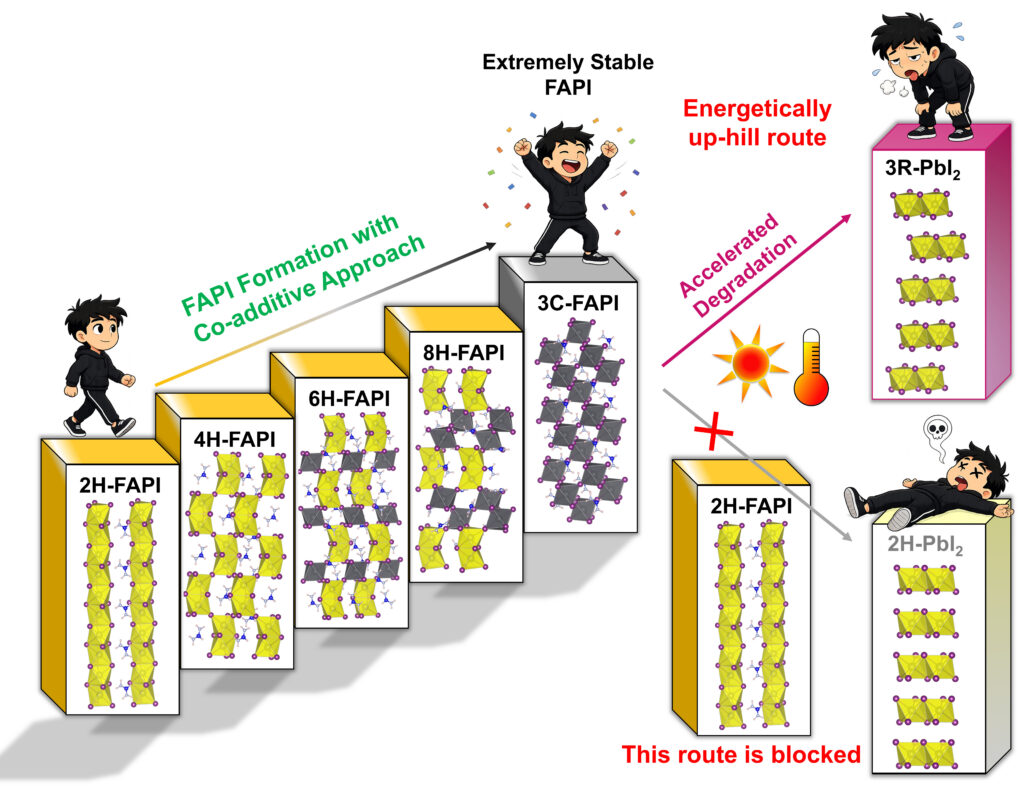
“The key novelty of this work is that it shows that by using specific additives, both the formation pathways and degradation pathways can be tailored. This study demonstrates for the first time that chlorine is incorporated into the perovskite lattice, creating an energetically uphill degradation pathway,” said corresponding author Aditya D. Mohite to pv magazine. “In this co-additive approach, formamidinium chloride enables a stepwise transition pathway and confirms chlorine incorporation, while the two-dimensional perovskite serves as a template to guide crystal growth. Together, both additives induce compressive strain, thereby stabilizing the system.”
Mohite likened the stepwise phase transition to climbing a staircase one step at a time with control and ease, rather than trying to jump several steps at once. “The combined effect of the two additives promotes superior crystallization through a uniform and gradual transition pathway, inducing compressive strain and imparting exceptional stability to the system,” he said. “This study demonstrates for the first time that chlorine is incorporated into the perovskite lattice, creating an energetically uphill degradation pathway.”
At the beginning of their study, the team conducted in situ formation and film characterization studies with several additives with and without chlorine. According to their findings, a 15 mol % FACl and 0.5 mol % BA2PbI4 combination, or FAPI-CA film, exhibited a superior crystallization pathway across all polytypes. Based on this finding, they then conducted accelerated degradation studies by exposing the films to 15-sun illumination under an inert atmosphere while gradually increasing the temperature from 65 C to 75 C, and finally to 90 C, over more than 400 hours, using X-ray diffraction measurements to track structural changes and degradation pathways over time.

“This study reveals that the chlorine is incorporated within the lattice of the perovskite. Earlier works had suggested that chlorine leaves the lattice. The presence of chlorine in the lattice induces a stepwise phase transition pathway, thereby reducing the microscopic yellow-phase (or delta phase) defects,” Mohite explained. “Moreover, the chlorine also changes the conventional degradation pathway through the yellow phase; this co-additive strategy avoids that pathway altogether and surprisingly enables a different energetically unfavorable transition mechanism, thereby creating the best possible scenario for the perovskites in terms of stability.”
Following that, the group tested the FAPI-CA films in a device stack with an architecture consisting of a fluorine-doped tin oxide (FTO), a mixed phosphonic acid–carbazole self-assembled monolayer hole-selective contact, a FAPI absorber, a buckminsterfullerene (C₆₀ ) electron transport layer (ETL), a bathocuproine (BCP) buffer layer, and a copper (Cu) metal contact.
The best device achieved a power conversion efficiency of 25.1% with an average of 24.1% across 40 devices. “Perovskite solar cells fabricated using this dual-additive approach retain 98% of their initial efficiency after 1,200 hours of accelerated aging under open-circuit voltage conditions at 85 C,” said Mohite.
The research findings were presented in “Bypassing the yellow phase for extremely stable formamidinium lead iodide perovskite solar cells,” published in Science. Scientists from the United States’ Lawrence Berkeley National Laboratory, Northwestern University, and DirectH2; the United Kingdom’s University of Cambridge; and France’s University of Lille, University of Rennes, and Institut National des Sciences Appliquées Rennes have also participated in the study.
The post Stabilizing perovskite solar cells with chlorine appeared first on pv magazine Global.