

Here’s a question that sounds almost too strange to take seriously: what if one of the most Earth like worlds in the Solar System is kept warm by a 9 km thick blanket of methane ice? Welcome to Titan and to a discovery that’s quietly rewriting what we thought we knew about Saturn’s most remarkable moon.
Titan is already extraordinary. It’s the only place in the Solar System other than Earth with a dense atmosphere, and the only place with rivers, lakes, and seas sitting on its surface. The twist is that those lakes aren’t filled with water. Titan is so cold, around minus 179 degrees Celsius, that liquid methane and ethane do the job instead. Rain falls as methane, rivers carve channels in water ice as hard as rock and it is, in the most literal sense, an alien world.
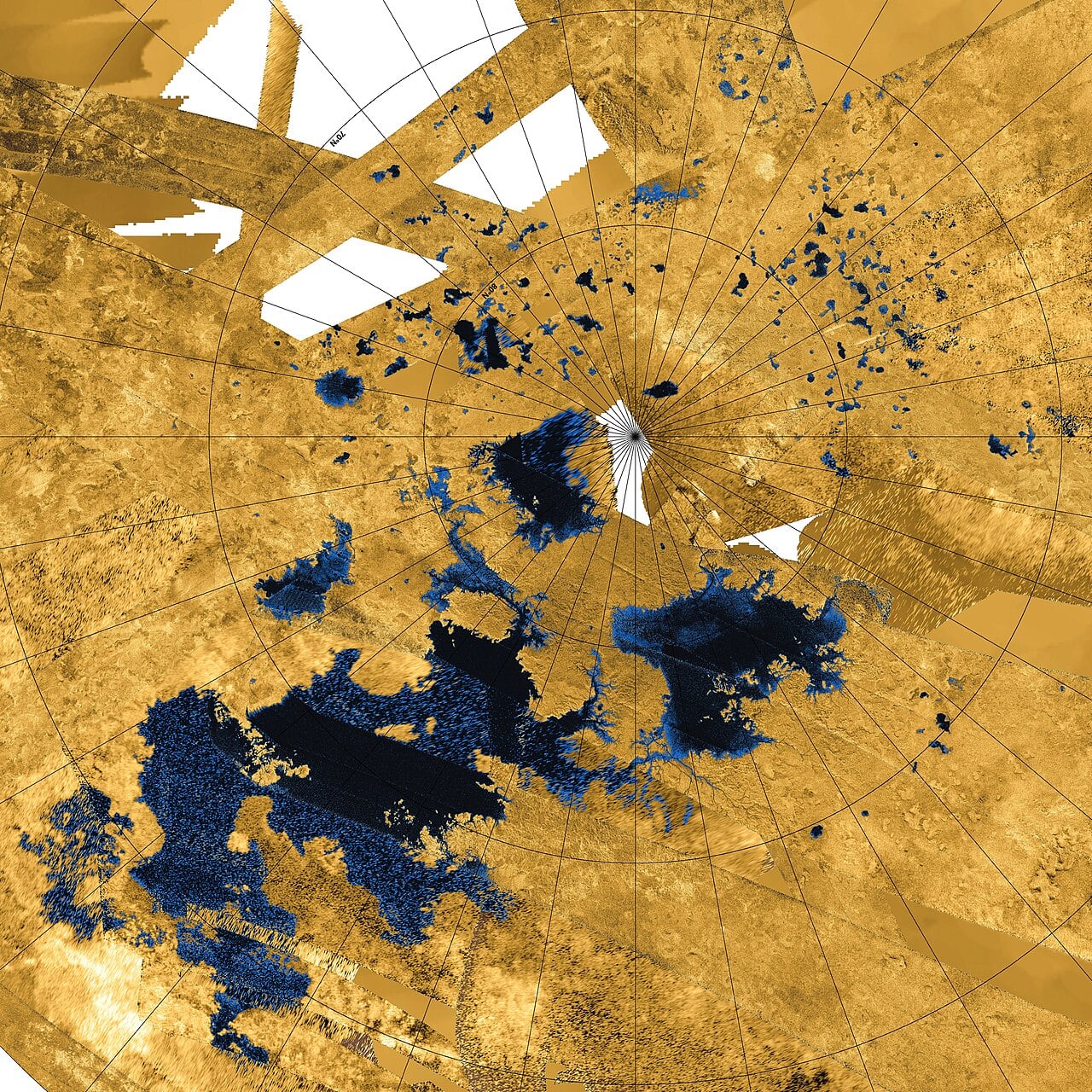 False-colour, medium-resolution Cassini synthetic aperture radar mosaic of Titan’s north polar region, showing hydrocarbon seas, lakes, and tributary networks. Blue colouring indicates low radar reflectivity areas, caused by bodies of liquid ethane, methane and dissolved nitrogen. Kraken Mare, the largest sea on Titan, is at lower left. Ligeia Mare is the large body below the pole, and Punga Mare at half its size is just left of the pole. White areas have not been imaged (Credit : NASA/JPL-Caltech/Agenzia Spaziale Italiana/USGS)
But scientists have long been puzzled by something. Titan’s atmosphere is saturated with methane, yet methane is constantly being destroyed by sunlight so something must be replenishing it. In addition to this, Titan’s craters are unusually shallow, far shallower than you’d expect for a cold, rigid, inactive world. Both puzzles have now found a possible answer in the same place: the crust.
Planetary scientists at the University of Hawaiʻi at Mānoa modelled what would happen to Titan’s craters over time if the uppermost layer of ice wasn’t ordinary water ice, but something called methane clathrate, a form of solid ice where methane molecules are physically trapped inside the crystal structure, like gas locked in a cage. The results were striking, a clathrate crust between 2 km and 9 km thick produced crater depths that matched what the Cassini spacecraft actually observed. Crucially, nothing else did.
Methane clathrate turns out to be both stronger and far more insulating than ordinary ice. Think of it like the difference between a single pane window and triple glazing. A clathrate crust traps heat beneath it, keeping the ice shell below warm and pliable, warm enough the researchers suggest to be slowly churning and convecting, like an extraordinarily sluggish version of the boiling surface of a pan of water. That convection would explain the shallow craters because the ice softens and flows, slowly filling them in, just as warm glaciers on Earth move and deform over time.
 True-colour image of layers of haze in Titan’s atmosphere (Credit : NASA)
What of the methane atmosphere? A warm, convecting ice shell would allow methane trapped in the crust to gradually escape upward into the atmosphere, providing exactly the kind of long term replenishment that has been so difficult to explain.
Beneath Titan’s ice shell, the models suggest there is a liquid water ocean. If that ocean exists and harbours any form of life, the chances of detecting any biological signals at the surface depend entirely on whether material can travel upward through the ice. A warm, convecting shell makes that journey far more plausible than first thought. Things are getting a little more exciting for NASA’s Dragonfly mission, a rotorcraft lander which is due to arrive at Titan in 2034. It will have a lot to look for.
Source : Saturn’s moon Titan has insulating methane-rich crust up to six miles thick