In 1985, the physicist Heinz R. Pagels wrote, “Stars are like animals in the wild. We may see the young, but never the actual birth, which is a veiled and secret event.” In the decades since then, astronomers have drawn closer and closer to figuring out what actually goes on in the veiled stellar nurseries throughout the Universe. The tale of starbirth we know today invokes the collapse of clouds of gas and dust into prestellar cores, but it still has many unknowns, such as the role of magnetic fields in the clouds where stars are born.
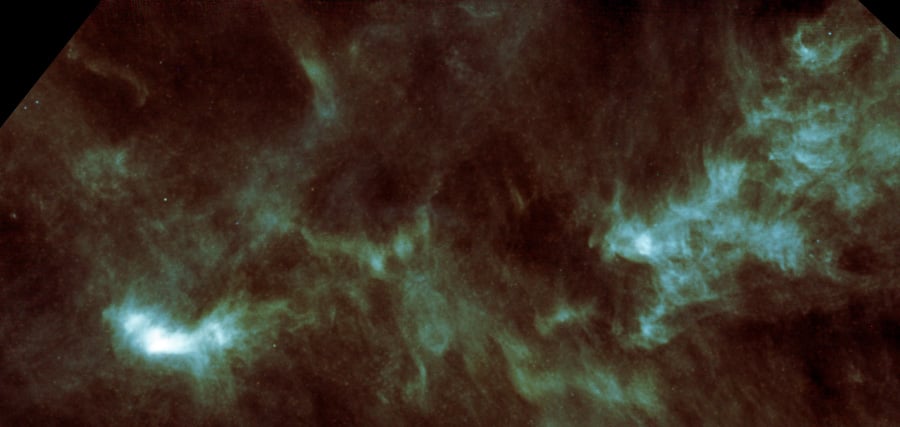
Researchers from Kyushu University and the Max Planck Institute for Extraterrestrial Physics have used radio astronomy techniques to study the magnetic field influence in prestellar cores. Lead researcher Doris Arzoumanian at Kyushu explained her team’s findings using the Institute for Radio Astronomy in the Millimetre Range (IRAM) to study a prestellar core called L1544. It lies in a region of the Milky Way called the Taurus Molecular Complex. At a distance of 140 parsecs, it’s one of the closest star-forming regions to Earth.
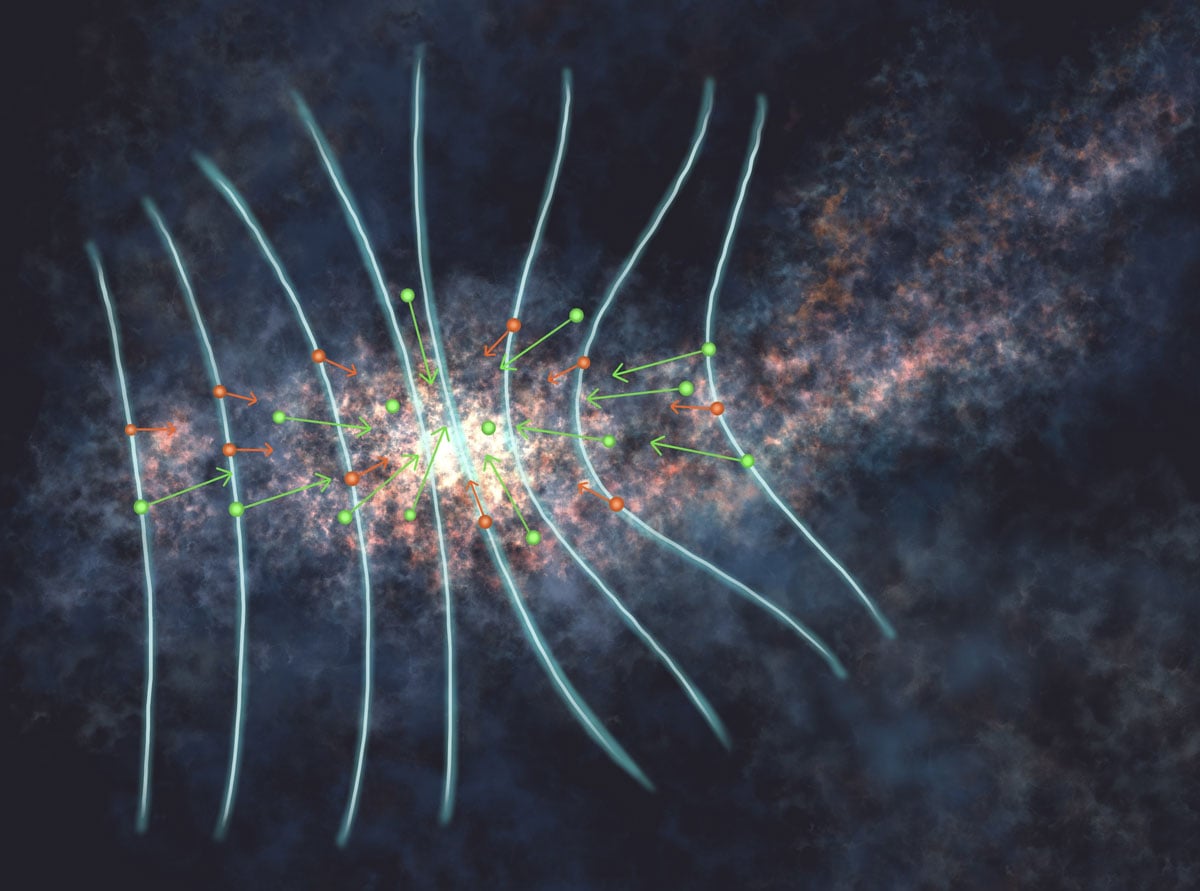
A graphical representation of ion-neutral drift in the L1544 prestellar core. The blue lines represent the magnetic field lines, which are bent due to the gravitational contraction of the core. The red and green dots depict the ion and neutral molecular species, respectively, and the arrows trace their inflow motion towards the core center (the faster they travel, the longer the arrows). While in the outer part of the core both the ions and neutrals are attached to the magnetic field lines, within the inner part of the core the neutrals decouple from the magnetic field lines and infall faster compared to the ions, which remain attached to the field lines. This ion-neutral decoupling, known as ambipolar diffusion is required for the onset of the gravitational collapse of the prestellar core, which will produce a protostar in its center and ultimately a stellar system similar to our own Solar System. Credit: Arzoumanian, et al.
“Prestellar cores are fascinating stellar bodies,” said Arzoumanian. “They are dense and cold, and a source of a lot of complex chemistry. The cold environment allows for molecules to assemble into more complex ones like precursors of prebiotic organic molecules. One of the questions we are investigating is the role of magnetic fields in star formation. Strong magnetic fields permeate prestellar cores. If that field is too strong, it can delay gravitational collapse and therefore star formation. We wanted to investigate how prestellar cores reduce the strength of their magnetic field.”
The result of the team’s research is the detection of a phenomenon called “ambipolar diffusion”. This happens when neutral particles in a plasma decouple from the plasma. In the molecular clouds that are the most likely homes to starbirth creches, there are both neutral particles and some amount of partially ionized gas where the ions are strongly coupled to magnetic fields that thread through the cloud. Neutral particles interact with the embedded magnetic field indirectly through collisions, so their velocities can be measured. Studies such as Arzoumanian’s give key insights into the activity of molecules in the core and with its magnetic fields.
Looking for Molecular Tracers
Prestellar cores are cold regions, despite the fact that they’re coalescing to form future stars. They can be anywhere from 10 to 30 degrees Kelvin (about -263 C to -243 C). That’s cold enough to freeze molecules to dust grains, essentially veiling them from deeper analysis. So, the team searched around for other molecules to act as “tracers” of activity. “We selected Diazenylium-d1 (N2D+), an ion, and para-monodeuterated ammonia (para-NH2D), a neutral molecule, as our tracers because they are generally located in similar high-density regions within prestellar cores,” said team member Silvia Spezzano, group leader at the Max Planck Institute for Extraterrestrial Physics. “We therefore collected spectral data of the core and modeled the velocity of the two molecules.”
The result was a very clear velocity difference between those molecules of about 0.05 km/second, which the team interpreted as “ion-neutral drift”. This happens as the density of the prestellar core increases during accretion. It gets protected from radiation, and that puts a damper on ionization. The end result is that the coupling between the molecules and the embedded magnetic field grows weaker. As the neutral particles fall towards the center of the prestellar core, they speed up. In the meantime, the ions remain coupled to the magnetic field, causing the velocity difference. This process is ambipolar diffusion, and it has been difficult to observe. “Until now, observing this phenomenon in a prestellar core was a major challenge,” said Arzoumanian. “As ambipolar diffusion continues, the strength of the magnetic field decreases. Eventually, gravity becomes the primary driving force in the core, resulting in its gravitational collapse into a protostar.”
Looking for Ambipolar Diffusion in All the Right Places
To confirm their finding, the team hopes to observe other prestellar cores using techniques of radio astronomy, as well as principles of dust physics and astrochemistry, according to Arzoumanian. A larger sample of prestellar cores should be examined to study ion-neutral pairs in cores at different stages of evolution. Statistical studies will also provide a way to assess the impact of the magnetic field geometry and density structures in these cores, along with other effects. The team also suggests that future studies could focus on ion-neutral drift velocities in other structures in star-forming regions, such as dense filaments.
Such observations should give new insights, essentially pulling aside the veil on other aspects of star formation and an understanding of the 3D magnetic field strength in cores, and more insights into the evolution of dust size distribution within prestellar cores as they continue on the road to forming stars. “Understanding star formation addresses a fundamental question about the origin of life in planetary systems and helps us better understand the universe as a whole,” said Arzoumanian.
For More Information
Capturing the Cosmic ‘Drift’ Before a Star is Born
Probing the Ion-Neutral Drift Velocity Toward the L15445 Prestellar Core
Heinz R. Pagels (1985). “Perfect symmetry: the search for the beginning of time”, Simon & Schuster