If I snapped my fingers and shut off every fusion reaction in the Sun right now, just like that, with every single proton deciding to sit quietly and wait instead of fusing and releasing energy, what would happen?
Nothing.
Nothing. It would be a perfectly normal day. The Sun would still hang in the sky. Plants would still grow. You would still get a sunburn. Absolutely nothing would change. Not today, not tomorrow, not a thousand years from now.
Civilizations would rise and fall. Ages would come and pass. We might develop the technology to reach the stars, or we might just stay home and order takeout. Either way, the Sun would simply keep on being the Sun.
If we killed the Sun today, it would take MILLIONS of years for anything different to show up to the outside universe.
Oh, except for the neutrinos. Those we would notice right away, because we would stop receiving any solar neutrinos at all. But honestly, who cares about neutrinos?
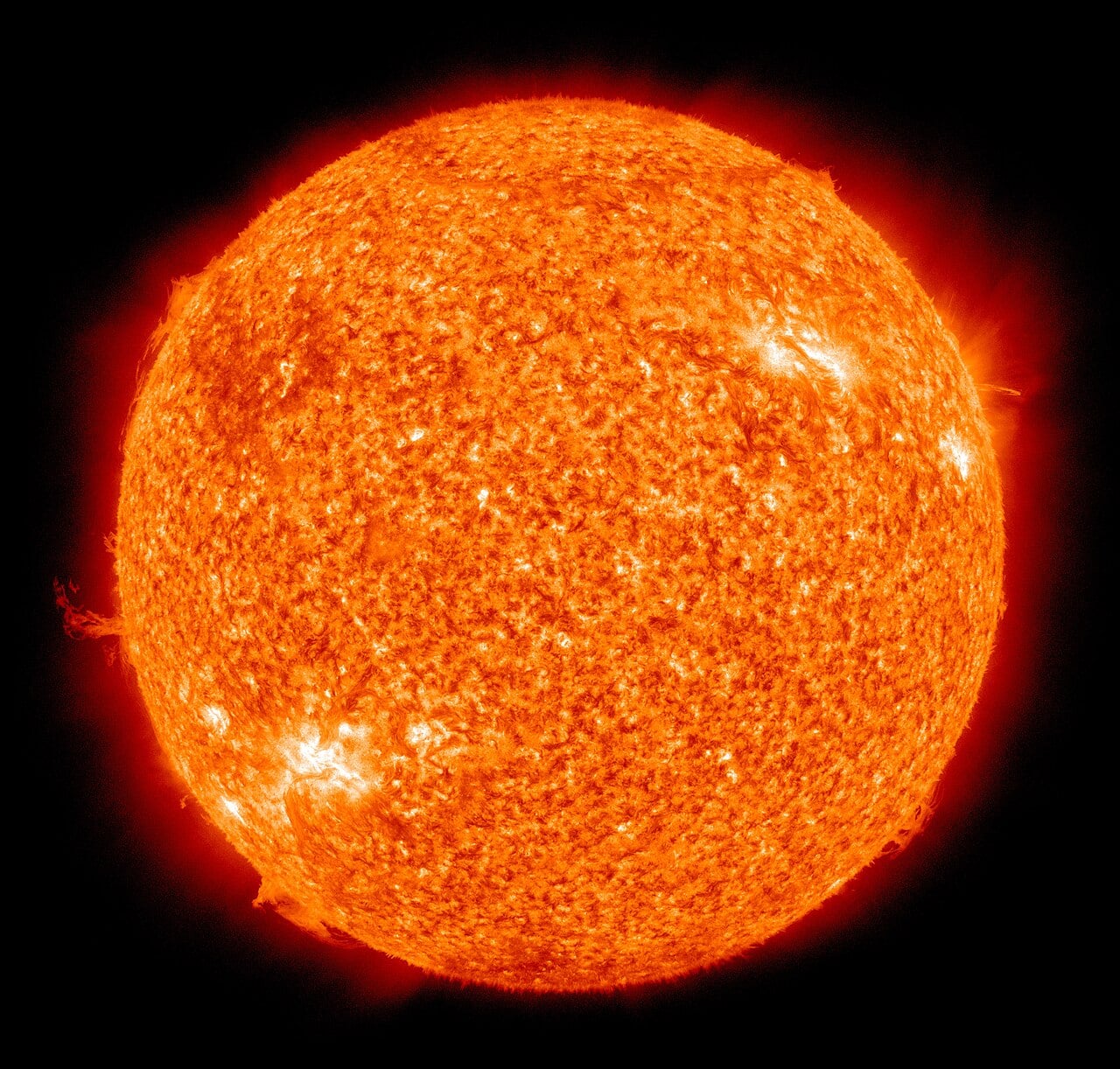
Before we dig into the how, let’s get straight on the what. Let me paint you a portrait of our dear old Sun. As stars go it is large but not grand, bigger than the small ones, smaller than the big ones, comfortably mediocre. But forget the other stars for a moment. Within our own solar system, the Sun is by far the largest single object there is. It alone holds more than 99 percent of all the mass in the entire system. If you swept away every planet, every asteroid, every comet, every last speck of dust, the solar system would stop being much of a system, but the Sun would barely notice they were gone.
You could cram more than 1.3 million Earths inside its volume, and it outweighs our planet by a factor of 330,000. That means a tremendous amount of stuff packed into a comparatively modest space. And what does a lot of stuff like to do? Gravitate. Enthusiastically. The Sun is just an enormous pile of matter squeezing inward as hard as it possibly can, which drives the pressure at the core up past 260 billion times the air pressure at sea level, and the temperature to a toasty 15 million Kelvin or so.
So: hot, and a touch cramped.
Which is exactly what you need to trigger nuclear fusion. But here is the strange part, the part that explains almost everything about how the Sun could switch off without us noticing. Nuclear fusion is really, really inefficient. Consider what fusion actually demands. You have to take two hydrogen atoms, which under these conditions are just bare naked protons, and force them to merge into a single helium nucleus. This is hard. Genuinely hard. Protons carry identical positive charge, so they repel one another, and that repulsion only grows fiercer the closer they get. To fuse, two protons have to come within about a femtometer of each other, close enough for the strong nuclear force to finally take over and glue them together.
But at that distance, the electrostatic repulsion is so overwhelming that the temperature and pressure at the Sun’s core are more than 700 times too weak to do the job. If fusion depended on heat and pressure alone, it would never happen. Not once.
The only way around the wall is to cheat, using quantum tunneling. Protons are not tidy little points, just as our quantum forefathers warned us. They have wave functions, fuzzy clouds of probability describing where the proton might turn up the next time nature comes looking for it. Those clouds are not large, but they are larger than the proton itself. So if you bring two protons close together and you are patient, every so often their wave functions overlap just enough that the protons find themselves within a femtometer of one another, and boom, fusion.
Almost.
Because two protons cannot actually form a stable nucleus. It is like being roommates with yourself: eventually you get sick of your own quirks and habits and start browsing rental listings across town. For fusion to stick, one of the protons has to convert into a neutron, which is entirely possible by way of the weak nuclear force.
Yes, the weak nuclear force. The worst of the nuclear forces. It barely ever bothers to show up. Two protons meet, wave functions overlapping, and almost every single time, nothing happens at all.
Stack it all together, the slim odds of the wave functions overlapping and the even slimmer odds of the weak force actually firing, and you get one successful fusion event for roughly every 10^27 encounters. Millions upon billions upon trillions of protons bump into each other and just shrug and bounce away. Nope. Sorry. Not today.
A typical proton spends around 10 billion years rattling around the core before it finally fuses. Ten billion. That is more than twice the current age of the Sun.
Thankfully, the Sun has protons to spare. The core alone holds something like 10^56 of them, which is, last I checked, a lot, with plenty more nearby waiting their turn to drift down. In any given second, any individual proton has only about a 10^-19 chance of fusing. But multiply that pitiful probability by that absurd number of protons and you get a steady burn of roughly 600 million tons of hydrogen consumed every single second.
And yet, zoom out and look at the efficiency, and in a cosmic sense the Sun barely works at all. It is genuinely terrible at fusing. It should be embarrassed. It is one small step above not working.
Check this out. The Sun pours out a ridiculous amount of power, more than 10^26 joules every second. One second of that output could run all of modern civilization for over 600,000 years. Only one part in 2.2 billion of that energy ever strikes the Earth, and even that sliver is 8,000 times humanity’s entire energy appetite.
So yes, in raw total numbers, that is a staggering amount of power. But as a matter of efficiency? Awful. Across the whole core, the Sun averages about 277 watts per cubic meter. Sounds fine, until you realize your own body, with all its metabolism and fidgeting and muscle movement, puts out around 100 watts in less than a tenth of that volume.
That’s right. Pound for pound, a human being generates roughly five times as much power as the core of the Sun. Replace the Sun’s core with a comparable mass of warm human bodies and it would glow five times brighter. Do not attempt this at home.
A compost heap is more energetically intense than the center of the Sun.
The Sun is blinding and luminous and powerful not because fusion is some raging inferno, but because the Sun is simply ENORMOUS. The intensity is feeble. The scale is everything.
Which means that if we shut fusion off, we would not have much to lose. At least, not at first.
In Part 2, we meet the two Victorian aristocrats who worked out how the Sun could keep shining with the furnace switched off, and got the right idea for entirely the wrong reasons.