
Manufacturers may be leaving money on the table. See which 2026 tariffs qualify for duty drawback and how to recover up to 99%.
By: Tony Nogueras, LCB, Founder & CEO of Alliance Drawback Services
If your company pays duty on imported merchandise and later exports that merchandise, something similar to it, or a finished product made with it, most of what you paid at the border can come back. The mechanism is duty drawback: a refund of up to 99 percent of the duties, taxes and fees paid at import, reaching five years into the past. Section 301, the Section 122 surcharge and the IEEPA reciprocal tariff all qualify. Section 232 is the one with conditions attached, and those conditions have been loosening.
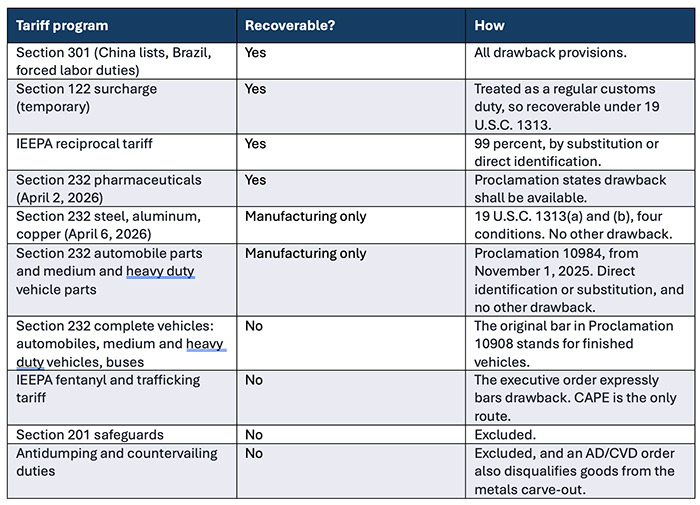
- Section 301, including the forced labor duties effective July 24, 2026, is fully recoverable. So is the Section 122 surcharge and the IEEPA reciprocal tariff.
- Section 232 started as a blanket no on drawback, but newer proclamations have opened manufacturing drawback. Eligibility is set proclamation by proclamation, not by statute.
- Steel, aluminum, copper, and automobile and heavy duty vehicle parts now allow manufacturing drawback. Pharmaceutical duties open it broadly. Complete vehicles remain barred.
- Never recoverable: the IEEPA fentanyl tariff, Section 201 safeguards, and antidumping and countervailing duties.
Duty drawback is a refund. When goods enter the United States, the importer pays duty at the border. If those goods, or a qualifying substitute, later leave the country or are destroyed, the government returns up to 99 percent of what was paid. The program dates to 1789, so that goods passing through the country on the way to a foreign customer are not permanently taxed by it.
Two routes cover most companies. Import components, build a finished product, export it, and the duty on those inputs comes back. Or import goods and re-export them unused, where the export need not be the same merchandise, because matching is allowed at the eight-digit tariff classification.
Most companies that qualify never file. Nothing is automatic. It takes records tying imports to exports, and nobody tells you the money is there.
Section 301 duties have always been recoverable, and that now covers a lot of ground. The China lists, the Brazil action, and the forced labor duties effective July 24, 2026 at 10 or 12.5 percent across roughly 60 economies are all eligible for duty drawback under every provision.
The Section 122 surcharge, the temporary measure the forced labor action replaced, is also recoverable. Its proclamation carried no drawback exclusion and directed that the surcharge be treated as a regular customs duty, and regular duties are recoverable under 19 U.S.C. 1313.
The IEEPA reciprocal tariff is recoverable too, though since the Supreme Court struck the IEEPA tariffs down most importers will get that money back faster through CBP’s CAPE process in ACE than by filing a drawback claim.
In practice: a manufacturer imports $2 million of components and pays the 12.5 percent forced labor duty, roughly $250,000. Forty percent of finished output is exported. The duty on that share, about $100,000, is recoverable at up to 99 percent. The rest is not.
When these tariffs began, the proclamations barred drawback outright. The 2018 steel and aluminum actions and the April 2025 automobile action all state that no drawback shall be available. That is where the shorthand came from: Section 301 recoverable, Section 232 not.
The newer proclamations have gone the other way and allow manufacturing drawback: vehicle and automobile parts from November 2025, the restructured steel, aluminum and copper tariffs in April 2026, and pharmaceuticals, which opened drawback broadly. This can move because the exclusion was never statutory. Nothing in 19 U.S.C. 1313 bars it, so each proclamation decides for itself, and later ones can amend earlier ones.
“Section 232 began as a blanket no on drawback. The newer proclamations have opened manufacturing drawback, so exposure written off under the original rule is worth a second look.”
-Alliance Drawback Services Analysis
The proclamation effective April 6, 2026 allows manufacturing drawback under 19 U.S.C. 1313(a) and (b), but only where all four of the following hold:
- The article is a derivative product listed in Annex I-B or Annex III, or added later through the inclusions process.
- It is not within the scope of any antidumping or countervailing duty order, including an order on another country’s products.
- It is a product of a trade agreement partner: Canada, the European Union, Japan, Mexico, South Korea, the United Kingdom, or another country with a final Agreement on Reciprocal Trade.
- Its metal content is entirely aluminum or copper smelted and cast, or steel melted and poured, in one of those partner countries.
Melt and pour is a sourcing test, not a shipping test. Where the metal originated decides eligibility, not where the part was assembled.
Proclamation 10908 barred drawback on the April 2025 automobile tariffs. Proclamation 10984 changed that for components. As of November 1, 2025, manufacturing drawback under 1313(a) and (b) may be claimed on the duties imposed on automobile parts and on medium and heavy duty vehicle parts, by direct identification or by substitution. The bar still applies to complete vehicles.
Note what happened there: the October proclamation reached back and amended the earlier automobile action. For a parts supplier that is the difference between writing the duty off and recovering it, and it is easy to miss because it arrived inside a proclamation about trucks.
The proclamation of April 2, 2026 took the opposite approach to the metals action, stating that drawback shall be available with no attached conditions. Unused merchandise, manufacturing and rejected merchandise drawback are all open on those duties.
Antidumping and countervailing duties are excluded, and an AD/CVD order also disqualifies goods from the metals carve-out. So are Section 201 safeguards. The IEEPA fentanyl and trafficking tariff is expressly barred by the executive order that imposed it, making CAPE the only route to that money.
One more thing that trips people up: goods already subject to Section 232 are carved out of the forced labor action entirely. The two do not stack. A line pays one or the other, and which one decides how recoverable it is.
Because eligibility is written into each proclamation rather than the statute. Nothing in 19 U.S.C. 1313 bars drawback on Section 232 duties. The early actions chose to bar it and the more recent ones have chosen to allow manufacturing drawback, so the answer depends on which proclamation covers your product.
Review entries by program rather than in aggregate. Each line carries its own recovery status depending on which program assessed the duty. Anyone who wrote off Section 232 exposure should re-check it, particularly parts suppliers.
Any company importing duty-paid goods that later leave the country, whether re-exported unused or built into something else. The metals conditions matter most to fabricated metal, machinery and electrical equipment suppliers. The forced labor tariffs reach most sectors sourcing from the covered economies.
Most of the tariffs a U.S. manufacturer pays on exported production are recoverable, and many companies that qualify have never filed. The work is no longer deciding whether drawback applies, but reading it line by line: which program assessed the duty, and what that program’s proclamation says. Manufacturers who analyze recovery program by program will find duty that a blanket assumption wrote off.

About the Author:
Anthony Nogueras is the Founder and Chief Executive Officer of Alliance Drawback Services and brings nearly four decades of specialized experience in U.S. duty drawback and customs compliance. Under his leadership, Alliance serves a diverse client base that includes numerous Fortune 500 companies across a wide range of industries, with cumulative duty drawback refunds for Alliance clients expected to exceed $1 billion in 2026.
Mr. Nogueras is a recognized subject matter expert on drawback whose insights have been featured in the Journal of Commerce and other trade publications, and he actively collaborates with U.S. Customs and Border Protection on drawback policy and implementation matters. He graduated with high honors from San Francisco State University with a bachelor’s degree in International Relations and Economics and is a Licensed U.S. Customs Broker.
Read more from the author:
New Section 301 “Forced Labor” Tariffs Are Drawback-Eligible: What Importers Should Know. | Alliance Drawback Services, July 2026.
Section 232: Drawback Relief for Pharma Tariffs. | Alliance Drawback Services, 2026.
Sources
Proclamation 10908, automobiles and automobile parts (clause 10, no drawback), as amended. Proclamation 10984, medium and heavy duty vehicles, parts and buses (clause 15, extending manufacturing drawback to MHDV parts and to automobile parts from November 1, 2025). Proclamation adjusting steel, aluminum and copper, effective April 6, 2026. Proclamation on pharmaceutical imports, April 2, 2026. USTR Section 301 forced labor final action, effective July 24, 2026, and its Section 232 exclusion. CBP CSMS # 69567203, August 18, 2026. 19 U.S.C. 1313; 19 CFR Part 190.
This article is for general information and is not legal advice. Tariff programs are changing quickly in 2026; confirm current requirements with a licensed customs broker before acting.