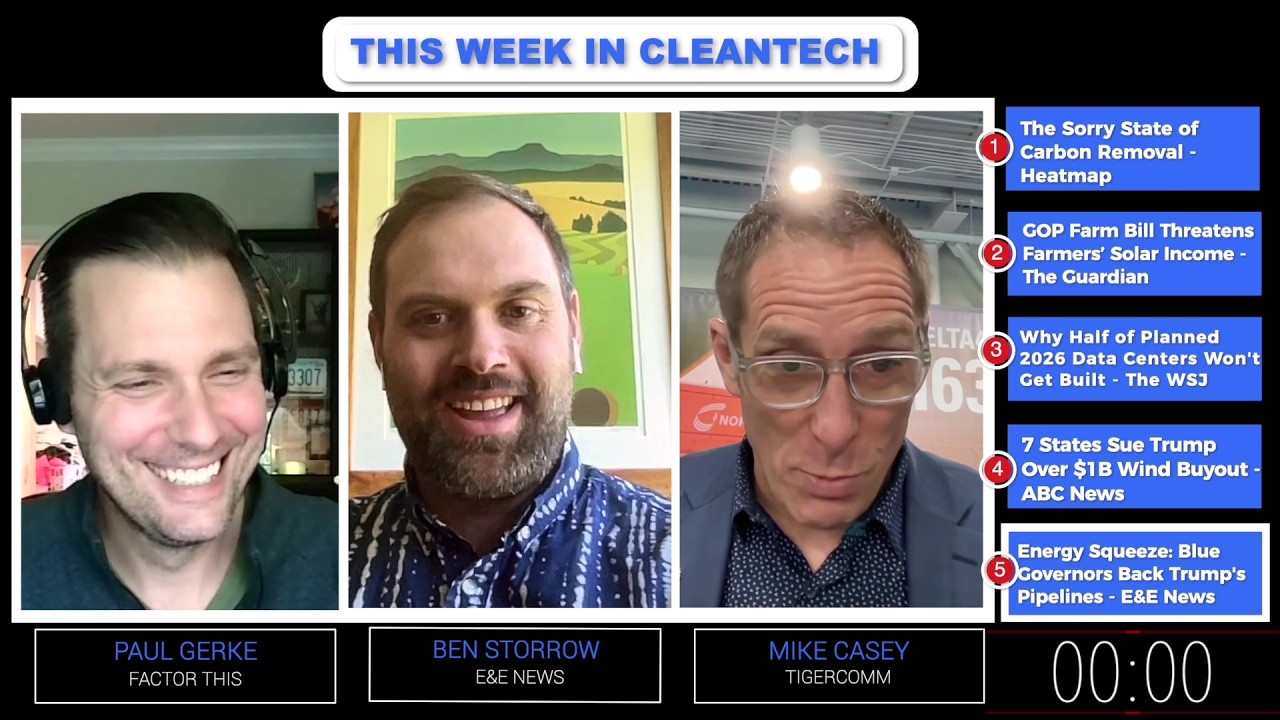
This Week in Cleantech is a weekly podcast covering the most impactful stories in clean energy and climate featuring Paul Gerke of Factor This and Tigercomm’s Mike Casey.
This week’s episode features special guest Benjamin Storrow from E&E News, who discusses how some Democratic governors are more open to natural gas pipeline expansion as energy costs rise.
This week’s “Cleantecher of the Week” is Kevin Doffing who runs a group of veterans involved in cleantech. He has 50 caliber shell casings he uses as lobby swag. Congratulations, Kevin!
A State of Carbon Dioxide Removal report finds the sector is growing, but not fast enough to meet Paris Agreement targets, and rising CO2 pollution keeps raising the bar. Humans currently remove ~2.2 billion tons of CO₂ per year, about 5% of annual CO2 pollution, almost entirely through conventional methods like tree planting, forest management, and wetland restoration.
Novel methods like direct air capture or DAC, biochar, and enhanced weathering grew from 1.4 million tons in 2023 to just 2 million in 2025, when they need to hit 70 million by 2030 and 360 million by 2035 for the world to achieve net zero, according to the report authors. Biochar accounts for most of that novel removal growth.
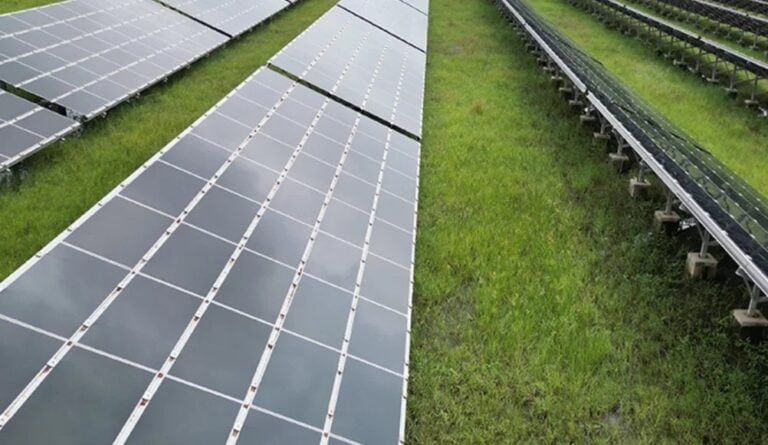
The House farm bill would block federal funding for ground-mounted solar on prime farmland — a big deal for farmers who rely on USDA grants as a financial lifeline during tough times. The administration also cancelled $7 billion in Biden-era funding for affordable solar projects, prompting a lawsuit by over a dozen state attorneys general.
Even farms that qualify for exemptions get cut off if their panels include components made in China, which produces about 80% of the world’s solar panels. Critics say that’s essentially a ban in disguise, and it hits small farmers hardest.
Tech companies are pouring unprecedented capital into AI data centers, but supply-chain backlogs, permitting fights, and power shortages are causing major delays, with JPMorgan finding over 60% of capacity planned for 2027 not yet under construction, and another 7% delayed.
Google has taken its own approach to breaking through these bottlenecks by leveraging its own power generation and shifting computing to where power is available. The company pointed to 42 energy deals in the past year and plans to add another $70 billion in capital expenditures this year.
Seven northeastern states filed a lawsuit Tuesday accusing the Trump administration of illegally using nearly $1 billion in taxpayer dollars to kill offshore wind development off the East Coast.
The lawsuit alleges the $795 million reimbursement was drawn from the Judgment Fund, which the states say was an unlawful use of those funds. The filing also accuses the deal of violating the Outer Continental Shelf Lands Act, which restricts Interior’s ability to cancel offshore wind leases.
Democratic governors in New England — including Massachusetts’ Maura Healey, Connecticut’s Ned Lamont, and Rhode Island’s Dan McKee — are increasingly open to natural gas pipeline expansion after years of opposing fossil fuel infrastructure.
The shift is driven by soaring energy costs, with the region recording the largest wholesale power price increases in the nation in 2025, compounded by Trump’s moves to block offshore wind development. The governors are framing it as an “all of the above” energy strategy, though environmentalists argue the pivot contradicts long-standing climate commitments and mirrors a broader rollback of clean energy policies happening in blue states like New York, Maryland, and California.