As operations become larger and more complex, companies are shifting from choosing individual radios to designing communication around people, environments and coverage needs.
For years, organizations purchasing two-way radios often started with a product question:
Which radio should we buy?
As industrial operations become larger and more complex, a more useful question is emerging:
What communication problem are we trying to solve?
That shift—from product selection to industrial communication solutions—is changing how organizations can approach workplace communication.
Consider several industrial environments.
A manufacturing plant may struggle with machinery noise.
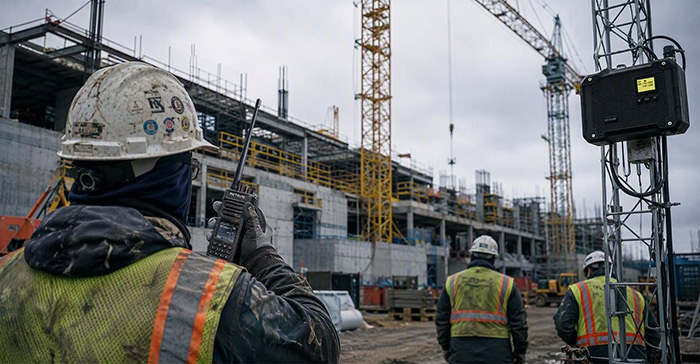
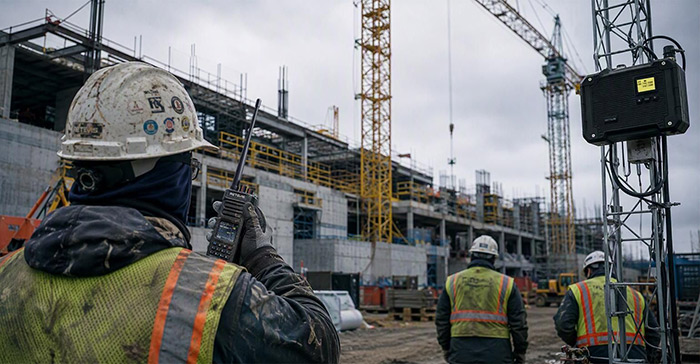
A construction project may need communication across concrete structures and multiple floors.
A warehouse may experience coverage gaps between racks or buildings.
A large campus may need teams to communicate across a much wider area.
A potentially hazardous industrial environment may require certified intrinsically safe equipment.
These organizations may all use two-way radios.
But they do not have the same problem.
A scenario-first communication strategy begins by mapping four factors:
People — Who needs to communicate?
Environment — Where are they working?
Barriers — What interferes with communication?
Workflow — Which communications matter most?
Only after answering those questions should organizations determine the appropriate technology.
For some teams, straightforward handheld radios may be sufficient.
Others may require rugged industrial radios, digital communication, different talk groups or specialized equipment.
And some sites may need extended coverage.
Large facilities illustrate why product-only thinking has limits.
If workers are separated by significant distance, multiple buildings or structural barriers, direct radio-to-radio communication may not provide consistent coverage everywhere.
A repeater can receive and retransmit radio communications, extending the communication path.
That changes the architecture from:
Radio → Radio to: Radio → Repeater → Radio
and changes the purchasing question from:
“Which radio?” to “Which communication system?”
RETEVIS’s development over the past 16 years reflects this broader evolution.
The company continues to develop individual radios, but increasingly organizes communication around different real-world needs—from business operations and heavy industry to professional solutions, outdoor communication and amateur radio.
Within industrial applications, products such as the rugged RETEVIS RB48 series can address demanding frontline environments.
Digital products such as RB48D can support more structured team communication.
Repeater solutions can extend coverage across larger sites.
And intrinsically safe products such as MateTalk E2 address specified hazardous environments within their certification scope.
The products are different because the communication problems are different.
This points toward a broader shift in professional communication.
Specifications will remain important.
But organizations increasingly need to understand how those specifications work together in the real environment.
Reliable communication therefore becomes:
**Product Reliability
- Audio Reliability
- Coverage Reliability
- Scenario Fit
- Service Support**
For RETEVIS, its 16th anniversary is an opportunity to articulate that evolution—from providing radios toward becoming a Reliable Communication Partner built around real communication needs.
The next generation of industrial communication will not be defined by radios alone.
It will be defined by whether the right person can reach the right team, in the right environment, when communication matters.
Different World. Same Connection. Always Reliable.