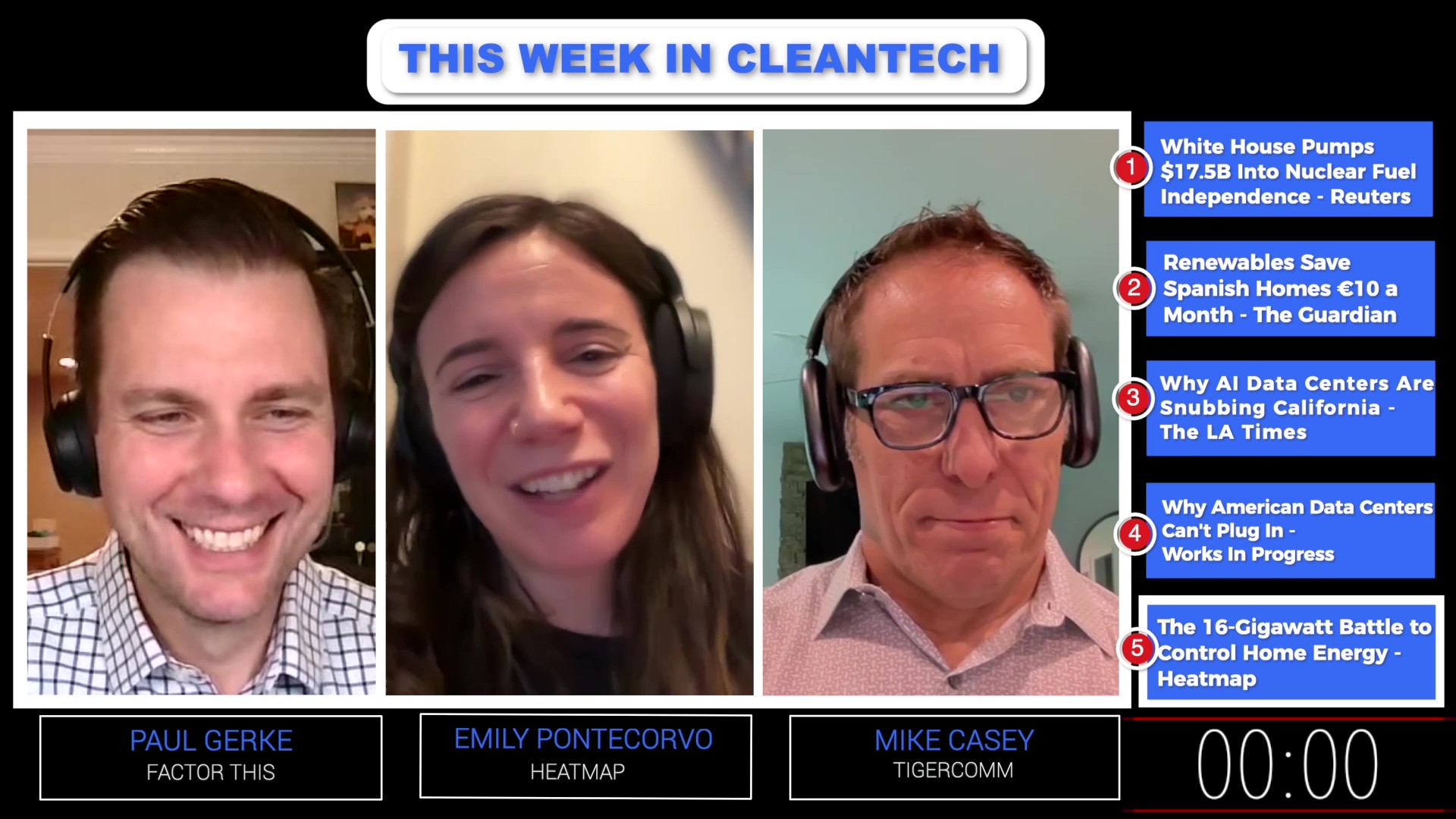
This Week in Cleantech is a weekly podcast covering the most impactful stories in clean energy and climate featuring Paul Gerke of Factor This and Tigercomm’s Mike Casey.
This week’s episode features special guest Emily Pontecorvo from Heatmap News, who discusses a new partnership making more than 16 gigawatts of virtual power plant capacity.
This week’s “Cleantechers of the Week” are Luigi Resta and Maile Resta. Their utility-scale developer, Energies out of Utah, featured one of their site crews going to work on a solar project just like earlier generations of his family did in coal mines. We want to congratulations them for showing how to make the case for clean energy to the country. Congratulations Luigi and Maile!
On Tuesday, the DOE announced $17.5 billion in conditional loans to help utilities and energy companies buy the parts needed to shore up the US commercial nuclear supply chain. The Office of Energy Dominance Financing, formerly the Loan Programs Office, will back as many as five loans, each supporting two 1.1 GW Westinghouse reactors per site.
Westinghouse, owned by Brookfield and Cameco, will partner with up to five utilities to procure reactors and other “long-lead” items like reactor vessels and steam generators at a fixed price. Each project will be jointly owned, with Westinghouse and its partner each required to commit $500 million before they can access DOE funds.
Spanish households are saving about 10 euros a month on electricity because of wind and solar built over the last five years. According to climate think tank Ember, typical bills would be 19% higher if electricity were still as tightly coupled to gas prices as in 2021. That decoupling is what shielded Spain from the Iran war. Gas prices jumped 60%, but Spanish electricity bills barely moved. They actually got slightly cheaper in April.
Gas now influences Spain’s power price just 9% of the time, down from 52% in 2021. In Italy, which has Europe’s highest wholesale prices, gas sets the price 75% of the time.
Monterey Park, California became the first US city to permanently ban data centers by popular vote this month, and a recent poll found 70% of state residents don’t want them nearby.
But unlike Virginia or Texas, California has structural barriers keeping them out. 1.) Industrial electricity prices more than double the national average, 2.) long grid-connection wait times leaving some Silicon Valley centers sitting empty, and 3.) a state rule that certifies any backup generator over 100 MW as a power plant.
That 100 MW cap keeps facilities small. The average US data center is expected to demand over 600 MW by 2030. California’s mostly come in under 100.
Chris argues that America isn’t short on electricity to power AI data centers. The problem is connecting the data centers and the new plants that would serve them to the grid. Before anything connects, grid operators have to study how it changes power flows and whether upgrades are needed. That process has gone from under 20 months for the median power plant in 2005 to 55 months by 2023.
It runs on a first-come, first-served basis, so high-value projects sit behind speculative ones. Think about this number: since 2000, 72% of connection requests were eventually withdrawn, which clogs the queue and forces costly re-studies of everyone behind them. The piece argues the fix isn’t picking the power source, it’s removing the bottleneck of the queue.
Tesla, Sunrun, and Renew Home announced a partnership making more than 16 gigawatts of virtual power plant capacity, roughly equivalent to 16 nuclear reactors, available to utilities and data center developers across the country. The capacity comes from aggregating unused electricity from thousands of home solar systems, batteries, and smart thermostats, with about 60% tied to Renew Home’s devices and the rest from Sunrun and Tesla.
The companies are pitching VPPs as year-round, turnkey grid resources that require no new hardware, land, or interconnection, while also kicking back earnings to participating households. No offtakers have signed on yet, though the group has already bid over a gigawatt into PJM’s emergency procurement and is awaiting results.
Want to make a suggestion for This Week in Cleantech? Nominate the stories that caught your eye each week by emailing [email protected]