Supernova remnants are what remains after a massive star undergoes gravitational collapse and explodes, shedding its outer layers into an expanding cloud of gas and dust. The heavy elements these clouds contain, such as iron, oxygen, and silicon, are critical to the formation of new planets and the emergence of life as we know it. Using NASA’s Chandra X-ray Observatory, an international team of astronomers has found a potential remnant in the vicinity of the supermassive black hole (SMBH) at the center of the Milky Way.
The possible supernova remnant was detected in the Sagittarius C (Sgr C) complex, a star-forming region located on the western edge of the central molecular zone (CMZ). If confirmed, this remnant would be one of the closest ever discovered to the SMBH at the center of our galaxy and in an environment whose X-ray properties are not well understood. The study of this object could also improve our understanding of the Galactic Center, a region characterized by massive stars, dense gas clouds, and exotic magnetic fields.
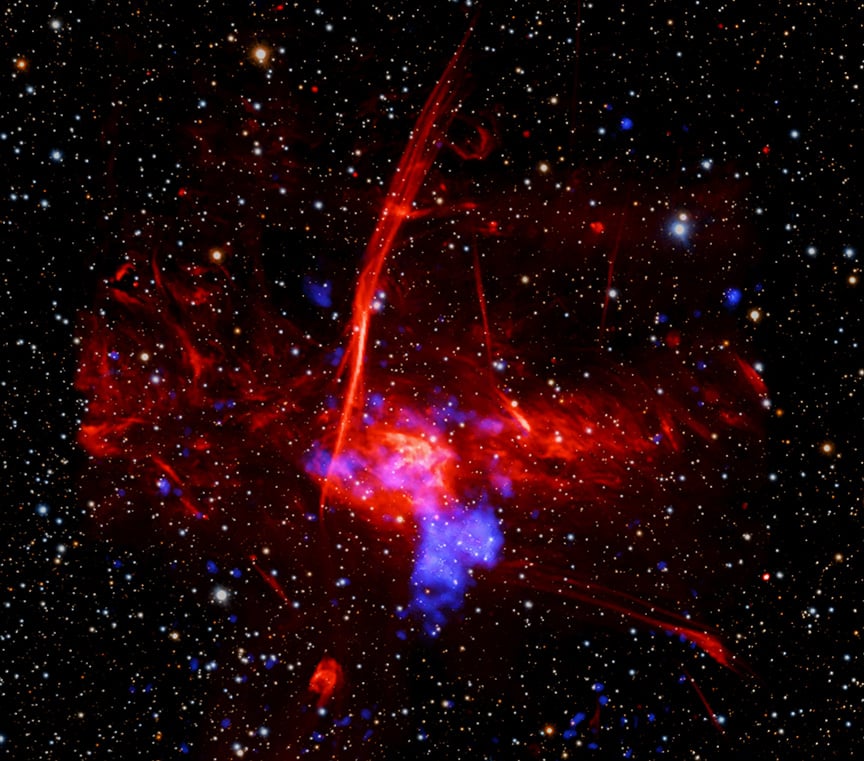
The composite image below combines X-ray data from Chandra and the ESA’s XMM-Newton mission (shown in blue), radio data from the MeerKAT telescope in South Africa (red), and optical data from the Pan-STARRS telescopes in Hawaii (red, green, and blue). The long red filaments shown in the radio data are caused by energetic particles traveling along magnetic field lines, with the most notable bundle stretching perpendicular to the Milky Way’s plane.
The large blue section towards the center and lower half of the image is a “blob” of X-ray emission, believed to be evidence of the suspected supernova. The location of the remnant (circled in the image) is Sgr C, a bubble of ionized hydrogen (a “H II” region) surrounding a massive, young star. Radiation from this star ionizes the surrounding hydrogen, causing it to glow brightly in the radio spectrum.
Previous observations with NASA’s now-retired Stratospheric Observatory for Infrared Astronomy (SOFIA) mission showed evidence of an expanding gas shell surrounding Sagittarius C. This provided the first hints that a supernova had occurred in the same spot. To confirm this, the team searched Chandra’s X-ray data for increased amounts of heavy elements, another telltale sign of a supernova explosion.
While they did not find any evidence of these elements, it is possible that the stellar debris has already mixed with the surrounding gas bubble. Alternatively, the X-ray blob could be hot gas coming from a collection of massive stars in the region. However, the team thinks this is unlikely because the X-ray emission is more than 10 times brighter than that of known stellar clusters with massive, young stars.
If what the team observed is a supernova remnant, it is expanding at velocities of about 3.2 million km/h (2 million mph) and is at least 1,700 years old.
The research was led by Zhenlin Zhu, an astrophysics researcher from the University of California, Los Angeles (UCLA). She was joined by Mark R. Morris, a UCLA Astrophysics Professor and one of the founding members of its Galactic Center Group (GCG); Gabriele Ponti, a Visiting Scientist at the Max Planck Institute for Extraterrestrial Physics (MPE), and the Como Lake Center for Astrophysics (CLAP); and Ping Zhou, a Research Fellow at the School of Astronomy and Space Science, Nanjing University. The paper describing their findings was published in The Astrophysical Journal.
Further Reading: Chandra X-Ray Observatory, The Astrophysical Journal