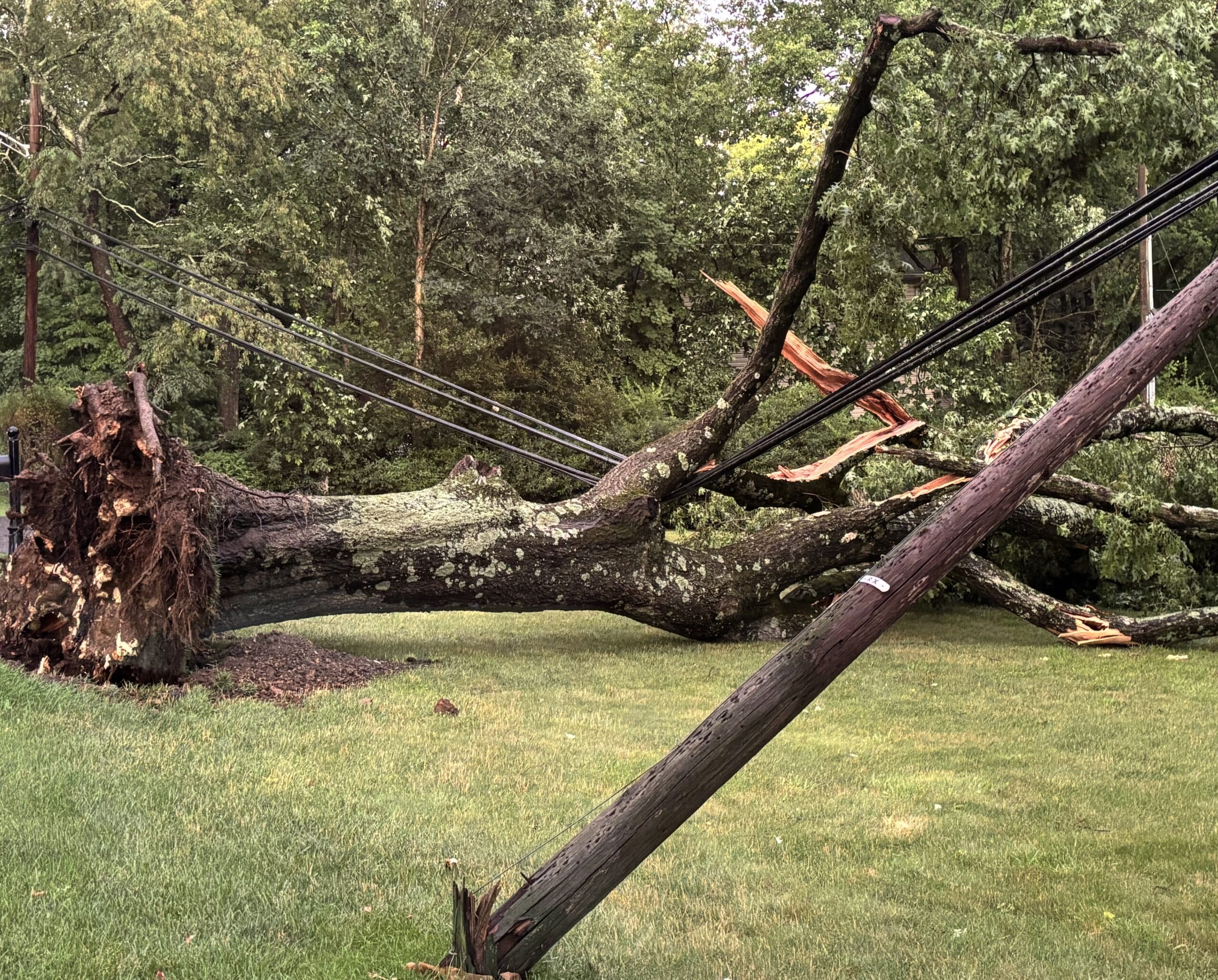

A couple of days after spreading five cubic yards of gorgeous hemlock mulch in my flower beds, my front lawn received some additional, unexpected landscaping when severe thunderstorms blew through New Jersey just before Independence Day. A massive tree, slated to be axed later this year for a sidewalk project, took its own exit in a gust of wind, uprooting from its home along the curb and toppling into telecom wires. At the time of this writing, it’s still there. To be fair, it has attracted far more attention from the neighbors than the wood chips.
Elsewhere in my vicinity during the storm, other flora fell on power lines, leaving my family without electricity from Friday evening through Sunday afternoon. The timing couldn’t have been worse, as temperatures soared into triple digits and PJM Interconnection broke demand records. To complicate matters, First Energy’s JCP&L sent its phone operators home for the holiday after business hours as a gesture of goodwill, meaning we couldn’t report the outage to a human being- a frustrating wrinkle, particularly when we weren’t sure which lines the tree in our front yard had taken out. Local police and fire supposedly reported the damaged pole, but somehow the telecom never got the message, and by the time they did, any hope for timely repairs was squashed by the ‘well, who is gonna move the tree?’ debate.
In short, my recent customer experience with both Mother Nature and local utilities has been less than ideal, even considering the circumstances. The reason is simple, really- I’ve been forced to think a lot more about electricity and my relationship with the grid than one typically does outside of similar emergency situations. It’s making me wonder why the telecom didn’t have a grid-edge sensor to inform it of the damage; I want to know how much it would cost JCP&L to underground our power lines; How much of a role did the tree’s goofy trim job to accommodate the wires play in its untimely demise? Is it really my responsibility when the township’s road salt ate away at the tree’s roots and contractors made it lopsided? (Editor’s note: Yeah, it is, and a costly responsibility at that)
You take it for granted. You really do. Both having electricity and not having a huge tree in your lawn and driveway. Since every summer from here on out will probably be the hottest one of my lifetime, I guess I need to get used to pouring gas into the generator and figuring out who to call about downed lines. Emergency prep feels like a distant to-do list item until the lights go out.
Welcome to the Factor This Brief, a weekly collection of energy industry finance and development updates, delivered straight to your inbox on Monday mornings and hosted in a not-so-brief fashion here on Factor This, featuring the people, projects, and technology driving our electric future.
Thanks for checking it out. If you like what you see or want to recommend a story for next week, drop me a line. In the meantime, may both sides of your pillow stay cool. And, as always, a tune for the ride:
Avangrid, a member of the Iberdrola Group, has begun panel installation at Oregon Trail Solar, a 57 MWdc (41 MWac) project located in Gilliam County, Oregon. Once complete next year, the site will include more than 100,000 solar panels and produce enough electricity to power about 10,000 U.S. homes each year. In addition to supporting about 200 union jobs, Avangrid expects the project to contribute $6 million in combined PILOTs (payments in lieu of taxes) and property taxes to Gilliam County over its lifetime, supporting a variety of public services, including schools and infrastructure.
“Beginning panel installation at Oregon Trail Solar marks meaningful progress in delivering new energy infrastructure in Oregon,” said Avangrid CEO Jose Antonio Miranda. “Projects like Oregon Trail are creating jobs, supporting local communities, and helping meet the growing demand for electricity across the region.”
Oregon Trail is adjacent to Avangrid’s operating Pachwáywit Fields solar project and its recently announced Shutler Energy Storage project. Today, Avangrid operates more than 2.5 gigawatts (GW) of capacity in Oregon. It also maintains its National Training Center in nearby Sherman County and a large corporate office in Portland.

Western US-focused utility-scale developer Avantus has closed a financing package of more than $525 million with BBVA, CIBC and Santander for the Aratina 2 utility-scale solar and storage project, located in eastern Kern County, California. The financing package includes construction funding, a tax equity bridge loan and letters of credit.
Currently under construction and expected to be operational by the end of 2026, Aratina 2 will deliver 150 megawatts (MW) of solar generation and 452 megawatt-hours (MWh) of battery storage capacity to the grid. It’s the second phase of the Aratina Solar Center, which, together with Aratina 1, will total 350 MW of solar with 952 MWh of battery storage. Avantus plans to maintain an ownership stake and operate Aratina 2, together with Aratina 1, as part of its independent power producer (IPP) strategy.
“Aratina 2 is another demonstration of Avantus’ ability to develop and finance large-scale projects in one of the country’s most complex energy markets,” assessed Omar Karar, executive vice president of capital markets and M&A at Avantus. “BBVA, CIBC and Santander’s participation reflects genuine confidence in our track record and our long-term strategy as an owner-operator.”
Aratina 2 is creating approximately 300 union construction jobs and will generate tax revenue to support Kern County public services, as well as provide permanent operations and maintenance jobs throughout its operating life. The project signed 15-year power purchase agreements (PPAs) with utility Southern California Edison (SCE).
White & Case LLP served as legal counsel on the transaction, with Cox Castle & Nicholson LLP serving as local counsel. Akin Gump Strauss Hauer and Feld LLP served as counsel to the financing parties, with Holland & Knight LLP serving as local counsel.
Community solar stalwarts Nexamp and TurningPoint Energy celebrated the opening of two new community solar farms in Minonk with a ribbon-cutting ceremony last month. The projects, which will serve nearly 700 residential customers, as well as Rush University Medical Center and the College of DuPage, are built atop a former coal-mining site.

The two Minonk community solar projects, developed by TurningPoint Energy and built, owned, and operated by Nexamp, have a combined capacity of 9.8 MWdc and together utilize 16,950 solar panels across roughly 40 acres, sending energy directly to the ComEd grid. Both are powered by 100% U.S.-manufactured modules.
Built above a former mine that extracted from the Colchester Coal Seam for approximately 75 years in the late 1800s and early 1900s, the projects are certified brownfield sites under the Illinois Shines program, earning credits for returning previously disturbed land to productive use. They also represent the first Illinois Shines community solar development in Woodford County.
“By transforming a former coal site into a long-term clean energy resource, we are demonstrating how smart policy, private investment, and experienced development partners can work together to repurpose legacy energy assets into solutions that advance affordability, reliability, and decarbonization,” offered Salar Naini, president of TurningPoint Energy.

The Minonk projects are also among the first in ComEd’s system to incorporate Distributed Energy Resource Management Systems (DERMS), a smart grid technology that monitors and manages distributed energy resources in real time. By integrating DERMS across both community solar arrays, the projects help ComEd more effectively balance load, manage variability, and enable clean energy to flow more smoothly on the grid, supporting reliability as Illinois continues to scale up renewable generation.
“We have been grateful to collaborate with Nexamp on one of the first projects on our system to use DERMs, which supports more flexible and efficient interconnection of community solar,” said Mark Baranek, SVP of technical services at ComEd.
The two Minonk community solar projects are nearly fully subscribed, with more than 650 unique participants demonstrating strong local and regional interest in shared renewable energy. One project serves approximately 450 residential customers, while the second includes approximately 200 low-income residential subscribers, expanding access to clean energy savings for historically underserved households.
Vesper Energy recently broke ground on Nazareth Solar, a 201 MW utility-scale solar project in Swisher County, Texas. The project is adjacent to the 600 MW Hornet Solar, one of the largest single-phase solar projects in the United States. Spanning roughly 1,000 acres of private land, Nazareth Solar follows Hornet Solar’s first year of operation, which delivered more than $5 million in local tax revenue and 1.5 million megawatt-hours to the ERCOT grid.
Nazareth Solar is expected to be commercially operational by Fall 2027 and will generate enough electricity to power more than 53,000 Texas homes annually. It is expected to generate $34 million in long-term tax revenue for Swisher County, supporting schools, roads, emergency services, and county operations. The project is also expected to create more than 200 construction jobs.


Vesper Energy secured $236 million in financing for Nazareth Solar through a construction-to-term loan and letter of credit facility supported by leading financial institutions.
“Breaking ground at Nazareth reflects what Vesper Energy proved at Hornet Solar, and we’re thrilled to bring the same discipline and execution to this project from day one,” said Karl Smith at Vesper Energy. “Every project is an opportunity to raise our standards for safety and quality. We have assembled an exceptional team, and our focus is on delivering this project safely, on schedule, and to the high standard our partners and communities have come to expect from us.”
Specialist investment manager Quinbrook has announced the final close of its second UK-focused Quinbrook Renewables Impact Fund (QRIF II), raising GBP 587 million ($786,377,485) in investor commitments and exceeding its GBP 500 million target.
QRIF II is Quinbrook’s fifth managed fund and builds on the strategy of its inaugural Renewables Impact Fund, which closed in 2023. The fund focuses on delivering the infrastructure required to support the UK’s Clean Power 2030 targets and Ireland’s target of meeting 80% of electricity demand from renewable sources by 2030. QRIF II was marketed exclusively to institutional investors in the UK and Ireland and saw a strong re-up rate from QRIF investors.
“As the UK and Ireland continue to make meaningful progress towards their energy transition goals, investor demand for infrastructure assets that deliver both resilience and decarbonization continues to grow,” said Keith Gains, managing director and UK regional lead. “With QRIF II, we have expanded our strategy into areas where we see strong long-term demand and supportive policy frameworks, including grid stability infrastructure in Ireland and the decarbonization of commercial transport in the UK. These investments are underpinned by long-term contracts and essential-service characteristics, which we believe are critical to delivering stable investor returns while supporting economy-wide decarbonization.”

The QRIF II portfolio is already well advanced and features long-term, inflation-linked contracts. It advances new investment in renewable energy and storage that will accelerate decarbonization of the power and transport system, improve security of domestic energy supplies, and provide critical grid support. These investments are supported by Quinbrook’s dedicated delivery partner, Private Energy Partners, which provides specialized development and construction management and technical services across the fund’s projects. Notable investments within QRIF II’s portfolio include:
- Mallard Pass Solar Project, a 373 MW dc (240 MW ac) solar PV project in the East Midlands, England, which is Quinbrook’s second nationally significant infrastructure project. Construction of Mallard Pass is expected to begin later this year with commencement of operations in 2028.
- Wexford Synchronous Consider Project, Quinbrook’s first investment in the Republic of Ireland. This proposed 963 MVA facility was awarded a long-term revenue contract under Eirgrid’s Low Carbon Inertia Services tender and is configured to provide critical grid services including inertia, short-circuit level, and reactive power that are essential to maintain stability in the Irish electricity grid. Construction is underway and is expected to be completed in 2027.
- Aegis Energy, a company building a network of clean energy refueling hubs across the UK to enable decarbonization of commercial and industrial vehicle transport fleets.
- Project Norton, a 65 MW solar and 41 MW battery storage facility in Stockton-on-Tees that is in late-stage development and expected to commence construction later this year.
To date, Quinbrook has invested GBP 1.2 billion of equity capital in projects and businesses operating in the UK and Ireland, with total capital investment of GBP 1.7 billion. The investments in the QRIF II portfolio are expected to further advance Quinbrook’s sustainability efforts in the UK and Ireland, support 2,300 indirect and direct jobs, and avoid more than 25 million tonnes of CO2 emissions over the projected lifetime of the fund’s investments.